Just how does one go about making oneself invisible? You can hide from prying eyes by donning a cloak. You are not in Tolkien’s Middle-earth with the ring of invisibility; rather, you are in a metamaterials research lab in particle physics. What are metamaterials and how do they act this way? The key to understanding how metamaterials work is in their structure, which is composed of small, repeating fundamental units that affect the transmission of light and other radiation in a manner similar to that of a conventional crystal. Metamaterials are able to control radiation in a physically novel manner because of the tiny size and unique form of these units.
What is metamaterial?
With metamaterials, it seems like practically anything is feasible, from ultrathin lenses to camouflage cloaks to sound absorbers. It’s no surprise that research and development in the field of these man-made, individualized structures are thriving at the moment. But what explains their strange abilities? And how may they be put to use?
The relatively unpolished term “metamaterials,” which combines the words “material” and the prefix “meta,” which in ancient Greek meant “beyond,” refers to artificial mediums, frequently arranged in a periodic fashion, with unexpected electromagnetic characteristics.
The majority of metamaterials are quite unremarkable. Some are composed of metal, while others are made of silicon or even plastic, so even their composition is nothing out of the ordinary. However, they cause incomprehensible behavior in electromagnetic radiation, including light.
Manipulation of light
In the case of some metamaterials, for instance, the beam’s direction, phase, and polarization can be altered to the point where the light is effectively compelled to go backward. The substance causes the beam to be refracted in the opposite direction from what would be expected of a typical material. This means that a concave convergent lens constructed from this metamaterial would actually scatter rather than concentrate light. A lens that diverges would focus light, which goes against the laws of physics.
This seemingly contradictory behavior is possible due to the fact that these metamaterials have a negative refractive index. Radiation incident upon this substance is hence not bent back toward the perpendicular but instead bent back beyond the perpendicular. Before the 1968 theoretical prediction by Russian scientist Viktor Veselago, the idea that such materials may exist was nothing more than a thought experiment. Because naturally occurring negative refractive indices were unknown. The first time they were seen was in man-made materials.
The negative refraction

One such property is the negative refraction that the Russian scientist Victor Veselago predicted 50 years ago. While we learned in high school that a lens is convergent if it is convex (curved), he proved that a flat lens can be used to focus light too. There must be a negative value in the magnetic permeability and electrical permittivity for the refractive index to be negative. This seems impossible to do in reality, if for no other reason than that common materials (metals, glassware, and plastics) are not magnetic.
But with a metamaterial consisting of a periodic network of parallel metallic wires (which presents a negative permittivity at low frequency) and a periodic network of small metallic loops called “split ring resonators,” which presents a negative permeability around a resonance frequency, English physicist John Pendry demonstrated in 2000 that this is indeed possible.
Some 16 years ago, Pendry developed a proposal for an invisibility cloak based on concentric layers of split ring resonators where the waves would travel along curved routes.
Micro- or nano-etching is the current method of producing metamaterials. Imprinted copper fibers on glass fibers make up the metamaterial’s dielectric portion. Fundamentally, they serve microwaves (at frequencies of a few gigahertz).
Making them function in the visible spectrum (frequencies of a few hundred terahertz), where metals become extremely absorbent, is one of the technical obstacles. This makes the metamaterial opaque, which is not ideal for the creation of a flat lens or an invisibility cloak.
About five years ago, scientists started wondering whether the science of electromagnetic metamaterials might be applied to seismic waves. At first glance, the comparison between light in nano- or micro-structured materials and mechanical waves in structured soils appears very far-fetched. Indeed, the so-called mass and spring models provide the basis for this transcription.
Light and Earth waves
Transforming the physical characteristics of space is the common denominator between electromagnetic and seismic metamaterials, and it is this technology that enables the invisibility effect. The basic idea is straightforward: modifying the coordinates in the equations controlling wave propagation results in a highly heterogeneous anisotropic material with intricate interference events.
For almost 20 years, Belgian physicist André Nicolet has advocated for the employment of the space transformation approach to facilitate the numerical solution of electromagnetic problems in unbounded medium (by transforming coordinates to shrink distances) or twisted guides (helical coordinates leading to a problem of an untwisted guide that is made of a heterogeneous anisotropic medium).
In 2006, Michael Pendry proposed using a solid disk in conjunction with a cloak to achieve invisibility. The cloak would be constructed from a heterogeneous anisotropic medium, which would cause light traveling through it to be deflected. Below is an illustration of this study in the fields of hydrodynamics, acoustics, and electromagnetism using an 8-inch-diameter (20 cm) aluminum invisibility cloak created in 2008 at the Fresnel Institute.
A shield against tsunamis or a cloak that makes waves invisible. This structure, which is machined into an aluminum disk 8 inches in diameter, is covered with tiny studs. It has a rim that is 4 inches (10 cm) in diameter. The employed metamaterial acts like an anisotropic fluid, causing the waves to deflect away from the focal point. Using a structure like this may be an innovative approach to stopping coastal erosion or shielding offshore infrastructure like oil rigs from waves.
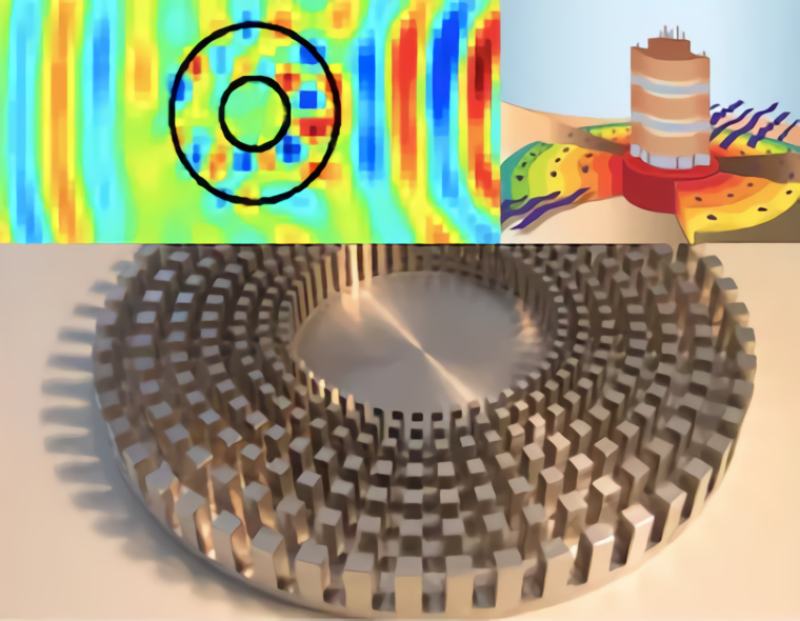
Tests with waves (8–15 Hz), sound waves (3–7 kHz), and microwaves (3–7 GHz) on an 8-inch-diameter metamaterial composed of 0.40-inch-high (1 cm) aluminum studs structured in concentric layers showed promising results. The lack of a field in the cloak’s core is seen on the experimental magnetic field map (top left), suggesting that this approach may be scaled up to create a large-scale seismic protection system (CNRS infographic, top right).
The term “invisible” is often used to describe an item that does not alter or only slightly alters the surrounding wave field. Either the item itself or the apparatus (which is called a “cloak”) around it has the ability to rebuild the wave field as if it did not exist in the region investigated (which is called “transparency”).
An invisibility cloak deflects waves away from a specific area by punching a hole in the space’s metric, but realizing such precise control over the paths of waves at a civil engineering scale is still a formidable issue.
Seismic metamaterials
Structured soil is an ancient concept. For “soft” soils, some civil engineers recommend using wooden piles due to their superior effective bearing capacity. This confirms the feasibility of a seismic cape for civil engineering, which, if wrapped around a building’s footings, could significantly dampen the local effect of an earthquake or of anthropogenic sources like vibrating machines used in public works and industrial equipment, at least for some frequencies.
In 2012, tests were conducted on a prototype cloak to verify the similarity between electromagnetic metamaterials and structured flooring. Surface waves, also referred to as Rayleigh waves, changed into volume waves that the soil absorbed and prevented from returning to the source.
References
- On-chip zero-index metamaterials | Nature Photonics
- An ultrathin invisibility skin cloak for visible light | Science
- Complex-amplitude metasurface-based orbital angular momentum holography in momentum space | Nature Nanotechnology