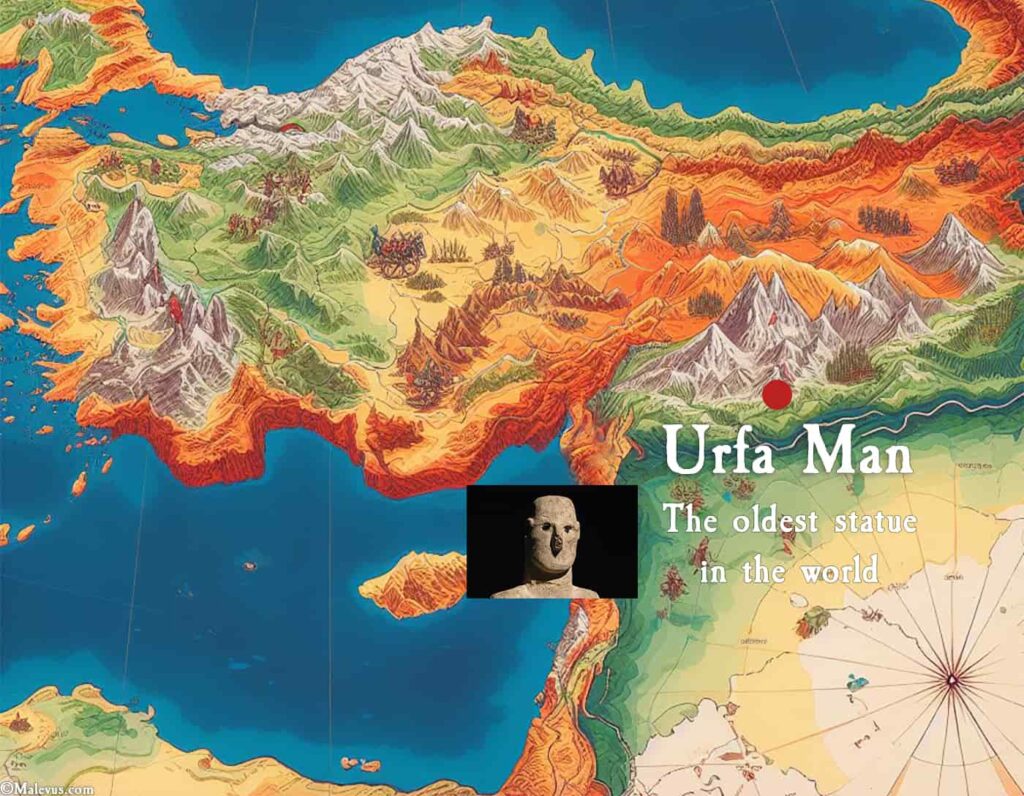
In the city of Şanlıurfa, Turkey, a prehistoric anthropomorphic figure known as the Urfa Man (Turkish: Urfa Adamı), or Balıklıgöl Statue, was uncovered during construction work. The age of the Urfa Man is 9000 BC, which places it in the Pre-Pottery Neolithic time period (c. 10,000–6500 BC). There are only a few miles between the Urfa Man and other prehistoric sites, Göbeklitepe (Pre-Pottery Neolithic A/B) and Nevalı Çori (Pre-Pottery Neolithic B).
The Urfa Man is the oldest known representation of a life-sized human sculpture. This makes it the oldest known statue in the world.
Discovery of the Urfa Man Statue
The Urfa Man was discovered in 1993 during road work in the Yeni Mahalle neighborhood north of Balıklıgöl (“Fish Lake”). Nevertheless, the precise location of its discovery has been lost to history. The Urfa Man was discovered while dismembered into four separate parts. It is unknown if the statue’s dismemberment was caused by the road work.
Even though the statue was dismembered, it was still whole. It was discovered under the foundations of the ancient Urfa dwellings that were near large water sources close to the north of Balıklıgöl during the Pre-Pottery Neolithic Period (10,000–6500 BC).

The findings confirmed in 1997 that the region had been continuously occupied since the time the statue was created.
The discovery of Pre-Pottery Neolithic “terrazzo floors” and other artifacts, such as distinctive flint tools, attest to this settlement’s existence.
Age
The estimates put its age between 11,000 and 9500 BC but the recent data points to c. 9000 BC. The statue may have been carried from the nearby Urfa Yeni-Yol site, which is from Pre-Pottery Neolithic A (c. 10,000–c. 8,800 BC). This site is also close to the other Pre-Pottery Neolithic sites, Gürcütepe and Göbeklitepe (the oldest known temple in human history).
What is Urfa Man Made of?
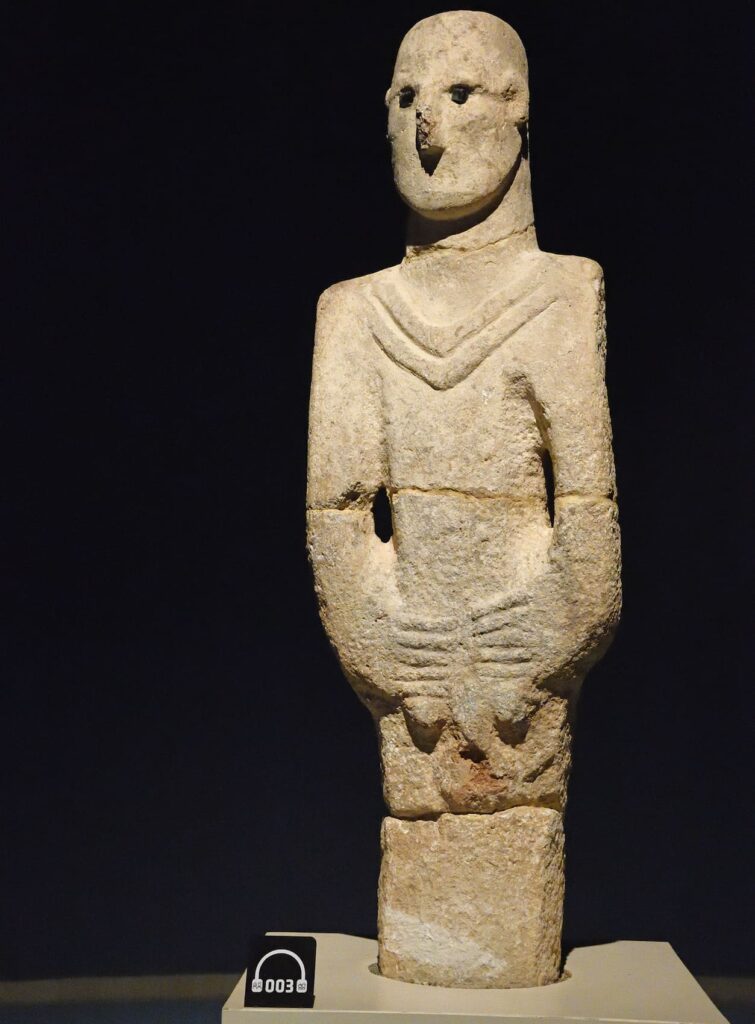
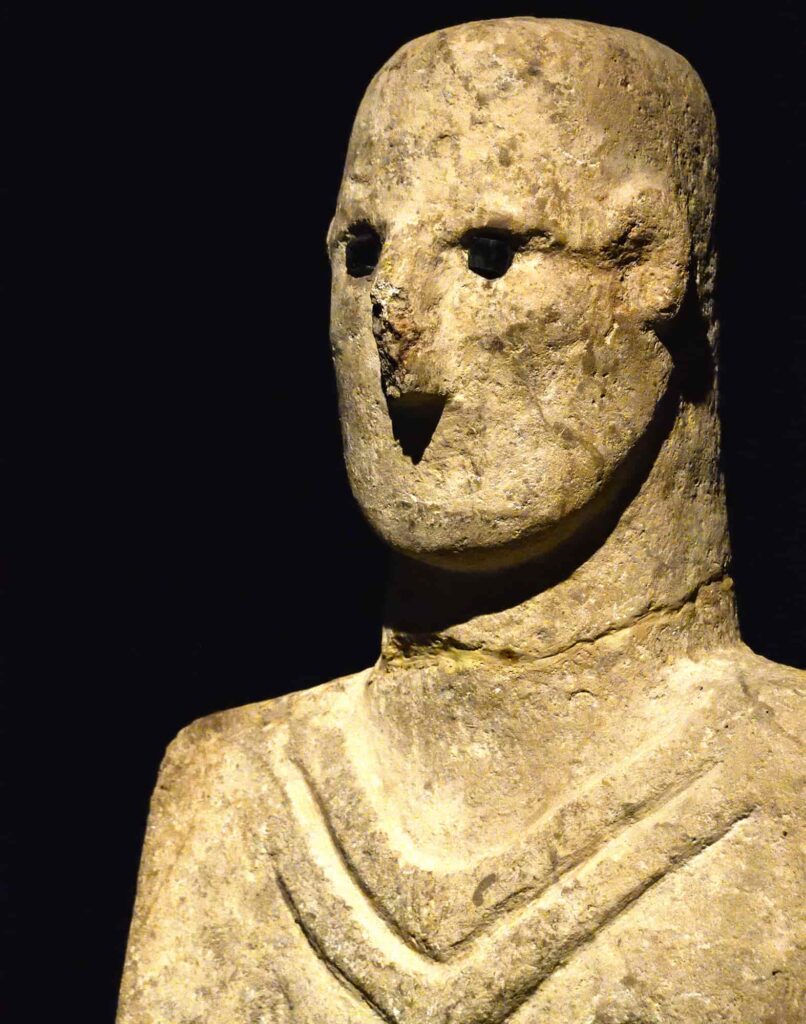
The statue is made of light sandstone and stands around 6 feet 3 inches in height (190 cm). The body is 21 inches in width and 25 inches in depth. It has no mouth and instead has two depressions inlaid with black obsidian for eyes, which is a natural volcanic glass highly valued back at the time.
The statue is completely naked, save for a V-shaped collar.
This object might as well be a metal necklace. The Urfa Man’s hands seem to clasp and conceal the genital region, and it has no visible feet or legs; instead, it tapers to the ground for support. No evidence suggests why this statue was created or utilized in the first place.
Its Symbolic Meaning
The statue stands on no legs. He has no facial hair or beard and no mouth. Many theories have been put forth to explain the missing mouth, such as that the person shown is wearing a mask or is concealing some truths. When seen from the front, the hands are joined at the navel. The museum notes that “the statue unquestionably represents male sexuality predominantly”. Since it is near the Göbeklitepe, a similarly dated religious sanctuary, the Urfa Man might be representing a local god.
Some Older Statuettes
Both the Lion-Man (Löwenmensch) figure and the Venus of Hohle Fels from Germany from the same time period (aged 35,000–41,000 years) are the earliest known statuettes in the world. Other oldest Upper Paleolithic statuettes include the Venus of Dolní Věstonice (aged 25,000–29,000 years), the Venus of Willendorf (aged almost 30,000 years), and the Venus of Brassempouy (aged 21,000–26,000 years), which existed before the discovery of the Urfa Man.
Are There Possibly Older Statues?
One of the oldest statues that are similar to the Urfa Man in appearance is from ʿAin Ghazal, an archaeological site in the Levant, Jordan. This site yielded anthropomorphic statues created between 7200 BC and 6250 BC.
The Urfa Man is shown prominently at the Şanlıurfa Archaeological Museum. Created around 11,000 years ago, it is the oldest statue in history. However, looking at the elaborated statuettes, which are incredibly older, there are likely statues that are many millennia older than the Urfa Man waiting to be unearthed (likely in Turkey again, the birthplace of civilization).
Featured Image: Dosseman, cc by sa 4.0, cropped.