Deep beneath the surface of the Aztec world—nine perilous subterranean levels down below the mountains, rivers, and clashing obsidian winds of the earth—lay the cold, shadowed realm of Mictlan, the final resting place for the vast majority of human souls. Reigning on a throne of bone at the bottom of that dark kingdom alongside her husband, Mictlantecuhtli, sat Mictecacihuatl, the formidable Aztec “Lady of the Dead.” Far from being a demonic punisher of sinners, Mictecacihuatl was the essential cosmic guardian of ancestral bones—preserving the skeletal seeds of past worlds so new life could be born, and presiding over colorful summer rituals that evolved directly into Mexico’s beloved modern Día de los Muertos (Day of the Dead).
Anatomy of the Queen of Mictlan: Defleshed Jaw and Necklace of Eyeballs
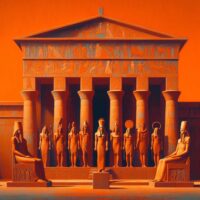
In the Nahuatl language of the Aztecs (Mexica), the name Mictecacihuatl translates literally to “Lady of the Inhabitants of Mictlan (the Place of the Dead).” In the painted bark-paper pages of the Codex Borgia and the Codex Fejérváry-Mayer, as well as inside monumental terracotta sculptures excavated at the Templo Mayor in the heart of Mexico City (Tenochtitlan), Mictecacihuatl is depicted with striking, unforgettable visual iconography:
- The Defleshed Skull and Swallowing Mouth: Her body is either completely skeletal or painted bone-yellow and blood-red, topped by a skull face with a wide-open, defleshed jaw—born with her mouth gaping open so she could swallow the stars during the daytime so the sun could shine alone in the sky!
- Hair of Night and Paper Rosettes: Her wild, curly black hair (representing the darkness of the night sky and the underworld) is studded with star-like eyes or crowned with folded bark-paper banners (amateteuitl) and owls—the nocturnal messenger birds of Mictlan.
- Skirt of Rattlesnakes and Eyeball Collar: Around her neck hangs an ornate collar threaded with human eyeballs and severed hands, while her waist is wrapped in a skirt woven from living serpents.
Guarding the Bones Against Quetzalcoatl’s Heist
In Aztec religion, where you went after death was not decided by how “good” or “bad” you were, but strictly by how you died: warriors who fell in battle and women who died in childbirth (whom the Aztecs honored as brave warriors who had captured a prisoner of life!) went to the radiant sky of the Sun God; people who drowned or were struck by lightning went to the lush rain-paradise of Tlalocan; and **everyone else**—noble emperors and humble farmers alike who died of natural causes, illness, or old age—made a grueling four-year journey down through nine subterranean levels of trials (guided across a wide river by a reddish-yellow Xoloitzcuintli dog) to reach Mictlan.
Once a soul reached the ninth level of Mictlan, Mictecacihuatl’s primary sacred duty was to **watch over the cleaned, dried bones of the dead** as well as the precious bones of the previous four destroyed races of humanity. In the famous Legend of the Five Suns, when the god Quetzalcoatl traveled down into Mictlan to steal those ancestral bones to create our current human race, Mictlantecuhtli and Mictecacihuatl tried every trick in the book to stop him—ordering their quail birds to startle Quetzalcoatl so he tripped into a pit, dropping the male and female bones and shattering them into different-sized pieces (which the Aztecs joked is the reason why human beings today come in all different heights, tall and short!).
From Ancient “Miccailhuitontli” to Modern La Catrina
During the Aztec calendar year, Mictecacihuatl was the guest of honor at two consecutive twenty-day summer festivals held during the ninth and tenth Aztec months (falling around late July and August): Miccailhuitontli (“The Little Feast of the Dead,” honoring deceased children) and Huey Miccailhuitl (“The Great Feast of the Dead,” honoring deceased adults), centered around erecting a towering stripped forest tree trunk (the Xocotl), burning copal incense, offering twenty-day marigolds (cempasúchil), and feasting with the spirits of departed family members.
When sixteenth-century Spanish friars arrived in Mexico and realized they could never persuade indigenous communities to stop honoring their ancestors and the Lady of the Dead, they shifted those late-summer indigenous festivals to early November to coincide with the Catholic holidays of All Saints’ Day and All Souls’ Day (November 1 and 2). Four centuries later, when Mexican printmaker José Guadalupe Posada drew his satirical skeleton lady in a fancy feathered hat in 1910 and muralist Diego Rivera painted her in a full gown as La Calavera Catrina, Mexican culture seamlessly reunited that modern skeletal icon with the ancient memory of Mictecacihuatl—ensuring that the Lady of the Dead still presides over every marigold-draped candle altar on the Day of the Dead today.