The nigredo, a Latin term meaning black or darkness, refers in alchemy to the phase of black (calcination) in the Magnum Opus, which is the initial step in the creation of the philosopher’s stone. It involves putrefaction and decomposition.
This is the primary and most crucial moment, symbolized by a black crow, where all alchemical ingredients must be “made to die,” soaked, and cooked extensively into a uniform black mass.
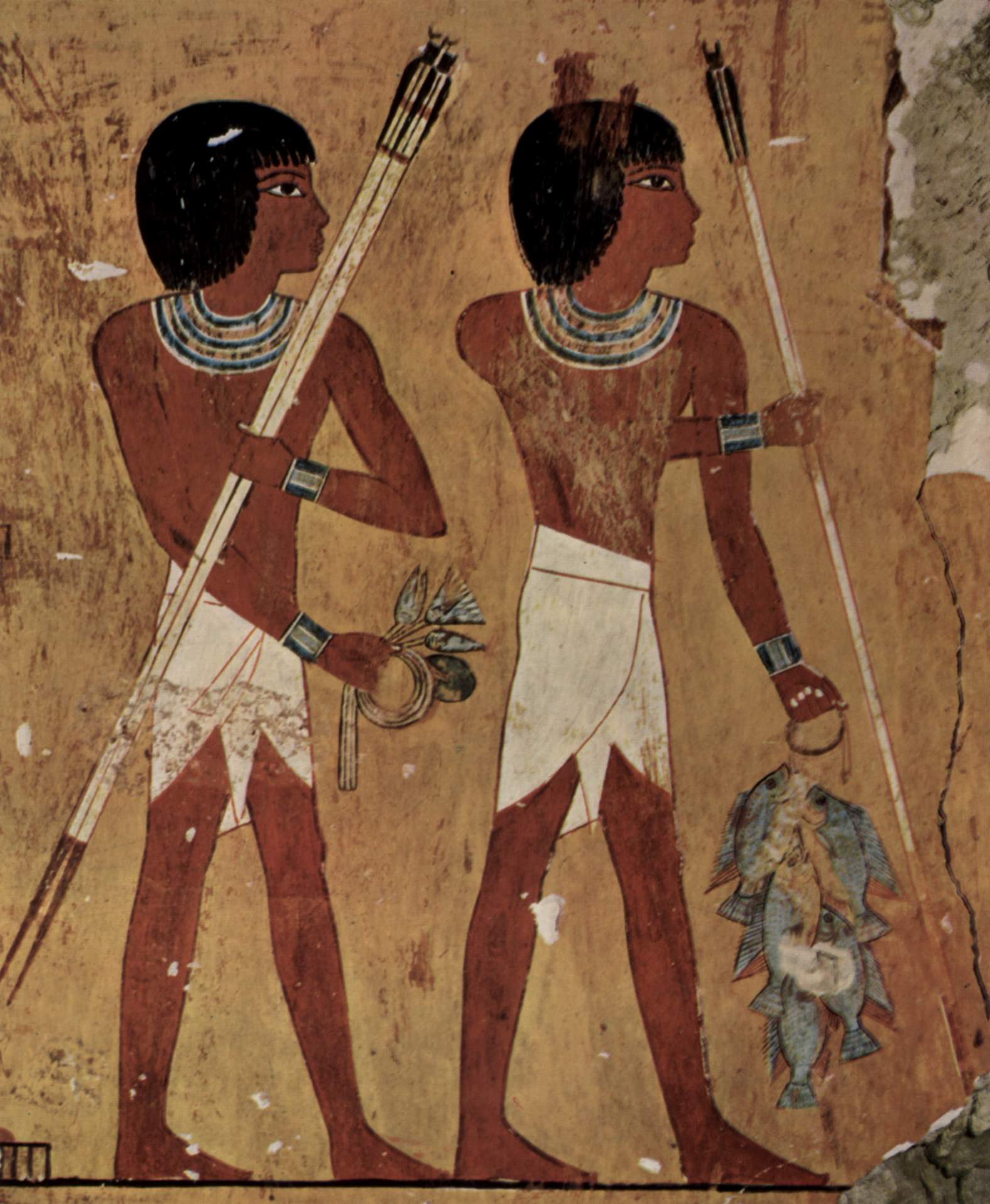
The black also contains a reference to the etymology of the term Alchemy itself as an ancient Egyptian priestly science, one interpretation being “black earth” (al-kimiya) like the one flooded by the Nile.
Characteristics of Nigredo
The nigredo represents the phase in which the matter must be decomposed to return to its primitive state, back to the condition of the original chaos from which the entire original narrative arose. It is necessary to destroy the elements so that they can be later recomposed in a higher synthesis.
Solve et Coagula (Dissolve and Coagulate) is precisely the alchemists’ motto, indicating the operations to be performed, of which dissolution and decomposition are necessarily the first essential steps. Indeed, liquefaction allows reducing matter to its undifferentiated essence, identified with the philosophical mercury. This can also be achieved through cleavage, meaning subdivision into its components, or calcination, reducing it to ashes over the fire.
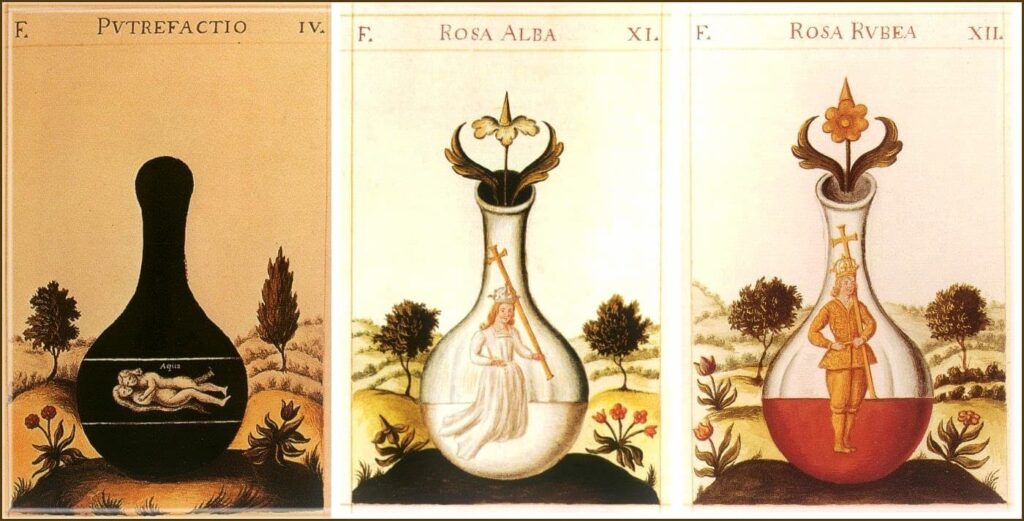
At the macrocosmic level, the nigredo is governed by Saturn, a planet whose heaviness and gravity are associated with dark and mournful colors and, among metals, with lead. In Christian alchemy, it involves the sacrifice of Christ on the cross, where the body is destroyed, and the blood is scattered. Golgotha (a former pilgrimage site), which properly means “place of the skull,” has become a recurring image to describe the alchemical nigredo.
In the Divine Comedy, the nigredo phase corresponds to Dante and Virgil’s passage through Hell. In the theory of humors, it is linked to melancholy, hence to black bile, placing it in winter among the four seasons and in old age among the stages of life.
In the initiation rite of Freemasonry, it is customary to confine the profane in a Reflection Chamber (the initiation room in Freemasonry) where they are left alone with a skull, in analogy with the alchemical operation of nigredo.
Nigredo in Psychology
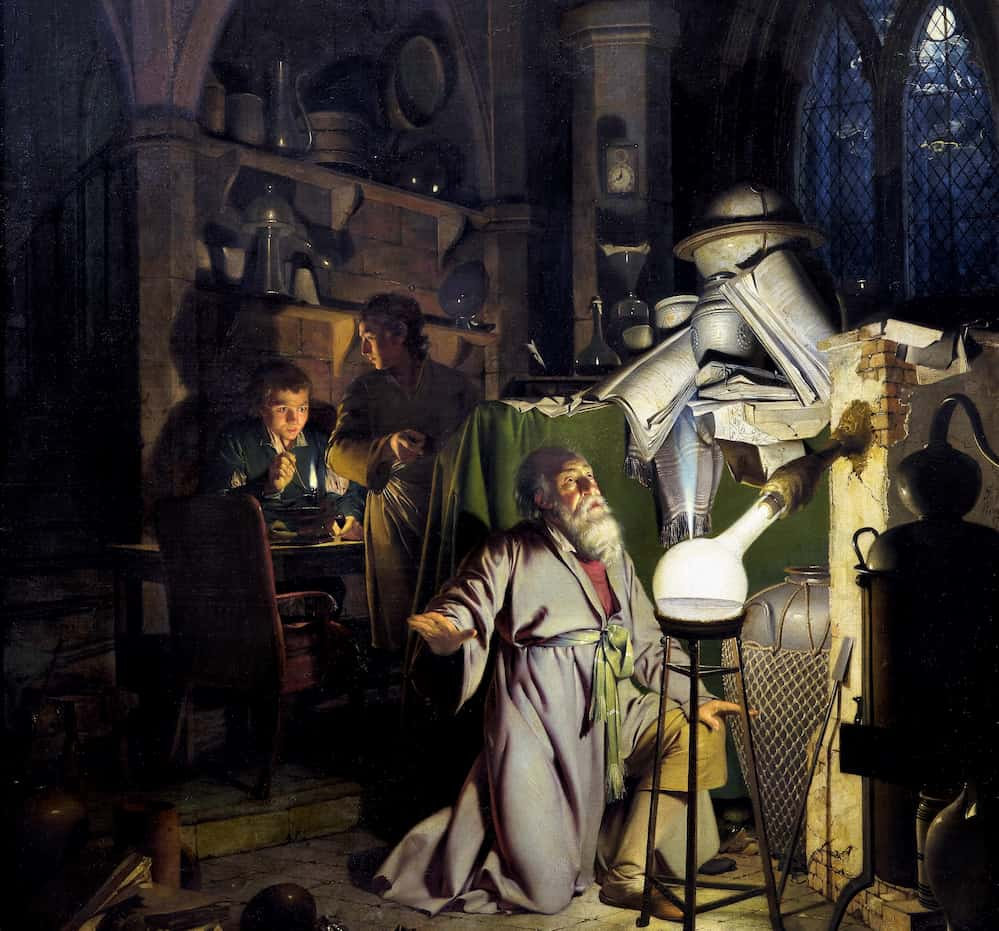
Within the framework of Carl Jung’s analytical psychology, the phrase has taken on a metaphorical meaning, representing the inside struggle to face one’s Shadow. As Jung put it, “the rediscovery of alchemical principles has become an important part of my pioneering work in psychology.” While studying alchemy, he and his fellow students “compared the ‘black work’ of the alchemists (the nigredo) with the often very critical involvement experienced by the ego until it accepts the new balance brought by the creation of the self.” The nigredo has two primary psychological meanings, according to Jungians.
The first sense stands for a subject’s initial condition of undifferentiated apathy. According to the author, “the first nigredo, that of the unio naturalis, is an objective state, visible only from the outside… an unconscious state of undifferentiation between self and object, consciousness and unconsciousness” (i.e., the subject is oblivious to the unconscious, as in the link with instincts).
According to the second interpretation, “the nigredo of the individuation process is, on the other hand, a subjectively experienced process, triggered by the painful and growing awareness of the subject of its shadow aspects.” A period of profound depression is necessary for growth as an individual.
Throughout individuation, “the confrontation with the shadow initially produces a dead balance, a stop that hinders moral decisions and renders convictions ineffective or even impossible… nigredo, tenebrositas, chaos, melancholy.
” Described as “the darkest time, the time of despair, disillusionment, envious attacks; the time when Eros and Superego are at daggers drawn, and it seems there is no way forward… nigredo, the blackening.
“
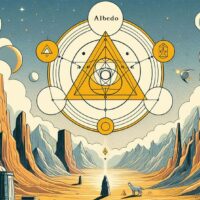
The painful and growing awareness by the subject of its shadow aspects, usually described as a moment of extreme melancholy, is, for Jung, a prerequisite for personal development on the path of individuation. The confrontation with the Shadow initially generates a standstill, disillusionment, and a retreat that slows action and reveals the ineffectiveness of one’s beliefs. Only later does what is called in philosophy “enantiodromia” occur, that is, the reversal into the opposite: the nigredo gives way to the albedo, and the ever-deeper descent into the unconscious suddenly transforms into an illumination from above.
Images like the albedo (whiteness), citrinitas (yellowing), and rubedo (redness) are part of the Magnum Opus at other levels. Along with many other alchemical ideas, Jung discovered psychological counterparts for analytical activity, which he compared to an opus, the analytical connection to a container, and the purpose of analysis as the union or combination of opposing components.
Cultural References to Nigredo
- Hydriotaphia, Urn Burial: In the alchemical literary discourse “Hydriotaphia, Urn Burial” (1658), the meditative stage of nigredo is described as being lost in the uncomfortable night of nothingness by the physician-philosopher Thomas Browne.
- Sonnets: The symbolisms in the Sonnets (Shakespeare) are filled with allusions to nigredo and the “phantom night.”
- William Butler Yeats: In his alchemical narratives, William Butler Yeats introduces the reader to the nigredo phase with the words: “to wrestle with the shadow, as in an ancient night.”
- The Abyss: “The Abyss” is a historical novel from 1968 by Marguerite Yourcenar, whose title refers to the alchemical phase of the same name in the Magnum Opus.
- Overlord: In the Japanese light novel and animation series Overlord, there is a character named Nigredo. His two sisters are named Albedo and Rubedo, all three named after parts of the Magnum Opus.