Fought across the rolling chalk plains of northern France during the summer of 1640, the Siege of Arras stood as one of the pivotal military turning points of the Franco-Spanish War (1635 to 1659) and the wider Thirty Years’ War. For more than a century, the heavily fortified capital of the County of Artois had been a proud bastion of Habsburg Spanish authority jutting dangerously toward Paris, so confident in its massive ramparts that a Spanish proverb carved over one of its gates boasted that the French would capture Arras only when mice ate cats. When three French marshals surrounded the city and starved out both its garrison and a powerful Spanish relief army in August 1640, France permanently broke the Spanish ring around its northern frontier—and inspired the immortal battlefield backdrop for Act IV of Edmond Rostand’s classic play Cyrano de Bergerac.
Strategic Importance of the Capital of Artois
Since Cardinal Richelieu brought France openly into the Thirty Years’ War against Habsburg Spain and the Holy Roman Empire in 1635, the northern border of Picardy had been a scene of constant anxiety for King Louis XIII. Just four years earlier in 1636, a Spanish imperial army commanded by the Cardinal-Infante Ferdinand of Austria—the younger brother of King Philip IV of Spain and governor of the Spanish Netherlands—had captured Corbie on the Somme River, sending cavalry patrols close enough to cause panic in the streets of Paris.
At the center of Spain’s southern defensive line stood Arras. Divided into two strongly fortified halves—the older medieval Cite and the larger commercial Ville—Arras was encircled by thick brick and stone bastions, deep dry ditches, horned outworks, and flooded marshes fed by the Scarpe River. In the spring of 1640, while the Cardinal-Infante concentrated his main Spanish field army further north along the Scheldt River expecting a French attack on Charlemont or Mariembourg, Richelieu and Louis XIII executed a brilliant strategic feint. Ordering three separate French armies commanded by Marshal Gaspard III de Coligny (Marshal de Chatillon), Marshal Charles de La Porte (Duke de La Meilleraye, Grand Master of Artillery), and Marshal Honore d’Albert (Duke de Chaulnes) to converge rapidly from different directions, twenty-three thousand French infantry and nine thousand cavalry suddenly closed a ring around Arras on June thirteenth, 1640.
The Lines of Circumvallation and Contravallation
Inside Arras, the military governor, an experienced Irish soldier in Spanish service named Owen Roe O’Neill, commanded a determined garrison of roughly two thousand professional soldiers supported by several thousand armed townspeople eager to defend their traditional privileges under Spanish rule. Realizing that the Cardinal-Infante Ferdinand would soon march south with every soldier in the Spanish Netherlands to rescue the city, the three French marshals did not immediately throw their troops against O’Neill’s walls. Instead, they spent the first three weeks digging one of the most formidable earthwork fortresses in seventeenth-century military history.
Working around the clock with picks and shovels, the French army excavated a fifteen-mile circle of trenches completely surrounding Arras. This double defensive ring consisted of a line of contravallation facing inward to prevent O’Neill’s garrison from sallying out, and a massive outer line of circumvallation facing outward to stop the Spanish relief army from breaking in. Measuring twelve feet wide and ten feet deep, reinforced by high earthen ramparts, palisade stakes, redoubts, and flooded water traps, the French siege lines turned the besiegers into a fortified city of their own.
The Siege Within a Siege and the Convoy Wars of July
By late June 1640, the Cardinal-Infante Ferdinand arrived outside the French outer trenches accompanied by Duke Charles IV of Lorraine and General Guillaume de Lamboy at the head of twenty thousand veteran infantry and twelve thousand cavalry. Rather than assaulting Chatillon’s formidable outer earthworks directly, Ferdinand adopted the advice of his generals to besiege the besiegers: stationing his cavalry at Mount Saint-Eloi to cut off all French supply roads leading south to Doullens and Amiens so that the thirty-two thousand French soldiers in the trenches would starve before the town of Arras did.
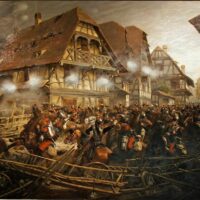
For the entire month of July 1640, the Siege of Arras became a desperate logistical struggle known as the war of the convoys. Inside the French lines, bread rations ran so low that soldiers boiled grass, roots, and horseflesh, exactly as dramatized in the famous scenes of Cyrano de Bergerac. Traveling personally to Amiens and Doullens to take charge of logistics, Cardinal Richelieu and King Louis XIII assembled a colossal supply convoy of four thousand wagons loaded with flour, wine, gunpowder, and livestock, escorted by an fresh eighteen-thousand-man relief force under François de L’Hopital, Seigneur du Hallier. Simultaneously, on August second, when the Cardinal-Infante launched a furious dawn assault against the French outer fort of Rantzau to stop the convoy from entering the lines, bitter hand-to-hand fighting raged across the parapet for hours until French cavalry charges threw the Spanish back just as the thousands of food wagons rolled triumphantly into the starving French camp.
Breaching the Walls and the Capitulation of August 9, 1640
With his soldiers fed and resupplied with fresh gunpowder, La Meilleraye turned the full fury of the French siege batteries back against the walls of Arras. Digging saps right beneath the Spanish counterscarp and exploding massive underground gunpowder mines on August seventh and eighth that blew wide breaches in the outer half-moons and main rampart, the French marshals prepared for a general assault that would have subjected the city to sack.
Seeing the breaches yawn open and watching the Cardinal-Infante’s relief army retreat northward after failing a final desperate attack on the French trenches, Owen Roe O’Neill and the magistrates of Arras recognized that further resistance was hopeless. On August ninth, 1640, they signed honorable articles of capitulation: O’Neill’s surviving garrison marched out with drums beating and flags flying, while King Louis XIII guaranteed the citizens of Arras their Catholic worship and traditional judicial parliaments. Finding the old Spanish inscription over the city gate, exuberant French soldiers chiseled away the letter “p” from the French word “pussent” (“may take”), changing the proverb to read: “When mice eat cats, the French will give back Arras.” Confirmed permanently as French territory nineteen years later in the Treaty of the Pyrenees, the capture of Arras shattered the myth of Spanish military invincibility alongside the concurrent revolts of Catalonia and Portugal.