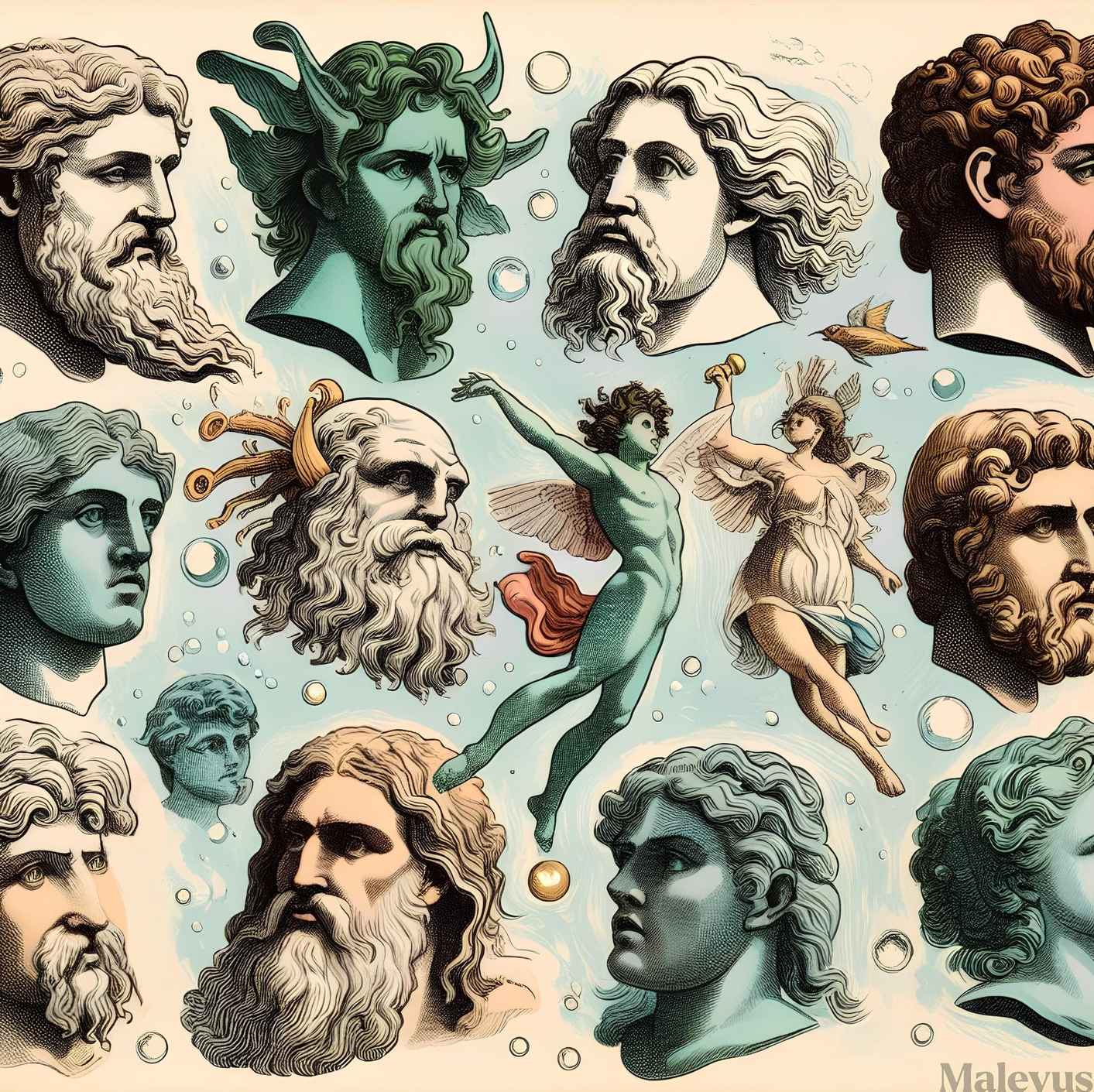
In the religious imagination of ancient Rome, not even Jupiter Optimus Maximus, the supreme ruler of the heavens, possessed the authority to alter the predetermined span of a mortal life once it had been decreed. That absolute, unyielding power belonged to the Parcae, the three sister goddesses who presided over birth, the unfolding of human existence, and the inevitable arrival of death. Adopted from the older Italian birth goddesses and fused with the Greek Moirai, the Roman Parcae sat at the center of the cosmos spinning, measuring, and severing the fragile linen thread of every person and empire on Earth.
Origins as Roman Birth Spirits Before Greek Influence
Long before Roman poets absorbed Greek mythology and equated the sisters with the Moirai, early Latin religion venerated a triad of indigenous goddesses concerned specifically with pregnancy and the perilous moment of childbirth. The Roman antiquarian Aulus Gellius, quoting the earlier scholar Marcus Terentius Varro, explained that the name Parcae derived directly from the Latin verb parere, meaning to give birth or bring forth—or alternately by linguistic inversion (antiphrasis) from the verb parcere, meaning to spare, because the goddesses of fate spare no mortal when their final hour arrives.
In their original archaic Roman form, these three birth spirits were invoked around the family hearth to ensure a safe delivery at the end of a nine or ten month lunar pregnancy. As Rome conquered the Hellenistic Mediterranean in the third and second centuries BC, Latin writers such as Livius Andronicus, Catullus, Virgil, and Ovid blended these native Italian birth spirits with the three Greek daughters of Necessity or Night—Clotho, Lachesis, and Atropos—creating the enduring literary image of three solemn weavers governing human destiny from cradle to grave.
Nona, Decima, and Morta: The Three Sisters and Their Tools
Each of the three Roman Parcae held a distinct name and a specific physical tool corresponding to the three phases of mortal life. The first sister was Nona, equated with the Greek Clotho (the Spinner). Her Latin name meant “the Ninth,” originating from her role as the goddess invoked by expectant Roman mothers in the ninth month of pregnancy when the infant was ready to enter the world. Holding a wooden or golden distaff and spindle, Nona drew raw wool or flax fibers together and spun the initial thread of an individual’s life, embedding both prosperous white threads and sorrowful dark threads into the yarn at the moment of birth.
The second sister was Decima, corresponding to the Greek Lachesis (the Apportioner). Meaning “the Tenth” after the tenth lunar month of gestation in the inclusive Roman counting system, Decima held a measuring rod and a globe or scroll. As the thread spun by Nona passed through her hands, Decima measured its exact length and guided its path across the trials, triumphs, and turning points allotted to that person during their years on earth. The third and most feared sister was Morta, equated with the Greek Atropos (the Inflexible). Derived from the Latin root mors (death), Morta stood waiting at the end of the measured span holding a pair of iron shears; with a single, impartial snip of her blades, she severed the thread, instantly extinguishing the mortal’s life regardless of whether they were a slave or a Caesar.
Why Not Even Jupiter Could Overrule the Parcae
One of the most profound philosophical aspects of the Parcae in Roman literature is their relationship to the Olympian gods. In Virgil’s Aeneid and Ovid’s Metamorphoses, the decrees of the Parcae—known in Latin as the Fata, literally “that which has been spoken,” the root of the English word fate—are stored as immutable bronze and iron tablets inside a cosmic archive proof against lightning, earthquakes, and time. When Venus weeps over the suffering of the Trojans or begs Jupiter to spare Julius Caesar from the assassins’ daggers on the Ides of March in Book Fifteen of the Metamorphoses, Jupiter reminds her that he himself cannot erase what is engraved inside the tabularia of the three sisters.
Far from diminishing the power of the gods, Roman Stoic philosophers viewed the harmony between Jupiter and the Parcae as proof that the universe is governed by rational cosmic law rather than arbitrary divine whims. During the Secular Games (Ludi Saeculares) celebrated by Emperor Augustus in 17 BC—where the poet Horace composed his famous Carmen Saeculare—sacrifices of pregnant ewes and cakes were offered at night along the banks of the Tiber directly to the Parcae, praying that the sisters who had already spoken glorious destinies for Rome would continue to spin an unbroken thread of prosperity for the Eternal City.