Across three thousand years of limestone temple reliefs, painted tomb frescoes, and colossal granite statues along the Nile, one garment defines the visual silhouette of ancient Egypt more clearly than any other: the shendyt. Worn by everyone from manual laborers and soldiers in the field to the reigning Pharaoh seated upon the throne of Horus, this wrapped linen kilt was a masterpiece of desert climate adaptation. Beneath its simple geometric lines, however, the quality of the weave, the stiffness of the pleating, and the addition of golden aprons transformed a humble piece of cloth into an unmistakable badge of social hierarchy and divine kingship.
Why Linen Was the Essential Fabric of the Nile
To understand the design of the shendyt, one must begin with the environment of the Nile Valley, where summer temperatures routinely exceed forty degrees Celsius under a relentless desert sun. Unlike the pastoral peoples of Mesopotamia and the Levant, who wove heavy garments from sheep’s wool, ancient Egyptians viewed animal wool as ritually impure for temple life and unbearably hot against the skin. Instead, Egyptian agriculture perfected the cultivation and processing of flax (Linum usitatissimum), which grew tall along the irrigated mudbanks of the Nile and was harvested before the seeds fully ripened to yield strong, silky fibers.
Beaten, combed, spun on drop spindles, and woven on horizontal ground looms (and later vertical looms during the New Kingdom), linen possessed unique thermal properties: it wicked perspiration instantly away from the body, allowed desert breezes to circulate through the weave, and actually grew softer and whiter with every washing in natron salts. At the highest tier of royal manufacturing, master weavers produced “royal linen” (byssus) so gossamer thin and translucent that five hundred threads fit into a single inch, feeling lighter than silk against the skin.
Evolution of the Kilt From the Old to the New Kingdom
In its earliest Old Kingdom form (circa 2686 to 2181 BC), the standard male kilt was a rectangular strip of unbleached or bleached white linen wrapped clockwise or counterclockwise around the waist and hips, reaching just above the knees and secured by tucking the loose corner into the waistband or tying it with a corded belt. For farmers, fishermen, brickmakers, and soldiers, this simple wrap allowed complete freedom of movement for climbing, rowing, and running, and could easily be hitched up between the legs into a loincloth when wading into the muddy waters of the Nile.

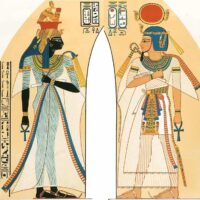
strictly speaking, the specific royal garment called the shendyt evolved from archaic prehistoric hunting skirts and reached its classic canonical form during the Old and Middle Kingdoms. The royal shendyt featured a finely pleated linen kilt wrapped around the thighs with a distinctive trapezoidal or rounded central tab hanging down between the legs in front. During the Middle Kingdom, scribes and provincial governors began wearing longer, calf-length outer kilts draped over shorter under-kilts, and by the opulent New Kingdom (circa 1550 to 1070 BC) under rulers like Amenhotep III, Tutankhamun, and Ramesses II, aristocratic kilts featured complex, fan-shaped vertical and horizontal sun-ray pleats set into the linen using wooden pressing boards and natural plant starch, paired with wide, triangular front aprons that projected stiffly forward when the wearer stood or knelt.
Royal Insignia: The Bull’s Tail, Cobras, and Golden Aprons
When worn by the Pharaoh in ceremonial scenes—such as smiting Egypt’s enemies with a mace or offering incense before the gods Amun and Osiris—the shendyt was elevated from everyday clothing into sacred ritual armor. Over the pleated white linen kilt, the king wore an ornate belt forged of gold, carnelian, turquoise, and lapis lazuli glass inlay, often clasped at the navel with a solid gold buckle bearing the Pharaoh’s royal cartouche name.
Hanging down the front center of the royal shendyt was a richly decorated ceremonial apron flanked on either side by rearing golden cobras (uraei) crowned with solar disks, symbolizing the fiery protective goddess Wadjet ready to strike down any enemy who approached the king’s body. Simultaneously, attached to the back waistband of the Pharaoh’s shendyt hung a long, braided ceremonial bull’s tail reaching down to the king’s calves, visually proclaiming that the ruler possessed the virile strength and untamed power of the wild celestial bull. Even centuries after Greek and Roman rulers conquered Egypt, Macedonian Ptolemies and Roman Emperors had themselves carved on the walls of Dendera and Philae wearing the exact same archaic pleated shendyt, knowing that to the people of the Nile, no man looked like a true Pharaoh without it.