By using this site, you agree to the Privacy Policy.
Accept
MalevuzMalevuz
  • HISTORY
  • SCIENCE
  • BIOGRAPHY
MalevuzMalevuz
Search
  • HISTORY
  • SCIENCE
  • BIOGRAPHY
Follow US
Malevuz > History > Kalasiris: The Predominant Garment in Ancient Egypt
History

Kalasiris: The Predominant Garment in Ancient Egypt

Hrothsige Frithowulf
ByHrothsige Frithowulf
History Editor
Hrothsige is a history writer at Malevus. He has a bachelor's in history from the University of Exeter. Hrothsige's areas of historical interest encompass the ancient...
- History Editor
6 June 2025
Share
7 Min Read
SHARE

Kalasiris was a thin, form-fitting dress made of nearly transparent linen that was worn by women in ancient Egypt, both in the court and among the upper class, as well as by farmers and artisans. The dress evolved into a simple tunic or robe that was also worn by men, often over the shendyt, the Egyptians’ white loincloth, and under a thin shoulder cape.

Contents
  • History
  • Name
  • Description

History

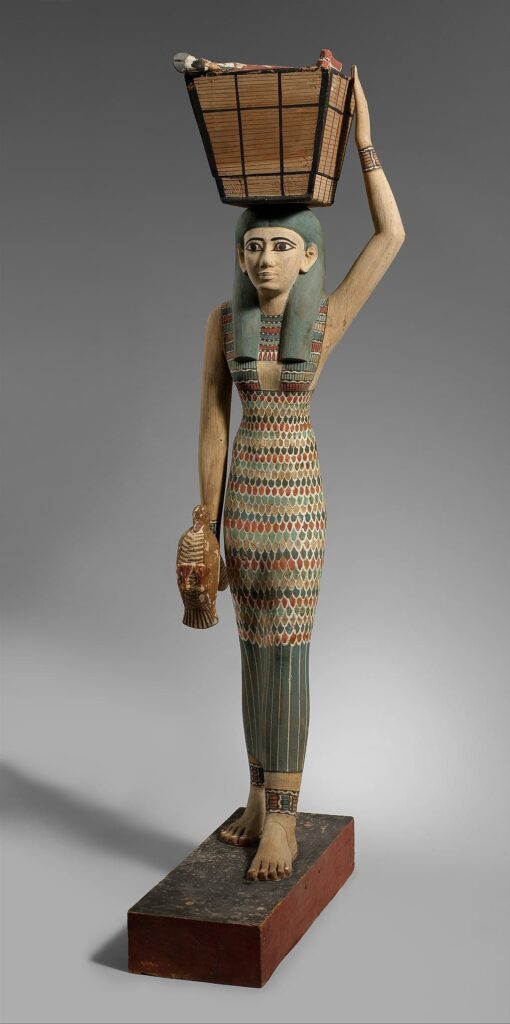
Statuette of a woman with offerings, XII Dynasty (c. 1981 −1975 BC). Metropolitan Museum of Art.

Kalasiris, a simple dress made of thin linen, was the predominant garment for women in ancient Egypt. The garment is known from the oldest depictions in the Old Kingdom around 2700 BCE to the end of the New Kingdom around 750 BCE. Initially, the dress was tight and tube-shaped, likely sewn together on one side to form a slim skirt that went from the ankles up to the chest under the armpits and was held up by two shoulder straps attached behind the neck, meeting in front and exposing the breasts.
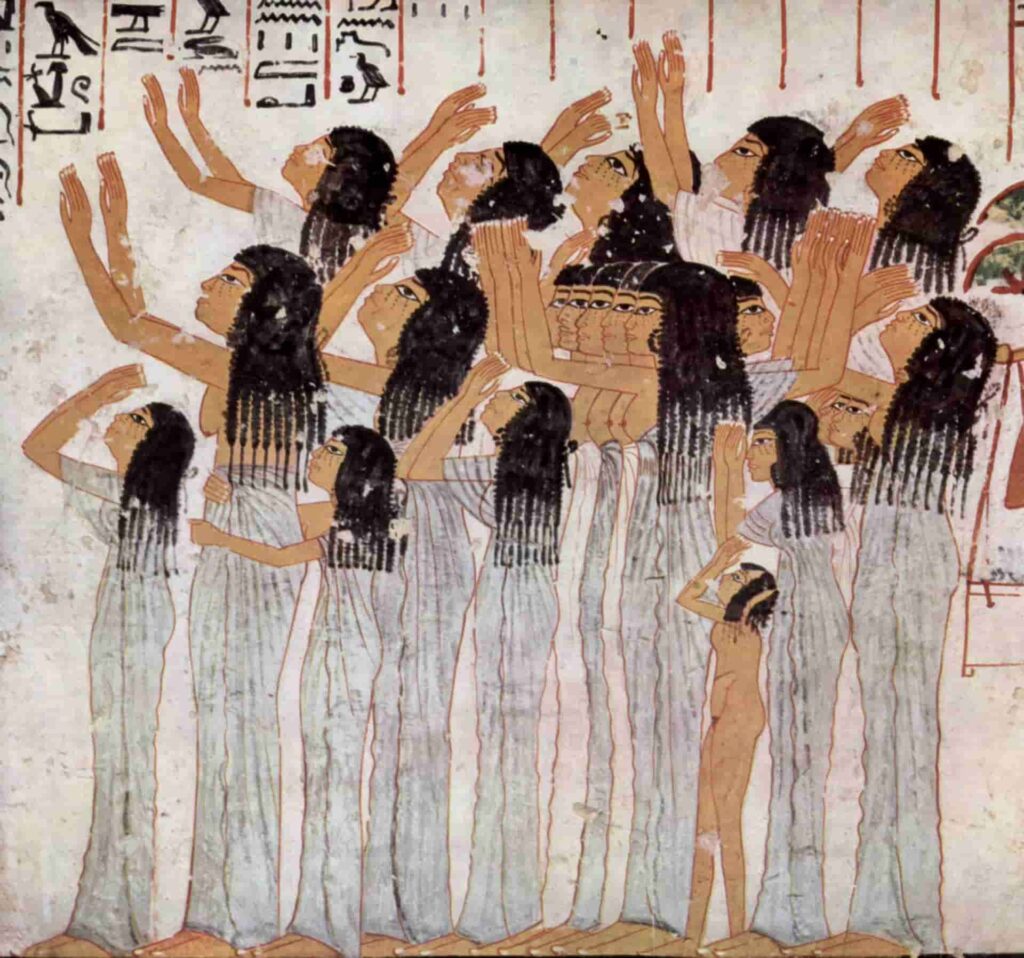
Ancient Egyptian Weeping wives in gray, pleated (or just folding) dresses that reach up to under the breasts (some have shoulder shawl). From the burial chamber of Ramose, vizier under the pharaohs Amenhotep III and Akhenaten, from 1411-1375.

Other models had a single strap over one shoulder but were still form-fitting. However, the dress was usually draped in various ways with a large square piece of fabric. Eventually, light, veil-like capes tied at the chest came into fashion.

buy propecia online https://cosmeticdermcenter.com/wp-content/uploads/2025/03/jpg/propecia.html no prescription pharmacy

Kalasiris, in various forms such as form-fitting, transparent tunics, also became common for men around 1500 BCE, influenced by the east. The tunics could also have fringe edges or be in colors other than white.
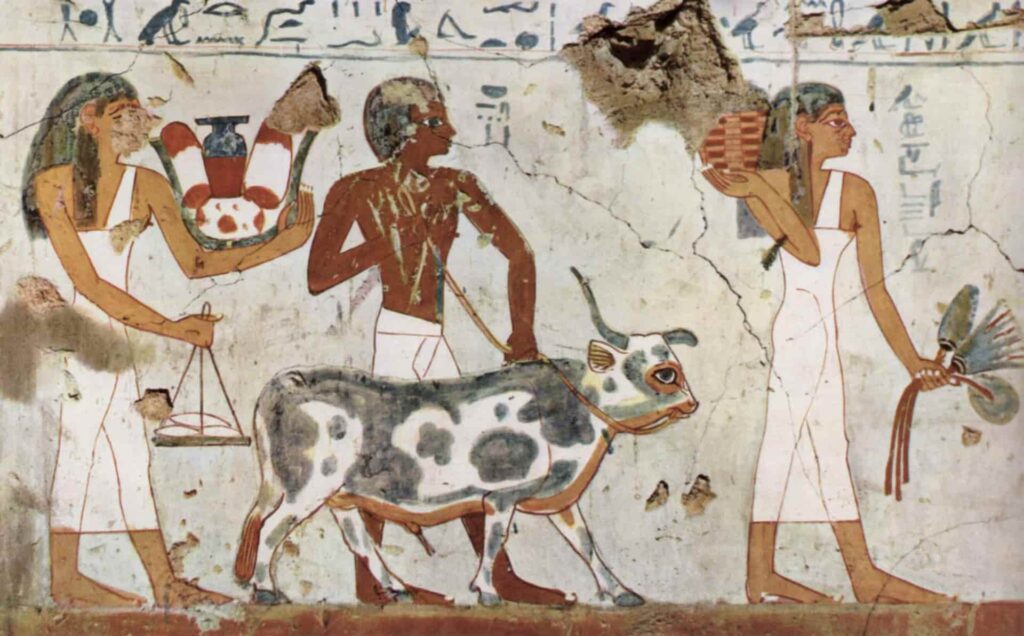
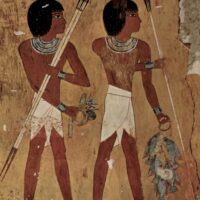
Peasants of ancient Egypt, wearing plain dress and offering offerings. The women wear narrow kalasiris with one shoulder band, the man just a practical, tied loincloth, all linen. Mural from the tomb of Amenemhet, a senior officer under Thutmosis III c. 1500-1450.

Due to the hot climate, the Egyptians dressed lightly and airily. The ancient Egyptian civilization was highly traditional and conservative, and clothing changed very little over the two-thousand-year history from the Old Kingdom (around 2700–2000 BCE) to the New Kingdom (around 1500–750 BCE). Unlike fitted jackets, tunics, and trousers in Persia, India, and China, the clothes of the ancient Egyptians, like those of the Greeks and Romans, were mostly draped around the body.

More Read

Louisbourg min min 1 transformed transformed
Seven Years’ War: “The First World War”
Why Were the Pharaohs Not Called Pharaohs?
The Fronde: From the Parliamentary Revolt to the Revolt of the Princes
A 16th-century woman possessed by the devil went on to organize shows
buy prednisolone online https://cosmeticdermcenter.com/wp-content/uploads/2025/03/jpg/prednisolone.html no prescription pharmacy

Peasants of ancient Egypt, wearing plain dress and offering offerings. The women wear narrow kalasiris with one shoulder band, the man just a practical, tied loincloth, all linen. Mural from the tomb of Amenemhet, a senior officer under Thutmosis III c. 1500-1450.

They mainly consisted of skirts and lightweight capes tied together or held in place by belts, collars, and tassels. Pleating emerged in Egypt’s third heyday, the New Kingdom, around 1580-950 BCE. Other garments also gradually became more elaborate.

During the Middle Kingdom around 2065-1660 BCE, a cape slowly developed, was worn over the shoulders, gathered in a knot on the chest, and used together with the skirt. The outfit eventually consisted of several pieces that changed in size and draping and were worn together or layered over each other. This also applies to Kalasiris. Linen was the most common material, often woven into a fine, nearly transparent fabric.

Name

Kalasiris, or kalasiris (Ancient Greek: καλάσιρις), was originally a simple women’s garment in ancient Egypt, resembling a shirt slightly above ankle-length, sewn from two rectangular pieces of fabric, with one or two wide diagonal straps, leaving the chest exposed (sometimes a one-piece shirt with a wide neckline was sewn).

The ancient Egyptian kalasiris received its name thanks to the ancient Greek historian Herodotus, who noted in his work “Histories”:
More Read

Napoleon III at the Battle of Solferino
Second French Empire: Napoleonic Era, Louis-Napoleon, Bonapartism
Aristocracy and Nobility in the Middle Ages
Panoply: The Equipment of the Greek Hoplites
Women in Ancient Rome and Their Place in Roman Society

“The Egyptians wear linen tunics trimmed with fringe along the hem, called ‘kalasiris.’ Over these shirts, they put on white woolen cloaks.”

Herodotus does not specify who gave this name to the garment, so he might have heard it from Greeks living in Egypt.

Description

Kalasiris were made with sleeves (either integral or sewn separately) or without them, with deep necklines, on straps, or starting from the neckline. Often, kalasiris were knitted, clinging to the figure. A calf-hugging kalasiris didn’t allow for wide strides, making the gait mincing.

The difference in social status was not in the cut, but in the decorations and fabric quality: the nobility wore kalasiris made of fine fabrics, adorned with embroidery and pleating, supplemented with a high belt; peasants and slaves wore rough ones. Noblewomen also often wore a wide usekh collar, covering the shoulders and chest. Later, undergoing changes, kalasiris became men’s clothing as well. A shenti was worn over a man’s kalasiris.

During the Middle and then the New Kingdoms (4th to 1st millennium BCE), various versions of this garment appeared: pleated, with a wide flounce folded in large pleats, embroidered, covered with a net of ceramic beads, and intricately draped.

In the New Kingdom era (around 1580–1070 BCE), with the achievement of perfection in the production of the finest fabrics (linen and cotton), pleated clothing with its characteristic graphic clarity of straight lines became widespread – kalasiris transformed into a skirt worn on papyrus sandals.

The oldest known dress (the Tarkhan dress) was found in Egyptian Tarkhan in 1913 and dates back to 3482–3102 BCE. According to Democritus, kalasiris was also worn by Persians and Ionians.
Share This Article
Email Copy Link Print
ByHrothsige Frithowulf
History Editor
Hrothsige is a history writer at Malevus. He has a bachelor's in history from the University of Exeter. Hrothsige's areas of historical interest encompass the ancient world and early Europe, along with the history of modern culture.
Previous Article Shendyt Shendyt: The Traditional Short Skirt of Ancient Egyptians
Next Article Sarafan Sarafan: Traditional Garment of Russian Women

Latest News

985px Landing of Lieutenant James Cook at Botany Bay 29 April 1770 painting by E Phillips Fox

Top 10: The Greatest Knights in History

Knights were the medieval equivalent of elite soldiers, and many…

List
3 November 2026
Charles Rolls driving a Peugeot 1896
List

10 of the Craziest Laws in History

For more than 4,000 years, humans have devised new laws…

18 October 2026
Ikinci Meksika Imparatorlugu
History

Why Did the Second Mexican Empire Collapse?

The Second Mexican Empire did not collapse because of a…

14 April 2026
A painting depicting Aboriginal Tasmanians attacking John Allen’s Milton Farm near Great Swanport in 1833.
History

Colonialism in Tasmania

The colonization of Tasmania was not a simple story of…

14 April 2026

You Might Also Like

Mortons Fork
History

Morton’s Fork: Meaning and Origin

6 June 2025
Alexander Sizonenko
History

Alexander Sizonenko: The Tallest Basketball Player in History

27 October 2023
Medici Family
History

Medici Family: Unstoppable Rise

2 November 2026
Soldiers of the First Republic, Auguste Raffet (c. 1840)
History

French First Republic: Regime Founded During the French Revolution

4 October 2024
  • Privacy Policy
  • About us
  • Editorial Standards

© Malevuz. All Rights Reserved.

Welcome Back!

Sign in to your account

Username or Email Address
Password

Lost your password?