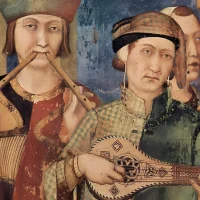
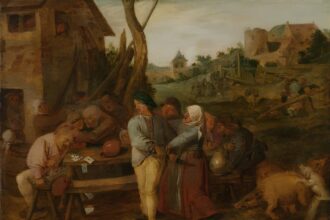
Marriage is one of the oldest social institutions, typically sanctioned by law, uniting a man and a woman in a special form of mutual dependence, often to establish and maintain a family. As early as the Middle Ages, the Church sought to regulate the union of spouses very strictly with the establishment of the sacrament of marriage in 1181, codifying marital life from the publication of banns to the consummation. But what actually happened behind the scenes of this so-called marriage?
The Church Formalizes Marriage in the Middle Ages
In the 11th century, during the Gregorian reform, the Church sought to impose a rigid distinction between clerics and laypeople. The former, tasked with ensuring the spirituality of society, were required to remain celibate, while the latter were responsible for the biological reproduction of the species and were required to marry according to increasingly strict rules that were identical for all. Marriage thus became a sacrament based on four central pillars: indissolubility, monogamy, consensus, and exogamy.
The union between a man and a woman must be unique and never be broken during the lifetime of the spouses. The publication of banns is mandatory to ensure greater publicity for the union. Severe sanctions threaten clandestine marriages. The Prior of St. Eloi reminds us that man is made in the image of God (made for himself), and woman is made in the likeness of man (created to help man), which is why she is subject to him!
By the end of the medieval period, women married around the ages of 17 and 18, and men were about ten years older, an age difference that reinforced male dominance. “Le Ménagier de Paris,” a treatise on morality and domestic economy, is intended for young wives. Obedience is imperative for women, but this does not prevent them from playing an important domestic role. The wife brings to the family her dowry plus a wealth of culinary, horticultural, and educational expertise.

A woman who exercises authority over her husband is unnatural; a beaten or cuckolded husband is a sign of scandalous inversion, attracting dishonorable ridicule. The ridiculed man must ride a donkey backward through the streets of the city!
Beat Your Wife or Celebrate Her
The husband holds over his wife a right of correction that an Italian proverb confirms: “Good wife or slob, every woman wants the stick.” Any head of household can punish his wife and family without anyone intervening. It is only when he exceeds what is ”accepted” that he can be condemned. However, such violent examples are rare; murder between spouses represents, in 1380–1422, less than one case of homicide out of a hundred.
The strong hierarchy within the couple does not prevent the expression of feelings.
There can be a real attachment between spouses.
This marital affection can be seen in the rare epistolary sources from the late Middle Ages.
Out of Wedlock in the Middle Ages
At the end of the Middle Ages, not all heterosexual couples were married. Before the Council of Trent (1545–1563), there were other forms of temporary or permanent cohabitation between men and women, even if they were condemned by the church: adulterous relationships, bigamy, concubinage, and second unions after separation.
It’s the infidelity of the married woman, not that of the man, that constitutes adultery due to the illegitimate children introduced into the household. The term “adultery” is used for women. Concubinage is widespread: clerics live with a concubine as “husband and wife,” sometimes with children too! For many young people from disadvantaged backgrounds, this could be a temporary choice while waiting to have a “real marriage.”
A Calendar for Love
The Church portrays the carnal act as a duty that spouses have to one another under conjugal law. However, it stipulates that such acts should only occur for procreation purposes and at specific times throughout the year. Spouses are required to abstain on Sundays, Wednesdays, and Fridays, as well as during the significant fasting periods leading up to Easter and Christmas, along with numerous feast days dedicated to saints. Furthermore, abstinence is mandated during the woman’s menstruation, pregnancy, the 40 days following childbirth, and prior to the churching ceremony.
Nevertheless, it is important to recognize the practical realities of human behavior. If these prohibitions were strictly adhered to, the frequency of intercourse between couples would have been limited to one to three days per month.
Prohibited Positions
The position of the woman on top of the man is prohibited by the church, as is the one where the man places himself behind his partner because it reduces him to the level of an animal. Canonical texts and medical works assure Christians that if they adopt these positions or if they engage in intercourse during periods not prescribed by the church, they will give birth to infirm, leprous, and deformed children.
However, the historian cannot extend his knowledge regarding these prohibitions.
Was the intimacy of the medieval couple limited? Only revealed to us is the restraint of men and women of the Middle Ages who preferred to cast a modest veil over amorous encounters forever lost.