During the time of Bartolomeu Dias, in the latter part of the 15th century, Europeans believed the earth to be flat, with the universe revolving around it. Navigating the high seas was considered foolish, and they had not yet conceived of any maritime route to the Indies. Thus, the adventurers of Portugal, a small nation of one million inhabitants, undertook a significant intellectual, technical, and human achievement by rounding the Cape of Good Hope, the southern tip of Africa. Step by step, over four generations, the Portuguese followed the African coast to reach the Indian Ocean, far from imagining the long voyage that would take them to the Indies.
The Portuguese Dream of New Conquests
Infante Henry the Navigator, son of King John I of Portugal, initiated the Lusitanian expansion. The prince aimed to explore new territories for religious and economic reasons, such as the spice trade, while disengaging from the Ottoman Turks’ control over European commerce. Despite the passing of Henry the Navigator before Bartolomeu Dias’ first mission, the Infante’s exploration of the globe directly benefited the latter. In 1415, Henry the Navigator led his first campaign. He crossed the Strait of Gibraltar and conquered Ceuta, a Spanish enclave in Morocco. Another feat was the crossing of Cape Bojador in 1434. Located 300 km south of the Canaries, this place was the limit of the known world. The Portuguese regarded it as the site of terrifying legends, in which monsters lurking in the deep sea emerged.
To improve navigation, Infante Henry established an academy that brought together astrologers, cartographers, and navigators from across Europe. Together, they invented celestial navigation, oceanic maps, and a lighter ship: the caravel. The coastal ships of the Algarve served as inspiration for the design of this vessel. Dias’s caravel had multiple masts and up to five sails, maneuvered by a crew of 25 men. Importantly, it could sail against the wind, an undeniable advantage for covering long distances.
All these significant efforts paved the way for the conquest of the oceans. To finance these innovations, the Infante, appointed governor of the Order of Christ, received spiritual rights over the African coastline from Pope Calixtus III. Thus, the Order sponsored the voyages of the caravels, whose sails bore their red cross. In 1454, the prince also obtained the pope’s approval to trade Africans as slaves. One last obstacle remained: the Equator, which inspired frightening myths. The navigators feared that their ships would burn up, they would scald, or their skin would turn black. They crossed it in 1474, and exploration continued.
Bartolomeu Dias de Novaes: A Short Biography
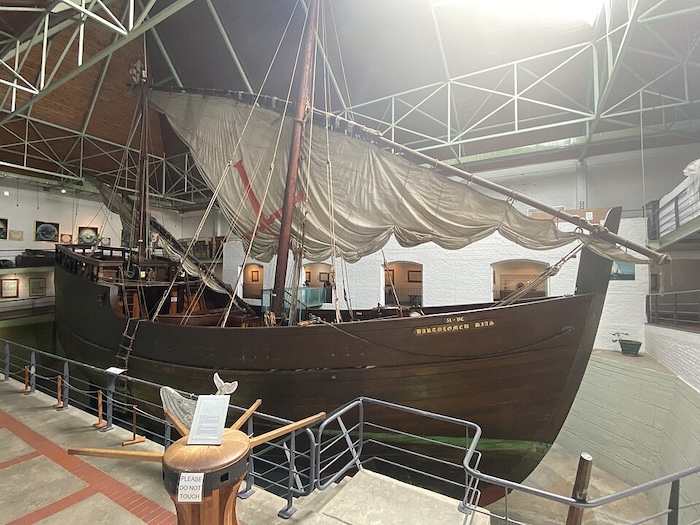
Bartolomeu Dias was the first explorer to link the Atlantic Ocean and the Indian Ocean via waterways, accomplishing this four years before Christopher Columbus discovered the New World, a revelation that overshadowed the success of Portuguese navigators. Born in Algarve in 1450, Bartolomeu Dias learned navigation from the German geographer and cosmographer Martin Behaim. At the age of 16, he embarked on his first expedition, but it wasn’t until 37 that his efforts yielded a remarkable success: the discovery of the Cape of Good Hope, the southern tip of the African continent. He drowned in a shipwreck in May 1500, during a subsequent expedition.
The Expedition to the Cape of Good Hope in 1488
The discovery of the Cape of Good Hope was crucial for the upcoming voyages of Portuguese and Spanish explorers. It provided evidence of a maritime route to the Indies and that the African continent indeed had an end. For the first time, cartographers conceived of the oceans as interconnected spaces. The world’s horizon expanded. Under the leadership of Bartolomeu Dias, two caravels and a ship dedicated to carrying supplies carried out this exploration along the African coast. The crew faced a shift in dominant winds between the northern and southern hemispheres. The slow-moving ship hindered their progress. They left it behind with nine guards.
A storm caught the caravels near the southern tip of the African continent, bringing them to the coast near the Bay of St. Blaise (now called Mossel Bay), 370 km east of the southern tip of South Africa. They anchored there on February 3, 1488, realizing they had reached the Indian Ocean and had rounded, without seeing it, the Cape of Good Hope. Bartolomeu Dias wanted to continue the exploration, but his exhausted crew rebelled. Turning back, he identified the point and named it the Cape of Storms. The king would later rename the Cape of Good Hope, seeing it as proof that this maritime route would lead Portuguese explorers to the Indies. Nine months after leaving it, he reunited with the ship with three survivors aboard. One of them, sick, died “of joy” upon seeing them return.
In late 1488, after 16 months of travel, the Portuguese made a triumphant return to Lisbon. Among the crowd welcoming them was a then-unknown Genoese, Christopher Columbus, who came to offer his services to the King of Portugal. In light of Bartolomeu Dias’s success, the king wished to exploit this route that bypassed Muslim lands. He rejected Christopher Columbus’s expedition, which sought to find a passage to the Indies from the West.
All Bartolomeu Dias Expeditions
| DestinatIon | Departure | Participants | Sovereign |
|---|---|---|---|
| Southern Congo | in 1466 | Pedrarias Davila, accompanied by Bartolomeu Dias, only 16 years old | Alphonse V |
| Ghana | in 1481 | Bartolomeu Dias | John II |
| Cape of Good Hope | in August 1487 | Bartolomeu Dias is 37 years old | John II |
| Calicut, India | July 8, 1497 | Vasco de Gama, accompanied by Bartolomeu Dias | Manuel I |
| Brazil, then Calicut, India | March 9, 1500 | Pedro Alvarez Cabral, accompanied by Bartolomeu Dias | Manuel I |