In the permafrost of Yakutia, in eastern Russia, scientists discovered the mummified and incredibly well-preserved remains of a 44,000-year-old wolf. The freezing conditions permitted the preservation of most of its internal organs, as well as the remains of its last meal. The latter analysis could provide valuable information on Pleistocene paleogenomes and paleomicrobiomes.
In 2021, researchers first discovered the mummified wolf in a thick layer of partially melted ice, approximately 40 meters deep in the Tirekhtyakh River in the Abyi region. After examining the remains, researchers from the Academy of Sciences of the Republic of Sakha (or Yakutia) stated that this was the first discovery of the complete remains of an adult wolf from the late Pleistocene (between 2.6 million and 11,700 years ago).
Robert Losey, an anthropologist at the University of Alberta, told Business Insider that this is the only complete adult Pleistocene wolf ever found, which is really remarkable in itself and entirely unique.
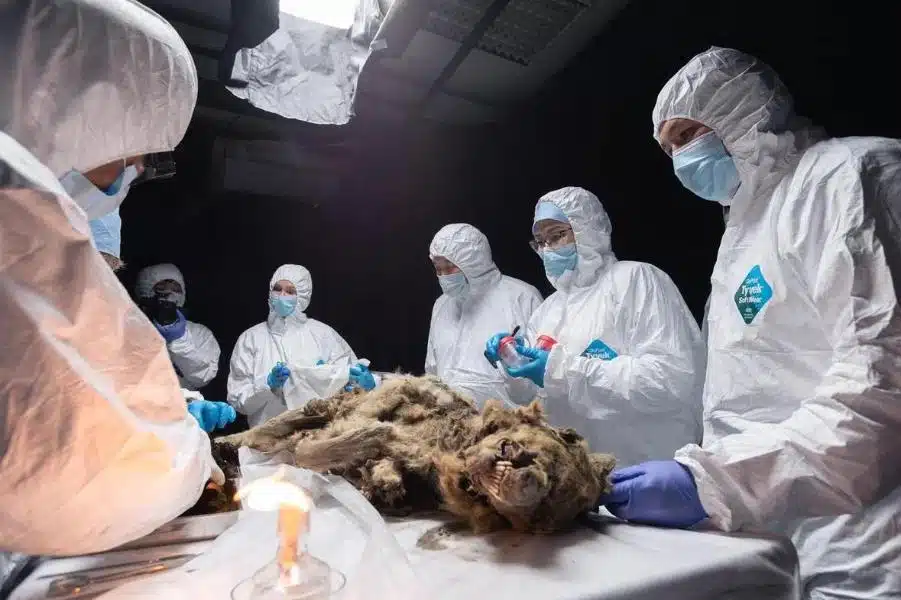
Researchers recently performed autopsies to study its diet and compare its genome with those of other ancient and modern wolves that lived in northeastern Eurasia. Experts suspect it could be an extinct species that was likely larger than modern wolves.

This project is part of a broad collaboration that began in 2014 and aims to study other Pleistocene animal fossils, including other wolves, horses, hares, and bears. The whole thing could offer insight into the complex ecological interactions of the time. This would improve our understanding of the evolutionary history of the Pleistocene and help us understand the causes of the extinction of many clades, which in turn could provide clues about potential future extinctions.
A Large Adult Male That Hunted in the Cold Plains
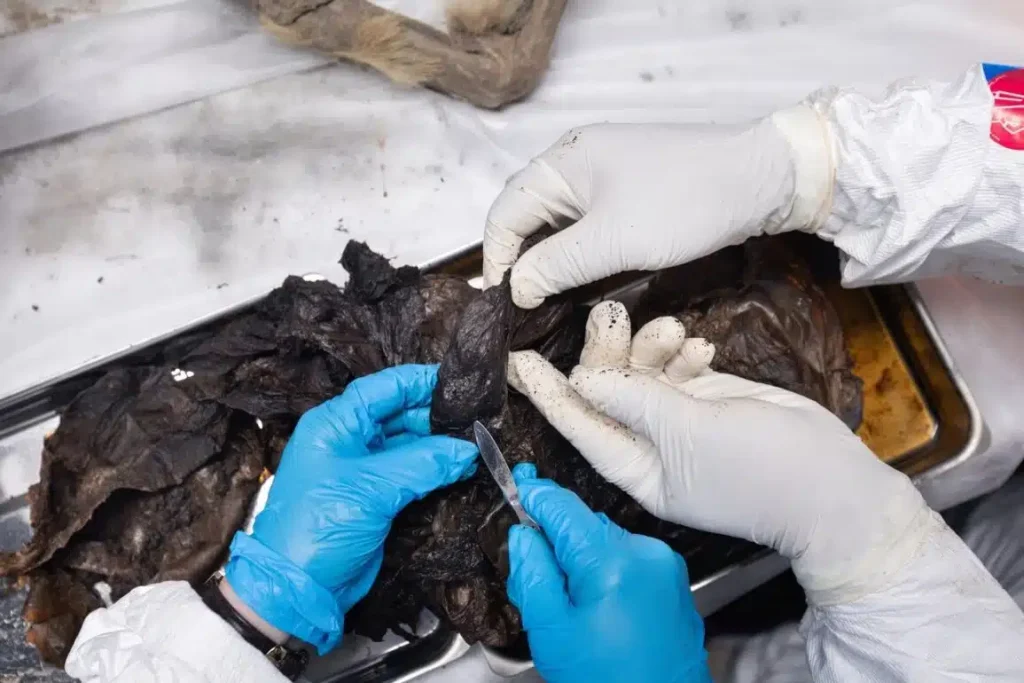
Co-led by a team from the Russian North-Eastern Federal University (NEFU), the autopsy was performed under sterile conditions to avoid contamination of the mummified remains. We took samples of internal organs to study the animal’s diet, its microbiome (paleomicrobiome), and the potential presence of unknown ancient microorganisms.
“Its stomach was preserved in an isolated form. There are no contaminants, so the task is not trivial. Thanks to this preparation, we hope to get a snapshot of the ancient Pleistocene biota,” Albert Protopopov, from the Academy of Sciences of the Republic of Sakha, explains in a NEFU press release.
The contents of its stomach indicate that it was a large predator that actively hunted. We found that the last animals it consumed had undergone partial digestion. The predator probably hunted in the cold plains, populated by mammoths, woolly rhinoceroses, horses, bison, and reindeer. The preserved soft tissues will also allow DNA extraction (paleogenome) for a comparative study with other wolves and prey.

We also collected samples for other studies. For instance, the researchers determined the wolf’s age (44,000 years) using one of its premolars. The researchers also knew it was a big adult male because of how worn down its teeth were and how developed its sagittal crest was. The sagittal crest is a bone ridge that runs along the middle of the top of the skull and supports the masticatory muscles.
Furthermore, the researchers suggest that unknown microorganisms that might be uncovered could potentially be used for the development of new drugs. Some viruses and bacteria can survive for thousands of years in permafrost and be released and reactivated after it thaws.
However, the discovery of these ancient carcasses, favored by the increasing thawing of permafrost, is not without danger. They could indeed release new pathogens that are potentially harmful to modern humans and animals. For example, in 2016, the melting of snow in the Yamal Peninsula (in Siberia) spread ancient Bacillus anthracis bacteria from a frozen reindeer carcass. This triggered an anthrax outbreak that infected 36 people in the region.
“We hope to get good results that will allow us to go a little further in understanding what the ancient microbial communities were, what functions they performed, and to what extent dangerous pathogenic bacteria were represented in ecosystems,” concludes Artemy Goncharov, from the North-Western State Medical University in Russia.