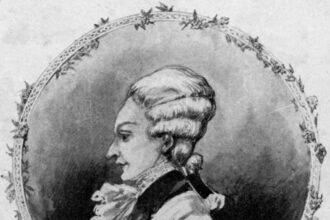
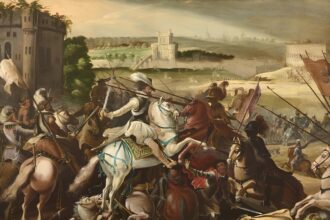
Swathed in his flowing scarlet silken robes with his pointed goatee, piercing dark eyes, and a network of spies that seemed to hear every whisper in seventeenth-century Europe, Armand Jean du Plessis, Cardinal-Duke of Richelieu (1585–1642)—Chief Minister to King Louis XIII—stands as the ultimate archetype of Machiavellian statecraft. Because he crushed rebellious French dukes, razed feudal castles, and made Catholic France the dominant power of Europe, his terrified enemies and later Romantic novelists like Alexandre Dumas spun an extraordinary web of legends around the “Red Eminence.” Separating archival fact from literary myth across eleven of the most famous legends of Cardinal Richelieu reveals a statesman who was often even more fascinating than his fictional villainy.
- 1. The Secret “Red Cabal” of Fourteen Palace Cats
- 2. He Invented the Rounded Table Knife to Stop Dinner Guests Picking Their Teeth
- 3. He Built a Mile-Long Stone Dam Across the Sea to Starve La Rochelle
- 4. He Was the Evil Villain Who Hunted D’Artagnan and the Three Musketeers
- 5. The Legend of the “Day of the Dupes” (November 11, 1630)
- 6. His Daily Fitness Routine of Jumping Over Palace Furniture
- 7. The Infamous “Six Lines Written by the Most Honest Man” Quote
- 8. He Secretly Funded Protestant Armies to Fight Catholic Emperors
- 9. He Built a Brand-New Ideal City Named “Richelieu” That Nobody Wanted to Live In
- 10. His Deathbed Reply About Forgiving His Enemies
- 11. His Mummified Head Took a 170-Year Journey After the French Revolution
1. The Secret “Red Cabal” of Fourteen Palace Cats
While Alexandre Dumas portrayed Richelieu as a cold-blooded monster devoid of human warmth, one legend about the Cardinal’s private life is 100% historically verified: this feared master of Europe was an obsessive, doting cat lover who kept fourteen cats inside his personal study at the Palais-Cardinal. When the Cardinal sat at his desk drafting treaties, kittens slept in the folds of his red silk robes. His favorite cats had colorful names recorded by palace diarists: Lucifer (a jet-black tomcat), Soumise (who slept on his lap), Ludoviska, Mimi-Paillon, Felimare (striped like a tiger), and two kittens named Racan and Perruque because they had literally been born inside the powdered wig of the academician Marquis de Racan! Richelieu even employed two full-time servants to feed his cats chicken paté twice a day and left generous annuities for their care in his final will.
2. He Invented the Rounded Table Knife to Stop Dinner Guests Picking Their Teeth
Every time you set a modern dining table with rounded-tip butter and dinner knives instead of sharp pointed daggers, you are touching a real culinary reform instituted by Cardinal Richelieu in the 1630s. Before Richelieu, aristocratic dinner guests brought their own sharp, pointed hunting daggers to the table to spear meat off platters—and to Richelieu’s disgust, guests constantly used the sharp dagger tips to pick meat out of their teeth during conversation (specifically his rough-mannered Chancellor, Pierre Séguier). Disgusted by the bad manners and worried about guests stabbing each other during political arguments, Richelieu ordered his steward to have the kitchen blacksmiths grind down the sharp points of every table knife in his palace into smooth, rounded curves—a design that King Louis XIV later made mandatory across all of France in 1669.
3. He Built a Mile-Long Stone Dam Across the Sea to Starve La Rochelle
During the famous 1627–1628 Siege of the Protestant Huguenot stronghold of La Rochelle on the Atlantic coast, critics mocked the churchman for thinking he could capture a port city supplied by sea by the English Royal Navy. Putting on steel body armor over his cassock, Richelieu personally directed thousands of workmen over winter to sink dozens of stone-filled ship hulls and drive massive timber pilings into the ocean floor to construct a 1,400-meter-long fortified sea-dike right across the mouth of the bay—physically locking the English fleet out until the starving city surrendered.
4. He Was the Evil Villain Who Hunted D’Artagnan and the Three Musketeers
In Alexandre Dumas’s 1844 masterpiece The Three Musketeers, Richelieu is cast as the scheming arch-nemesis of the King’s Musketeers and the employer of the femme fatale Milady de Winter. In historical reality, while the Cardinal did maintain his own rival guard company (“the Cardinal’s Guards” in red cassocks) that brawled in Parisian alleys with the King’s blue-cloaked Musketeers over honor, the real-life Charles de Batz de Castelmore d’Artagnan wasn’t even born until around 1611 and only became famous years *after* Richelieu died, serving loyally under Richelieu’s handpicked successor, Cardinal Mazarin!
5. The Legend of the “Day of the Dupes” (November 11, 1630)
According to palace lore, Richelieu came within five minutes of being fired and executed on November eleventh, 1630, when the King’s powerful mother, Queen Marie de’ Medici, cornered her son Louis XIII inside the Luxembourg Palace screaming in tears that he had to choose between his mother and his minister. When Richelieu tried to enter the locked room by sneaking through a secret chapel passageway only to be banished from the Queen Mother’s sight, the entire court rushed to congratulate the Queen’s allies as the new government—until a loyal courtier whispered to Richelieu not to pack his bags yet. Riding out to the King’s modest hunting lodge at Versailles that evening, Richelieu found Louis XIII waiting to embrace him and banish his own mother instead—prompting a witty observer to dub it the Journée des Dupes (“The Day of the Dupes”).
6. His Daily Fitness Routine of Jumping Over Palace Furniture
Despite suffering all his adult life from migraines, malaria fevers, painful abscesses, and intestinal tuberculosis that made him look frail and pale in public, palace servants leaked a hilarious secret about how the fifty-year-old Cardinal relieved stress behind locked doors. According to memoirs of the era, whenever Richelieu was completely alone with one trusted valet inside his private bedchamber, the dignified Prince of the Church hiked up his red cassock and practiced standing high-jumps and long-jumps over his palace chairs, tables, and beds to keep his circulation moving—once being caught mid-leap by an embarrassed courtier named De Gramont, who quickly saved his own skin by taking off his coat and challenging the Cardinal that he could jump even higher!
7. The Infamous “Six Lines Written by the Most Honest Man” Quote
Every political thriller quotes Richelieu’s chilling maxim: “If you give me six lines written by the hand of the most honest man, I will find something in them which will hang him.” While Richelieu definitely ran Europe’s first modern domestic postal-interception agency (the Cabinet Noir, or “Black Chamber,” which steamed open wax seals on noblemen’s mail, copied the letters, and resealed them invisibly) and used special judicial commissions to execute rebellious aristocrats like Cinq-Mars and Montmorency, historians later traced that exact six-line quote not to Richelieu’s own pen, but to nineteenth-century plays and novels exaggerating his judicial ruthlessness.
8. He Secretly Funded Protestant Armies to Fight Catholic Emperors
To pious Catholics across Europe, it seemed like a dark legend that a Roman Catholic Cardinal—wearing the red hat of the Pope—would ship millions of French gold livres to fund the Lutheran Protestant King of Sweden, Gustavus Adolphus, to invade Catholic Germany during the Thirty Years’ War. Yet this legend was completely true: guided by his cold doctrine of Raison d’État (Reason of State), Richelieu believed that preventing the Catholic Habsburg dynasty of Spain and Austria from encircling France took absolute priority over religious solidarity—while employing a barefoot Capuchin friar named François Leclerc du Tremblay (famous as l’Éminence Grise, “the Grey Eminence”) as his shadowy chief intelligence diplomat.
9. He Built a Brand-New Ideal City Named “Richelieu” That Nobody Wanted to Live In
In 1631, elevated to Duke of Richelieu, the Cardinal tore down his modest ancestral manor in Touraine and hired the royal architect Jacques Lemercier to build a breathtaking, symmetrical walled Renaissance utopia from scratch named simply Richelieu—complete with twenty-eight identical limestone aristocratic mansions along a ruler-straight main street. Because rich Parisian nobles hated living far away from Paris in the countryside, the Cardinal had to practically force courtiers to buy the houses; the moment Richelieu died in 1642, the nobles abandoned the town immediately, inadvertently freezing the seventeenth-century streets in time so that the town of Richelieu stands today as an untouched architectural time capsule.
10. His Deathbed Reply About Forgiving His Enemies
On December fourth, 1642, as the fifty-seven-year-old Cardinal lay dying in Paris, the parish priest administering the Last Rites asked him the mandatory Christian question: whether he forgave all his enemies. According to the famous anecdote repeated across Europe, Richelieu looked up calmly from his pillow and gave the ultimate statesman’s reply: “I have never had any enemies, other than those of the State.”
11. His Mummified Head Took a 170-Year Journey After the French Revolution
The final bizarre legend of Cardinal Richelieu occurred a century and a half after his death. In December 1793, during the Reign of Terror, revolutionary crowds broke into the Chapel of the Sorbonne, smashed open Richelieu’s marble tomb, and sawed the perfectly embalmed, mummified face and front half of the skull off the Cardinal’s corpse—Complete with his reddish-grey goatee and mustache still attached to the parchment-like skin! Stolen by a grocer named Cheval and passed nervously from hand to hand across five generations of French collectors and provincial families for seventy-three years while ghosts and curses were rumored to follow it, the mummified face of Cardinal Richelieu was finally authenticated by historians and reburied with full honors under his marble tomb at the Sorbonne in December 1866.