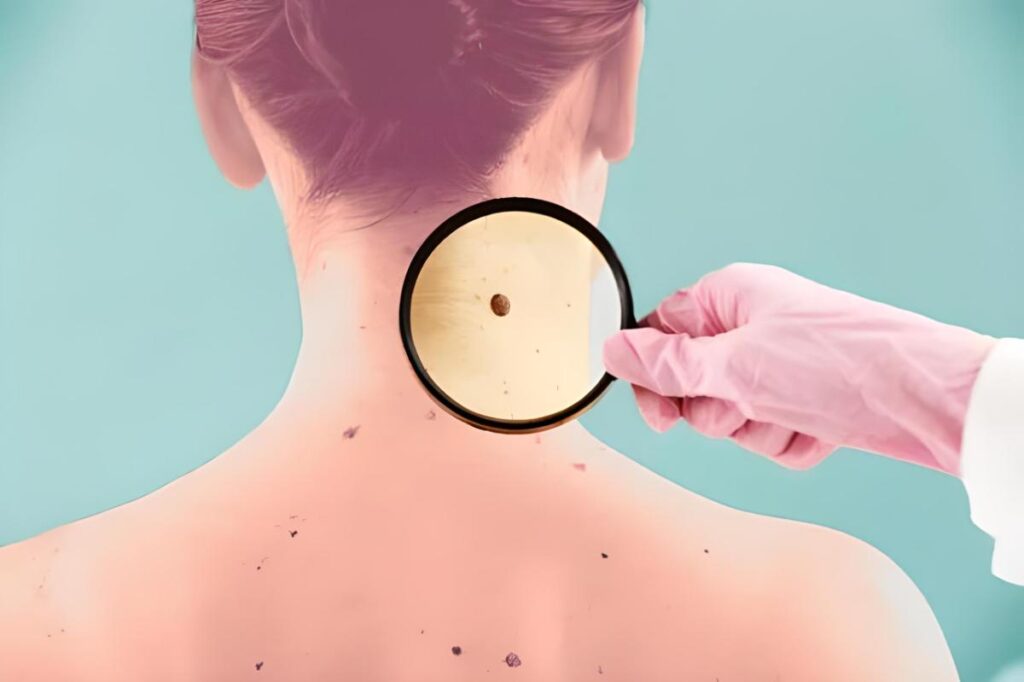
They are usually small and roundish, brownish in color, and can be located in very different places on our skin: moles (also known as nevus). Almost everyone has at least a few of these pigmented moles on their body, and some even have whole armies of them. These striking discolorations were already known to our ancestors. They called them moles because their brownish color resembles that of the liver. But how do these pigmented marks on our skin develop? And what distinguishes them from other skin spots, such as freckles?
In principle, the brown-colored moles are nothing more than spots in the skin where a particularly large number of pigment-forming cells are located. These so-called melanocytes produce the dark pigment melanin and also release it to the neighboring cells in the upper skin layer. This process also takes place during normal tanning of the skin. However, because the pigment cells are more densely located in the moles than in the rest of the skin, the pigmented moles appear darker, they usually stand out clearly from the surrounding skin.
Freckles can sometimes look quite similar; they, too, stand out from the surrounding skin as yellowish to brownish spots. But their cause is different. In freckles, the pigment cells do not sit more densely, but they form a special melanin more quickly and in greater numbers. Whether someone has these particularly active pigment cells or not is a matter of predisposition. People with very light, sun-sensitive skin usually get a particularly large number of freckles when they go out in the sun.
Sun and Predisposition Play an Important Role
But what about moles? Where do they come from, and why do some people have a particularly large number of them, while others have almost none at all? Several factors play a role in this: there are colored moles that are congenital and those that only develop in the course of life, usually in the first 30 years of life. The congenital pigmented moles are not always visible at birth, often they only appear within the first two years of life. At first glance, though, they don’t look much different from the moles that get colored as you get older.

Whether a person will acquire additional moles in the course of his or her life depends mainly on four factors. There is a hereditary predisposition to form many atypical pigmented moles, which is also coupled with an increased risk of black skin cancer. Above all, their occurrence has to do with skin type and sun exposure: The lighter (and thus more sun-sensitive) the skin is, the more pigmented moles it develops over time. The most important trigger for this is sunlight, especially in youth. Those who were repeatedly exposed to strong sunlight as children and possibly got sunburned will develop more moles over time.
But hormones also play a role in the “mottling” of our skin. During pregnancy and puberty, more pigmented moles often develop. If your immune system isn’t as strong, you may get more moles, especially when you’re a child.
Skin Cancer Can Develop From Moles
But what do moles mean for health? Those who have a mole or two need not worry: The pigmented moles themselves are harmless. However, because there are more pigment cells in these areas than elsewhere in the skin, the risk of one of them degenerating can be higher. Moles can then become a form of black skin cancer, the dreaded melanoma. 20 to 30 percent of melanomas arise from pigmented moles. The same rules apply for prevention as they do for skin cancer in general: Do not go into the sun for too long, and above all not in the midday, protect the skin with clothes and use sun cream.
But even then, it is definitely advisable to keep an eye on your moles. This is especially true for those people who carry more than 50 pigmented moles, as the experts explain. This is because the high number of moles indicates that their skin has already had a few sunny vacations. These people also usually have a higher risk of melanoma.

But how can I tell if a brown spot on my skin is simply a normal pigment mark or has already developed into skin cancer? This is where the ABCD rule comes in handy. It summarizes the four most important warning signs of melanoma. “A” stands for asymmetric structure. Irregularly shaped spots on the skin can be melanoma, especially if their shape changes over time. “B” stands for boundary: pigmented moles that are cleanly demarcated from their surroundings are usually not critical, but spots with blurred edges are more alarming. “C” stands for color. If a stain has different shades, especially dark or gray shades, this can be a warning sign. Finally, D stands for diameter; particularly large pigment marks or those that become larger over time should also be examined more closely.
Bibliography
- Rudolf Happle. “What is a nevus? A proposed definition of a common medical term“.
- Dysplastic (Atypical) Nevi. Melanocytic Lesions