What is the historical development of metalworking? Metals have played a key role in the production of many objects since 8000 BC, the earliest known use of metals in human history. Today, they permeate every aspect of modern civilization through the use of composites and specialty polymers. Metals found in nature, and copper, in particular, began to be used to make small objects such as needles in Western Iran and Eastern Anatolia around 7000 BC.
These objects were made by simply crushing and hammering copper into shape. The method of heating copper to make it softer was probably invented by accidentally setting the metal on fire. On the other hand, the invention of the method of melting copper in a crucible around 3800 BC led to the wider use of metals.
The Invention of Alloys
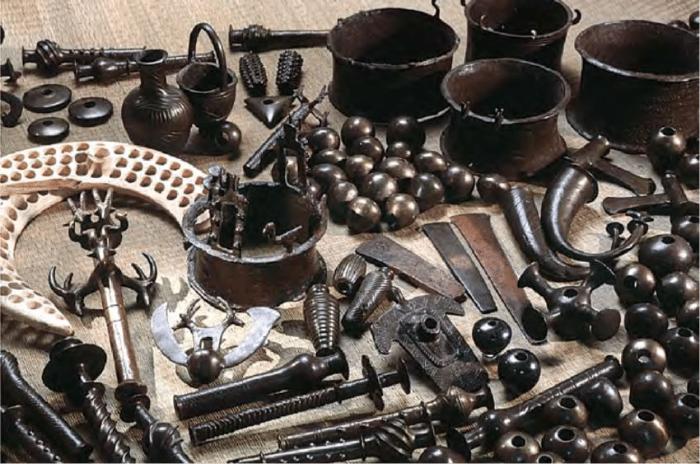
Bronze, the first alloy, was produced around 3000 BC. Made by melting tin and copper in a crucible, bronze was stronger and easier to work than its constituent materials. Bronze remained the primary metal for making objects and weapons until the invention of ironworking around 1250 BC. The technology for smelting pure iron was only invented in the 19th century. The first iron objects were therefore made by first melting iron ore into an impure iron “flower”, then separating the iron pieces and combining them in a furnace.
This production method continued in Europe until the invention of pressure furnaces in the 15th century. The 18th century Industrial Revolution brought new techniques and the use of coke in pressure furnaces. However, it was the invention of the Bessemer converter by the British inventor Henry Bessemer in 1856 that enabled the large-scale production of steel, a strong, high-quality iron and carbon alloy. Later advances in the industrial revolution made it possible to develop other metals such as aluminum, magnesium, and titanium, whose lightness and strength played vital roles in the development of the aerospace industry.

Timeline of Metalworking History
The discovery and growth of the metals sector:
- Prehistory — Western Iran and Anatolia. Copper ore is crushed or hammered into shapes to make small items such as rosary beads.
- 2600 — 2400 BC – Use of wrought copper foil. Early copper smelting methods were still fine enough to allow hot copper to be hammered into more complex shapes.
- 1500 — 1200 BC – Development of bronze casting. New techniques are developed for casting bronze vessels and decorating them by hammering through them.
- 1500 — 30 BC – Purification of gold. Around 1500 BC, the ancient Egyptians learn to separate gold from silver and begin to use it more widely for decorative purposes.
- 900 BC — 100 AD – Use of iron. Iron working spreads from western Anatolia, reaching Greece around 900 BC and West Africa around 400 BC, making it possible to make more robust tools and objects.
- 540 — 500 BC – Metal as money. Metal coins (a mixture of gold and silver) are first used in Lydia (present-day Turkey) around 640 BC. The ancient Greeks adopt this idea and spread it throughout the Mediterranean.
- 100 — 700 – Anglo-Saxon metalworking. The Anglo-Saxons take metalworking to an advanced level, often using animal forms for decoration.
- 700 — 800 – Sword-making. Sword-makers in Europe forge layers of carbon-added iron and thin strips of iron and then weld them together to produce stronger swords.
- 800 — 1300 — 1450 – Christian objects of precious metals. Medieval Christians make sacred objects such as crosses and reliquaries from gold and other precious metals, sometimes inlaid with precious stones.
- 15th century – Weapons made from cast metals. Cast iron is developed which finds immediate use in artillery because it is strong and can be formed into cylindrical shapes.
- 1810 – Tin can. British inventor Peter Durand patents a tin can for storing food. His patent is a box made of iron and coated with tin to prevent the iron from rusting.
- 1856 – Bessemer converter. The Englishman Henry Bessemer invents a converter that allows the production of high-quality steel.
- 1910 – Aluminum foil. The first aluminum foil is produced. The mass production of the metal becomes possible after the invention of a method in 1886 by passing an electric current through melted ore.
- 1950s – Titanium aircraft. Due to its high strength-to-weight ratio, titanium is widely used in military aircraft. It is now also widely used in commercial aircraft.
References and further reading:
- archive.org/details/materialsprocess00dega_419
- researchgate.net/figure/The-worlds-oldest-and-most-spectacular-prehistoric-metal-hoard-found-in-Israel-near-the_fig30_311701962