Who was Florence Nightingale? With the so-called gods and heroes it has created, war has been mostly a male aspect of human history for many centuries. In the Pantheon of ancient Greece, the goddess of health and healing symbolized prevention and treatment. Therefore, healing and caring for the wounded and sick have been part of the tradition of women since ancient times. Modern nursing came about because women wanted to be remembered for more than just marriage, family, and small jobs. They wanted to have a place in the world that was important.
The Birth of Nursing as a Profession
In the Middle Ages, orders such as the religious ones of St. John and the Third Order of St. Francis of Assisi covered some rules on how to look after the sick; but those were not sufficient for the birth of a disciplined nursing profession. Just before the Industrial Revolution, what was known as “nursing” was the work of prisoners, criminals, alcoholics, and old prostitutes who wanted to redeem themselves. The English writer Charles Dickens’s “Sairey Gamp” character sarcastically depicts the “nurse” of the period, who only carries food to patients, drinks whiskey, and makes herself as comfortable as possible.
Until the 1830s, the first examples of regular nurse training were often limited to the education provided by religious communities. The Catholic Vincent de Paul founded the charitable foundation “Daughters of Charity,” and later, in 1831, Catherine McAuley and Mary Aikenhead founded “Sisters of Mercy” and “Irish Sisters of Charity.”
From the Protestant community, Theodore and Friederike Fliedner founded the Deaconess Institute in 1836 and began training women in a small hospital in the town of Kaiserswerth, near Dusseldorf. But the Crimean War (1854–1866) of the time led to such atrocities that the situation of the wounded became so disastrous that the intellectuals and spirituals of the period pursued the nursing profession as a modern theory and practice.
Who was Florence Nightingale?
Florence Nightingale (1820–1910) was the daughter of one of England’s most wealthy and well-known families. At 17, Florence heard a voice saying God was calling her on a mission to help needy people. This mystical experience led her, despite all the obstacles from her family, to attend the Nursing Institute in Kaiserswerth at the age of 31. After working there for three months, Florence Nightingale went to the Sisters of Charity Foundation in Paris, and in 1853 she became the director of the “Care of Sick Gentlewomen” in London. Subsequently, she became director of the King’s College Institute.
Florence Nightingale was clever and well equipped; she was a girl of great talent in history, philosophy, science, classical literature, music, art, and especially mathematics. She had a diary that she used to take notes in, and one day she wrote, “To understand God’s thoughts, we must study statistics, for these are the measure of his purpose.” She traveled a lot and knew French, German, Italian, Greek, and Latin. She visited hospitals wherever she went and explored the architecture of these hospitals and how they were managed.
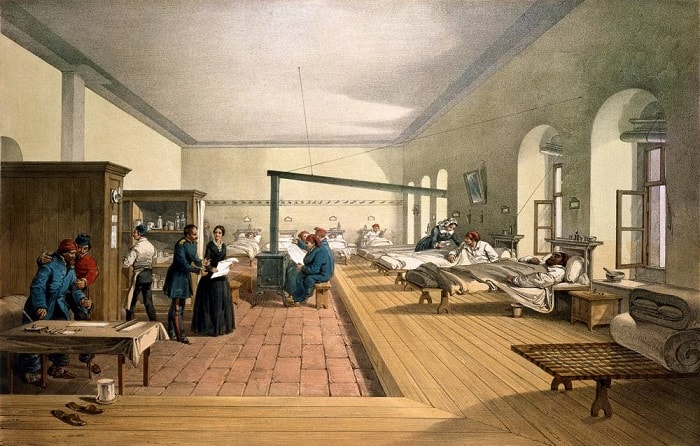
In November 1854, with all this experience and 38 trained nurses, Florence Nightingale volunteered to go to the British military hospital in Istanbul, Üsküdar. The Army’s Secretary of Health accepted Nightingale’s help, despite all the negative reactions from the British generals. Just before the arrival of Florence Nightingale, the press pointed out that 60% of the wounded soldiers in the hospital had died because of extremely unhealthy conditions. As a result, the British people gave their support to the secretary.
Florence Nightingale’s Approach to Hygiene
7 years before Ignaz Philipp Semmelweis wrote about the causes of puerperal fever (the condition caused by a uterine infection in the woman giving birth) and 25 years before Louis Pasteur put forward the germ theory of diseases, Nightingale knew that hygiene was a must in the hospital environment. Therefore, as soon as she arrived at the hospital, she immediately distributed tasks among her nurses to clean and ventilate the environment, keep the rooms warm and quiet, and take care of the patient’s nutrition. The outcome was that the mortality rate fell to a low of 2 percent in just two months.
She was concerned with both the physical needs and the welfare of patients; she was the first person to provide payment to patients’ families. She used her own money and hired a Turkish work crew to repair a burned-out wing of the hospital before accepting new patients.
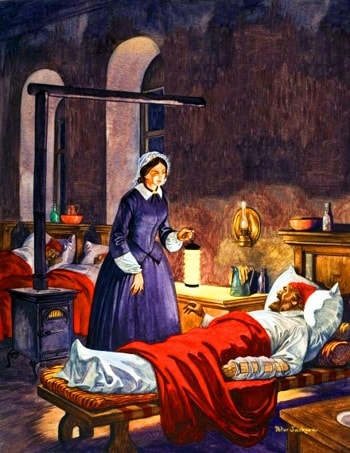
She was a dedicated person who went to the battlefields and walked around every patient in a hospital at night with her lamp. She won the admiration of the world press, and they called her “Lady with the Lamp.” When she returned to England, they welcomed her as a hero. She established the world’s first nursing school, St. Thomas Hospital, in 1860, with the funds collected for the Crimean War veterans.
Florence Nightingale’s Nursing Principles
- The content of nursing education is also determined by nurses.
- Nurse trainers are responsible for the health care provided by nursing program students and graduates.
- All trainers should also be trained by nurses.
- Nursing schools should be independent institutions that are not affiliated with any physician community or hospital.
- Nurses should be equipped with a very high level of education and should not stop learning throughout their working lives.
- In the nursing profession, the concepts of health and disease are inseparable, and nursing covers both the patient and the environment.
- Nursing studies should include theoretical practices as well.
These concepts and practical ideas brought by Florence Nightingale to the field of modern nursing, which is an independent profession that incorporates healing power, have also brought innovation to the practice of medicine. We can see the impact of her ideas and contributions to this profession in the nurses who work in hospitals today.
Bibliography:
- Kelly, Heather (1998). Florence Nightingale’s autobiographical notes: A critical edition of BL Add. 45844 (England)
- Rogers, Sarah (2022). ‘A Maker of Matrons’? A study of Eva Lückes’s influence on a generation of nurse leaders:1880–1919’ (Unpublished PhD thesis, University of Huddersfield, April 2022)
- Role Development for Doctoral Advanced Nursing Practice. Springer Publishing Company. 15 December 2010. p. 325.
- Vojnovic, Paola (2013). ‘Florence Nightingale: The Lady of the Lamp’ in Santa Croce in Pink: Untold Stories of Women and their Monuments. Adriano Antonioletti Boratto. p. 27.
- Bostridge, Mark (2008). Florence Nightingale: The Making of an Icon. p. 1172. ISBN 9781466802926.