The historical significance of printing cannot be underestimated. The replication of books has made them more affordable and accessible, resulting in greater literacy and the spread of ideas. Johannes Gutenberg, a German goldsmith, invented this innovative technique.
Who Was Johannes Gutenberg?
Little is known about the early years of Johannes Gutenberg’s life except that he was born in Mainz around 1400 and came from a privileged ruling family. He went to university, where he became a bookworm and trained as a goldsmith.
Around 1420, many families were deported from Mainz after the rebellion of the taxpaying middle class. The Gutenberg family was one of them. Gutenberg then went to Strasbourg and started to work on different things. One of those things was a “secret” that he only told his financial supporters. This secret was probably about the printing press.
Almost all books were written by clerks at the time, which was a laborious task. As a result, books were scarce and costly, and literacy was confined to the clergy and politicians. Wood printing generated many volumes, but the blocks had to be unearthed one by one for each page. All of this changed with Gutenberg’s latest innovation, the “replaceable/removable letter system.”
The removable letter system was a system in which a text was placed in place of individual embossed letters in the frame or matrix. The letters were then inked and printed on paper. The technique was invented in China and Korea in the 11th century, but it never became widespread, probably because of the large number of written Chinese and Korean characters.
Johannes Gutenberg invented his system with this technique. The method was simple and effective. First, he carved holes in hardened steel, and the holes were in the form of embossed letters. Through these holes, he would strike the letters on copper. He then placed the “negative” copper into his hand-held mold, which is his invention, and poured the molten metal into it, allowing him to make as many copies of the letters as he wanted. The metal used by Gutenberg was an alloy of lead, tin, and antimony, which melted easily and solidified rapidly in the mold. The alloy is still used today in printing on letterpress and on hot metal.
Gutenberg Press
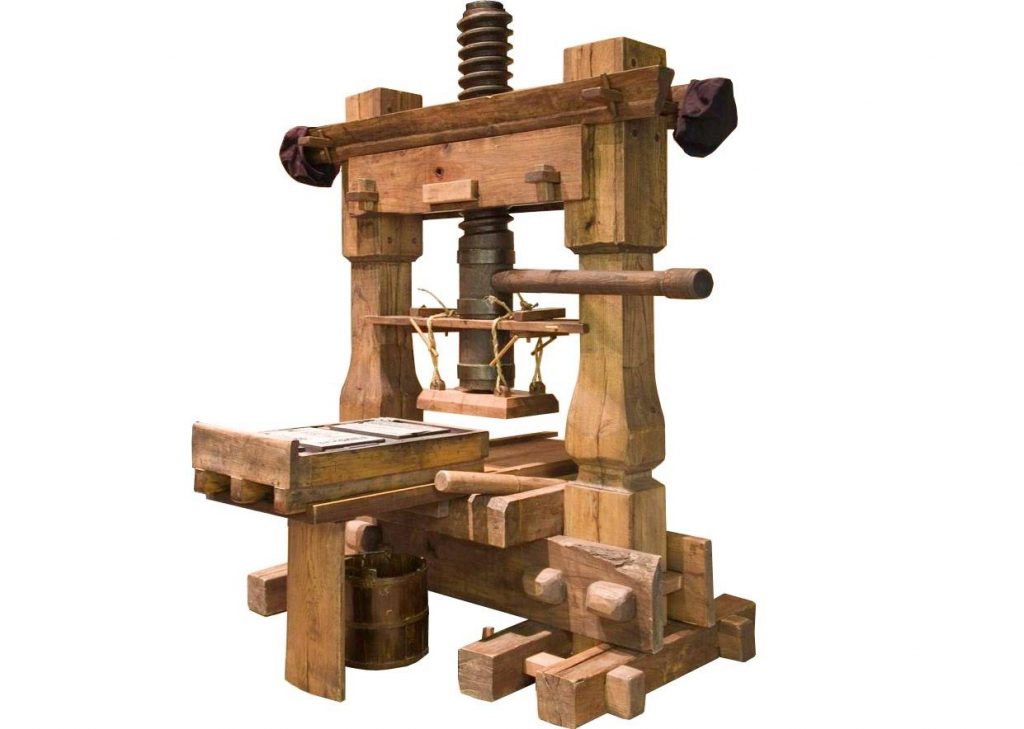
In the 1440s, while still in Strasbourg, Gutenberg set out to experiment with a new part of the printing system: The Press. The screw press used by winemakers inspired Gutenberg’s press. The inked, striped text was placed face up on a level surface, covered with paper, and then moved beneath a very heavy stone; the screw was then rotated, and the paper was placed into printing letters. The text could be replicated as this procedure was repeated.
Gutenberg also created oil-based ink that was more durable than the water-based ink that was commonly used at the time. He thought that when he put all of these ideas together, his invention would change the world.

Gutenberg and The First Printed Bible
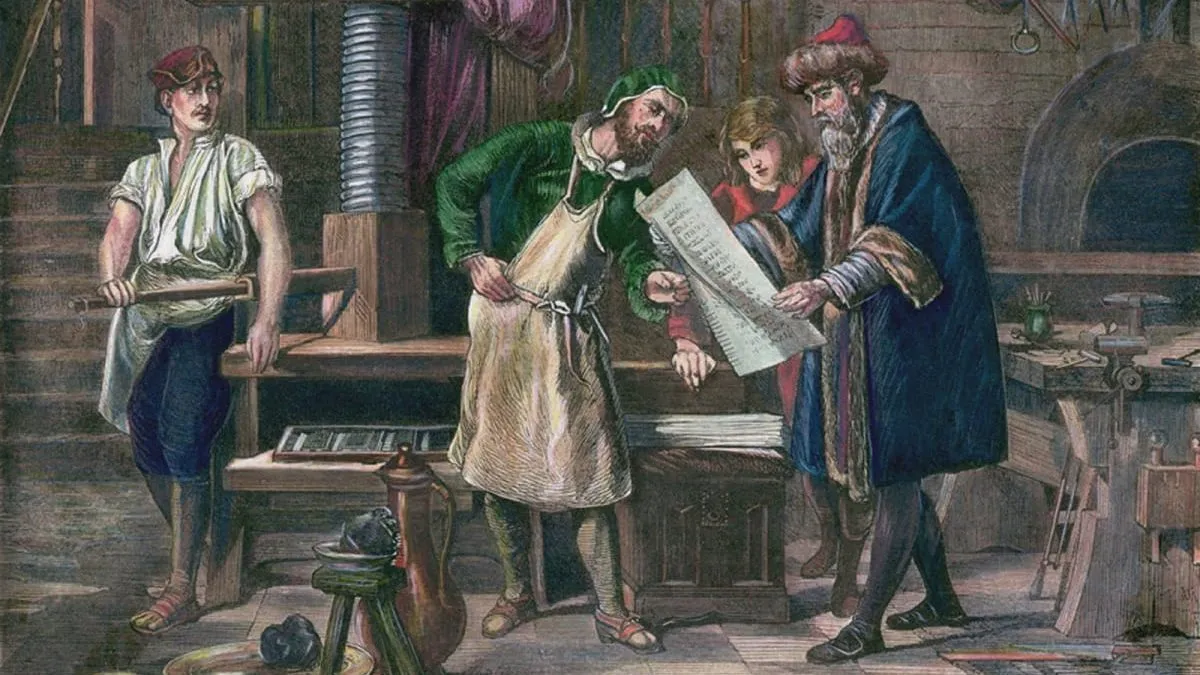
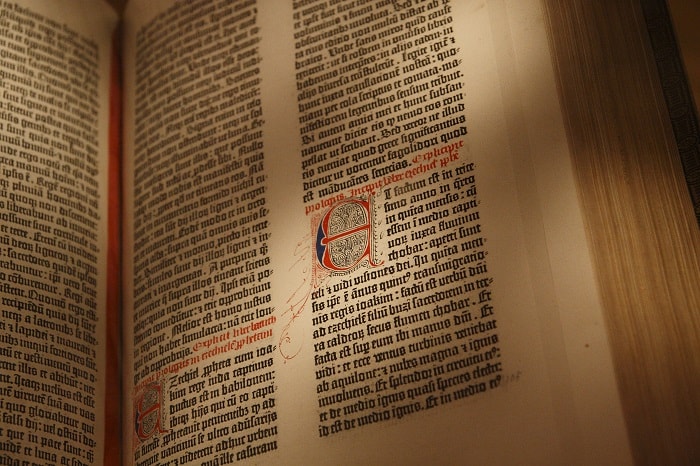
In 1448, Gutenberg returns to Mainz. He borrows money from a wealthy investor named Johann Fust (about 1400-1466) to open a printing shop. Knowing that the church is his main client, Gutenberg decides to publish the Bible. After an attempt to print some other texts, such as Latin grammar, Gutenberg began to study the Bible in 1452. The low price and high-quality printing of the Bible ensured the success of Gutenberg’s new technology, and the technology quickly spread throughout Europe. Millions of books were going to be published in 1500. Thus, Gutenberg realized the first media revolution.
Unfortunately, however, Johann Fust wanted his money back and accused Gutenberg of embezzlement. Gutenberg is told to hand over the printing equipment to Fust for the loan he borrowed. After that, Fust became a successful printer, and Gutenberg opened a small printing shop near Bamberg. Subsequently, in 1465, Gutenberg moved to a smaller city, where he was eventually appreciated for his invention and was awarded a pension. Three years later, he died blind and poor.
Roller Printing Machine
Although Gutenberg’s innovation revolutionized history in a short amount of time, printing books remained a tedious process. A large number of employees were required, and only a hundred pages per hour could be produced. With the creation of the cast-iron printing press and the introduction of steam power in the nineteenth century, printing speeds of up to a thousand pages per hour were achieved. Richard March Hoe, an American inventor, made another significant contribution to the history of printing in 1843 (1812–1886).