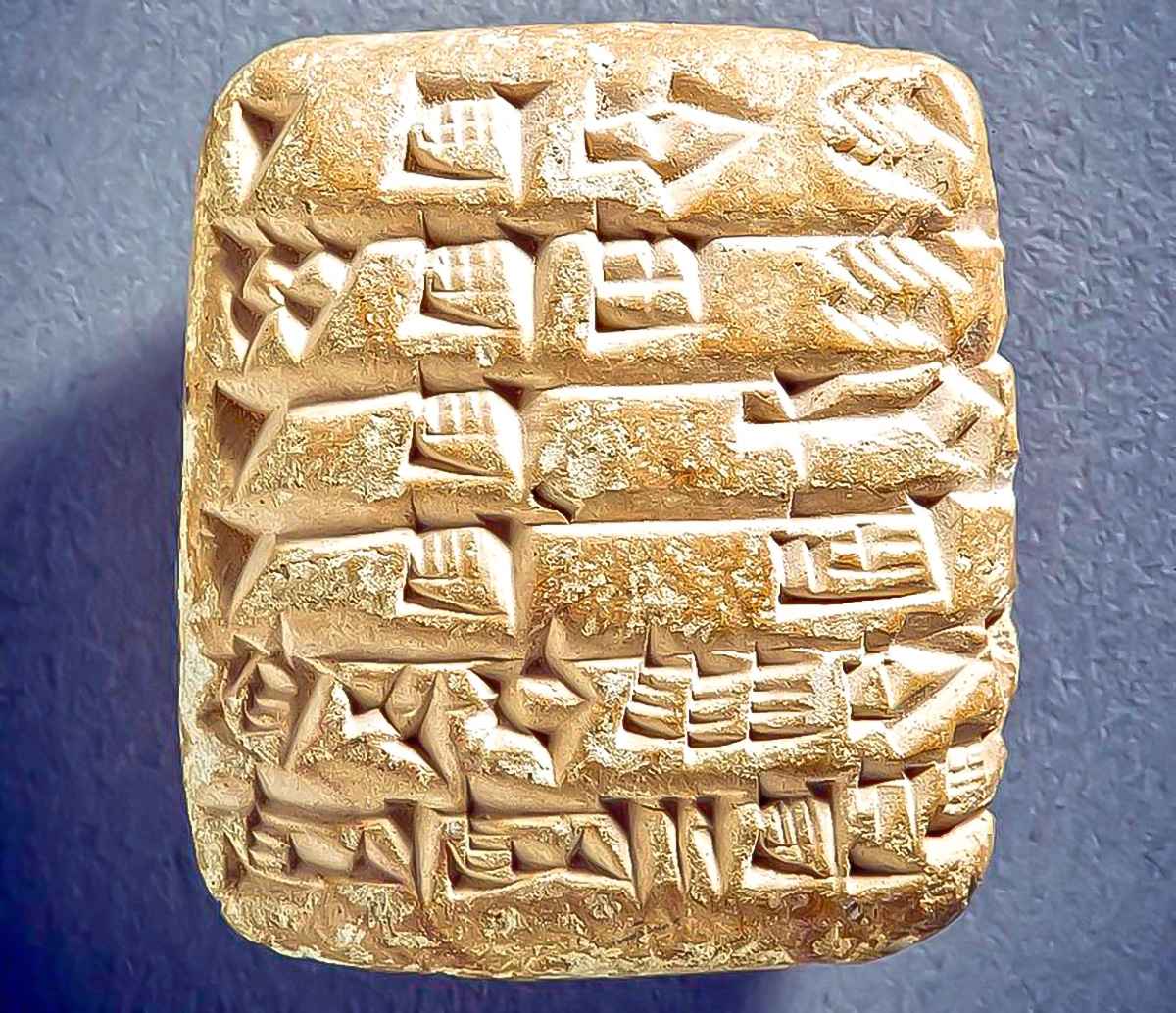
For thousands of years before the sixth century BC, the great river-valley civilizations of Egypt and Mesopotamia had accumulated impressive practical records of star positions, land-surveying geometry, and herbal medicine, yet they almost universally explained the underlying causes of natural events through the direct personal whims of the gods: a solar eclipse was a dragon devouring the sun, and an earthquake was the wrath of a subterranean deity. Then, around 600 BC along the Ionian coast of the Aegean Sea, a group of Greek thinkers initiated the single greatest intellectual revolution in human history: proposing that the universe is an orderly, predictable cosmos governed by fixed natural laws that the human mind can discover through observation, logic, and mathematics.
The Ionian Awakening: Thales, Anaximander, and Democritus
The birthplace of Western science was not originally Athens, but the wealthy maritime trading city of Miletus on the western coast of Anatolia (modern Türkiye), where Greek merchants rubbed shoulders with Babylonian astronomers and Egyptian engineers. There, Thales of Miletus (circa 624–546 BC)—hailed by Aristotle as the first natural philosopher—famously predicted a solar eclipse in 585 BC and argued that earthquakes occur not because Poseidon strikes the earth with his trident, but because the continents rest upon a subterranean ocean of water.
Thales’s pupils and successors pushed naturalistic inquiry in bold directions:
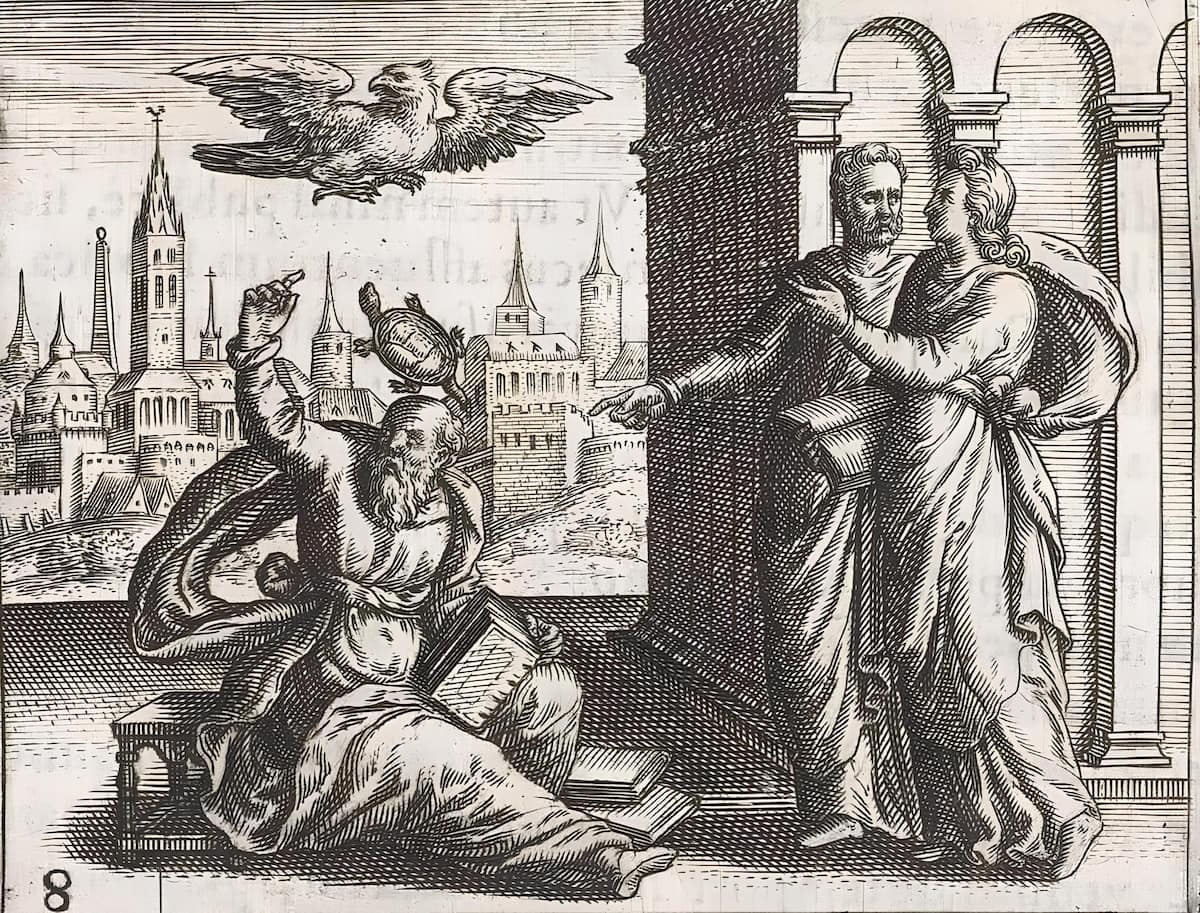
- Anaximander (circa 610–546 BC): Realized that the Earth does not sit on top of pillars or giant turtles; instead, it hangs unsupported in the center of empty space! Even more astonishingly, observing that human babies are born completely helpless compared to other mammals, Anaximander proposed an early theory of biological evolution, arguing that terrestrial life originally arose in warm primeval mud and fish-like aquatic creatures before adapting to dry land.
- Pythagoras and Mathematical Harmony: Discovered that musical pitch intervals (the octave, fourth, and fifth) obey exact mathematical ratios of string lengths ($2:1$, $4:3$, $3:2$), convincing Greek scientists that the entire universe is written in the language of numbers.
- Leucippus and Democritus (5th Century BC): Formulated the Atomic Theory more than two thousand years before modern chemistry, arguing that everything in the universe consists purely of indivisible microscopic particles called atomos (“uncuttable”) moving through empty void.
Hippocrates and Aristotle: Separating Medicine and Biology From Magic
In the fifth century BC, the physician Hippocrates of Kos and his school liberated clinical medicine from superstition. In their landmark treatise On the Sacred Disease—written about epilepsy, which everyone in the ancient world blamed on demonic or divine possession—the Hippocratic author declared boldly that epilepsy is no more “divine” than any other illness; it is a natural physiological disorder of the brain with a natural cause and natural treatment.
A century later, Plato’s greatest student, Aristotle (384–322 BC), founded the science of zoology and comparative biology. Spending years on the island of Lesbos wading into lagoons with fishermen to dissect over five hundred species of marine animals, birds, and mammals, Aristotle correctly classified whales and dolphins as air-breathing mammals rather than fish, documented the placental-like reproduction of dogfish sharks (a fact nineteenth-century biologists doubted until they rediscovered he was right!), and established the formal rules of deductive and inductive logic.
The Hellenistic Pinnacle: Euclid, Archimedes, and Eratosthenes
Following the conquests of Alexander the Great (who brought surveyors and naturalists on his campaigns), the center of Greek science shifted to the Library and Mouseion of Alexandria in Ptolemaic Egypt, unleashing three centuries of breathtaking mathematical and mechanical breakthroughs:
- Euclid (circa 300 BC): Compiled the thirteen books of the Elements, building all plane and solid geometry from five simple axioms—the most successful textbook in human history.
- Aristarchus of Samos (circa 310–230 BC): Eighteen hundred years before Nicolaus Copernicus, Aristarchus calculated that the Sun is vastly larger than the Earth and proposed the first heliocentric model of the solar system, placing the Sun at the center and arguing that the Earth orbits the Sun once a year while rotating on its axis once a day!
- Eratosthenes of Cyrene (circa 240 BC): Serving as Chief Librarian of Alexandria, Eratosthenes not only knew the Earth was a sphere, he measured its exact circumference using a stick and geometry! Learning that at noon on the summer solstice the sun shone straight down to the bottom of a deep vertical well in Syene (modern Aswan) with zero shadow, he measured the seven-degree shadow angle of an obelisk 500 miles north in Alexandria at that exact same hour—calculating the circumference of the Earth to within roughly one to two percent of modern satellite measurements.
- Archimedes of Syracuse (circa 287–212 BC): The supreme physicist and engineer of antiquity, who discovered the laws of buoyancy and hydrostatics (“Eureka!”), calculated a remarkably precise value for $\pi$ using the method of exhaustion (the precursor to integral calculus), invented the compound pulley and the Archimedes water-screw, and designed war catapults and claw cranes that lifted Roman warships out of the harbor.
- Hipparchus, Ptolemy, and the Antikythera Mechanism: Hipparchus invented trigonometry, cataloged 850 stars, and discovered the 26,000-year wobble of Earth’s axis (the precession of the equinoxes). And in 1901, when sponge divers off the Greek island of Antikythera pulled a corroded bronze box from a first-century BC shipwreck—the Antikythera Mechanism—modern X-ray tomography revealed a hand-cranked analog mechanical computer containing over thirty precision-cut bronze differential gears that calculated the orbits of the planets, the phases of the Moon, and solar eclipses to the exact day, proving that ancient Greek engineering had reached the threshold of the clockwork industrial age.