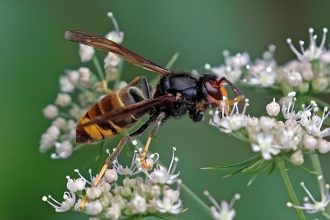
An ant mill is a phenomenon where a group of migrating ants loses their pheromone trail, becoming separated from their colony. In their search, they create their own trail, resulting in a circular movement. Eventually, the majority of ants in such a circle die due to exhaustion. This phenomenon is rare in nature but has been replicated in laboratories and appears in simulations of ant colonies. Similar occurrences have been observed in processionary caterpillars and fish.
Discovery of the ant mill
In 1910, the American myrmecologist William Morton Wheeler described a case he observed in the laboratory of a spontaneously formed ant circle that lasted for 46 hours. However, the first documented description of an ant mill dates back to 1920 by William Beebe. While exploring the Guyana jungle for the New York Zoological Society, later known as the Wildlife Conservation Society, Beebe encountered a group of wandering ants.
Upon seeing the ants, belonging to the genus Eciton, the next morning, he followed their trail and discovered it formed a closed circle, sometimes as wide as six rows. Beebe was astonished by this revelation and retraced the trail to confirm it. The circle measured 1210 feet (370 meters) in circumference, and by measuring the ants’ average speed, Beebe estimated it took them about two and a half hours to complete the circuit.
American animal behavior scientist Theodore Christian Schneirla (1902–1968) explained the phenomenon in 1944. Drawing from prior research on ant behavior, Schneirla concluded that the circular movement resulted from the chemicals left behind by ants, later identified as pheromones, which caused the ants to follow each other. A circular motion occurs when the leading ants lose the trail of the column and then rediscover the followers’ trail, akin to a tracker following their own footprints.
Schneirla also noted that a similar phenomenon was described as early as 1896 by Fabre, who observed a similar circular motion in the caterpillars of the silkworm.
Cause of the Phenomenon
The presumed explanation for the ant mill phenomenon is the pheromone trail that ants of certain species, engaged in group food gathering, mark on the soil surface during foraging expeditions. The goal is to facilitate a quick and efficient journey to the food source and back to the ant nest.
Using their antennae, located close to the ground, ants perceive the direction and intensity of the odor and strictly follow the pheromone trail.
At some point, due to various reasons, a malfunction occurs in the ant’s algorithm, causing it to start walking in a closed circle, leading its fellow ants into a deadly procession when they encounter its trail. A possible reason for the malfunction is that the food raid, in some cases, lasts too long, and by the time the ant returns home, the scent of the pheromone trail has dissipated.
As a result, halfway through the journey, the ant deviates from its course and turns several times, only to immediately encounter its own trail again. Newly emitted pheromones have the strongest scent, and the ant repeats the cycle along the recently created trajectory.
Small “whirls” occur in terrain of almost any type and are most common where two ant trails pass close to each other or intersect. However, a phenomenon similar to the one described at the beginning of the article occurs only in a large open area without particularly significant irregularities.
Evolution
Kinship
The occurrence of ant mills is known only to migrating ants. In the 20th century, it was assumed that the species exhibiting this behavior did not share a common ancestor where this behavior could have originated. It involved three lineages: Aenictinae and Dorylinae in the Old World and Ecitoninae in the New World, and it was believed to have independently evolved in each of these lines. From 2003 onward, it became evident that the kinship between these lines traced back much further, up to 105 million years ago. Therefore, there could indeed have been a shared ancestor before the complete separation of the Gondwana continent. As of 2023, all three groups are classified under Dorylinae.
Persistence
In their natural habitat, ant mills are rare due to variations in terrain, where migrating ants occasionally lose their trail, breaking the circle. When such natural obstacles are absent, for example, in a laboratory or on a sidewalk, the formation of an ant mill is almost inevitable.
Because ant mills are infrequent in nature, there is not much evolutionary pressure to eliminate this phenomenon. However, it is noteworthy that an evidently harmful behavioral pattern could persist for over a hundred million years. Explanations lie in two behavioral factors and the reproductive strategy:
The nomadic lifestyle and food-catching habits of migrating ants create a strong evolutionary pressure toward unconditional collective behavior. An ant isolated from the migrating column is nearly doomed, and an individual can hardly secure food alone, as migrating ants primarily hunt prey much larger than themselves.
Additionally, there is the reproductive strategy: unlike many other ants, migrating ants have queens that do not fly, resulting in slow evolution. Due to this combination, there are few evolutionary opportunities and little pressure to eliminate the detrimental collective behavior.