Sometime around 1887, on a rainy day, the modern tire’s narrative starts with young Johnny on a tricycle. The nine-year-old kid was dominating his bigger schoolmates in a bicycling competition once again. But on his slow and ungainly tricycle, he wasn’t able to show his full potential. Johnny’s metal rims were rattling on the cobblestone streets of Belfast because the strong rubber bands he had put around his three wheels were too thin.
The background
Johnny, being a typical nine-year-old, walked glumly to his father after the latest humiliation to complain about it. Johnny was wondering whether there was any way to smooth down the ride on his shaky trike. If the father John could only loosen a screw here and remove one there, maybe the bike would go quicker and Johnny could show it to his schoolmates.
Johnny’s dad was a veterinarian in Belfast. Until now, he had never even sat on a bicycle, but that was about to change. From that day on, Johnny’s dad began experimenting with pneumatic rubber tires, which would make his name renowned across the globe and revolutionize the cycling industry with the “Dunlop tires.”
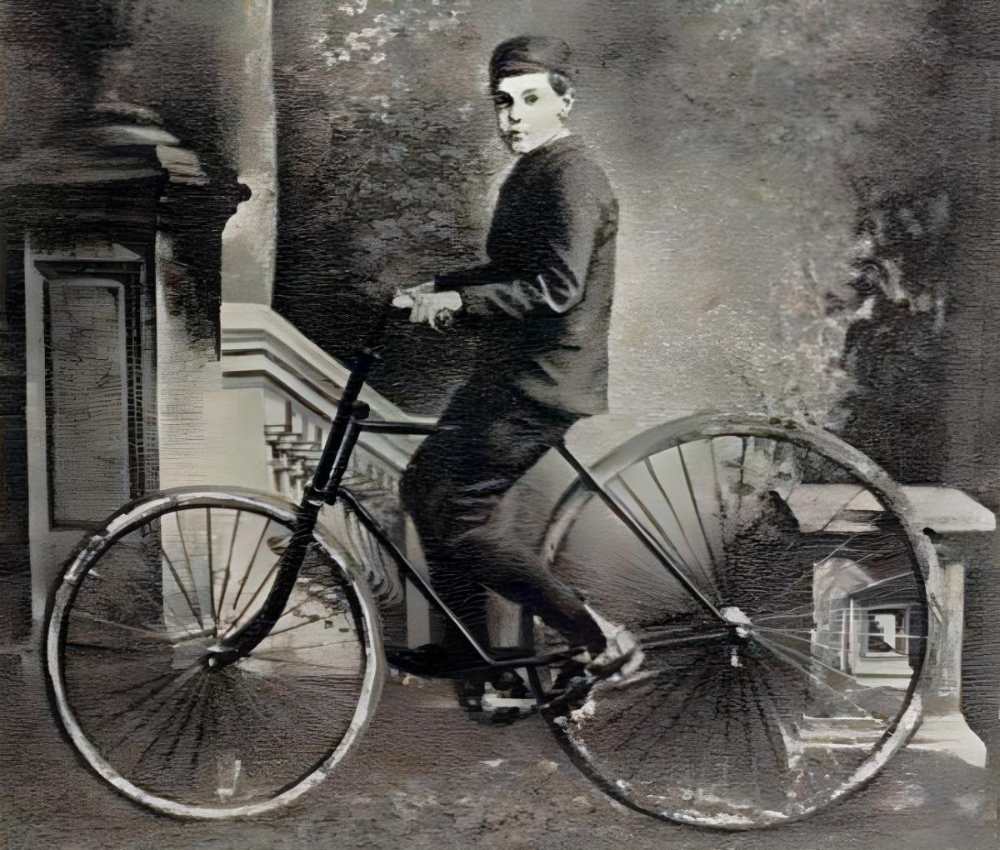
In 1888, John Boyd Dunlop was granted a patent for the pneumatic tire he invented. Official document number 10,607 claimed that Dunlop’s innovation would help to facilitate the movement of wheeled vehicles, particularly those of the lighter class like bicycles, ambulances, and hospital chairs. In a few short decades, millions of vehicles would have used his tires. But foremost, Dunlop had to fix up his kid’s tricycle.
According to John Dunlop’s notes, the inventor had been musing about the concept of the air-filled wheel for at least 20 years prior to its actual creation. While Dunlop conducted experiments around this period, no records of them survived.
One thing that is known for sure is that Dunlop used rubber extensively at his veterinarian clinic and that he even fashioned some of his own tools out of the material. Dunlop reasoned that there must be a solution for the wooden or metal wheels as well, and he hastily started gluing a hose to a thin rubber plate. He used pieces of the finest linen fabric to encase the tube. It has been stated that Dunlop inflated his tires using an old pacifier as the valve.
Rather an unpleasant job
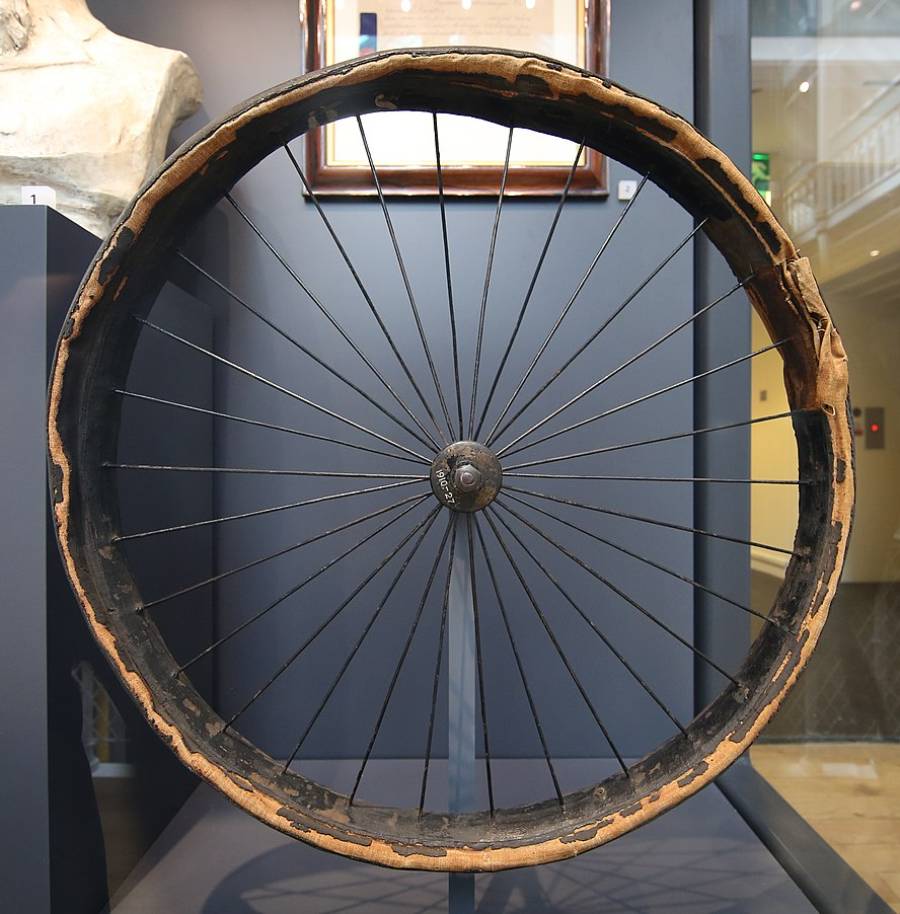
Dunlop made some adjustments to the design for the second rear wheel using the same blueprint. However, the front tire still had a layer of hard rubber on it, perhaps because the creator didn’t find much use for it. He wrote in his journal, “I did not feel it necessary to mount a pneumatic tire on the front wheel, since wheel building was rather an unpleasant job for me anyway, and I would have liked to keep the experiment private.”
Dunlop’s goal did take hold following Johnny’s maiden test ride on February 28, 1888, and his first triumph over his schoolmates. Robert William Edlin, a bicycle mechanic from Belfast, saw the tire as nothing less than the future of his company, and quickly joined Dunlop.

The bicycle manufacturer pounded the streets of Belfast almost every day. Dunlop said in his memoirs that on one of Edlin’s test rides, the cops pulled him over for going too fast. Edlin and Dunlop’s son drove this first practical pneumatic tire prototype for 60 miles. Next, Dunlop followed Edlin’s suggestion and applied for a patent on his invention. Patent No. 10,607 was issued for the invention of this new pneumatic tire.
Before the invention of pneumatic tires, the first rubber tires were solid pieces of rubber without air within them. R. W. Thomson, a Scottish engineer, received a patent in 1845 for the first pneumatic tire in history, and Dunlop developed it further in 1888.
The pneumatic tire was already invented
Number 10,607, however, should not have been granted in the first place since a Scotsman named Robert William Thomson had previously submitted a patent application for an air-filled (pneumatic) tire 40 years before Dunlop. However, since there was no need for his product, Thomson’s notion was quickly forgotten, perhaps even by the authorities.
No one seemed to notice the mistake for a while, and that’s perhaps because Dunlop’s pneumatic tire didn’t get much attention in its early stages, either. Cyclists most rejoiced over this “air trick,” and a professional cycling publication, “Irish Cyclist,” jokingly queried, “Pneumatic — has something to do with air, doesn’t it?”
Dunlop’s innovation came at a perfect moment; with Carl Benz’s recent creation of the first automobile, the transportation industry was poised for radical change, and Dunlop knew precisely what to do to “smooth” things over.
The devil inside a machine
What John Dunlop needed was a public figure in advertising who would help spread the word about his concept. As the leader of the Belfast Cruisers’ Cycling Club, William Hume wasn’t exactly a noteworthy choice to represent Dunlop. Because Hume had never achieved anything noteworthy in his life.
But Hume managed to rely on the Dunlop tire’s decisive edge despite his lack of riding skill, an advantage that even Johnny came to appreciate in his own races against his schoolmates. When compared to its steel and hard rubber counterparts, the pneumatic tire was clearly the victor, providing better speed.
On May 18, 1889, Hume won the first race ever held on the new Dunlop tire in Belfast. People were still talking behind Hume’s back before the race started, wondering aloud how his unusual bicycle was going to do. During the last lap, Dunlop overheard a spectator exclaim, “There’s a devil in that machine!”
With success came problems
Everything else Hume accomplished, Dunlop did as well. During that season, Hume almost swept the board, as shown by his nine first-place finishes in eleven days at a tournament in Liverpool. Investors started pouring in almost immediately after the project was a success. It was at this point that the first discussions on a business model, and the difficulties that Dunlop faced, got underway.
After hearing about Dunlop’s extraordinary success, Irish businessman Harvey du Cros recommended forming a company with two other businesspeople. However, Dunlop was really planning to retire; the almost-50-year-old’s health wasn’t holding up too well. In the early stages of the company’s inception, “I didn’t really need any money,” Dunlop remembered. “But I guess they had talked to Mr. Edlin and gotten his opinion of the value of my invention. He must have quoted quite a large sum.”
Dunlop’s invention never made him wealthy
At long last, Dunlop Pneumatic Tyre Co. Ltd. was formally established in Dublin’s Westland Row on November 18, 1889. Dunlop, the reluctant firm founder, and namesake cared only that his company would not have to relocate from Ireland. That way, he could personally monitor the manufacturing process of the tires.
However, Dunlop was surprised by how quickly the company expanded. In its first year of operation, the Dunlop company made almost 72,800 pounds; at the end of its second year, it had earned around 526,500 pounds; and soon after, the first European mainland Dunlop branch opened in Germany.
John Dunlop, on the other hand, was never meant to benefit financially. A patent battle with the heirs of R. W. Thomson, the actual inventor of pneumatic tires, compounded the stress of being unexpectedly placed in charge of a big firm. In 1896, Dunlop sold his patent for £3,000 to his business partner Du Cros because he was revolted about working on it.