Across the vast, flat tropical grasslands of the Llanos—the open cattle-ranching plains stretching across western Venezuela and eastern Colombia—cowboys (llaneros) riding home after sunset listen closely to the night wind blowing through the tall grass. If they hear a strange, melodic whistle climbing up and down the musical scale in the dark, every single local knows the survival rule by heart: if the whistle sounds loud and right beside your ear, you are safe because the monster is far away; if the whistle sounds faint and distant in the breeze, run for your life—because El Silbón (“The Whistler”) is standing right behind your back.
The Parricide Origin Story in the Venezuelan Llanos
Born in the oral campfire traditions of nineteenth-century Venezuelan and Colombian cattle ranches (hatos) in states like Portuguesa, Barinas, Cojedes, and Apure, the legend of El Silbón begins as a gruesome cautionary tale about spoiled arrogance and filial impiety. According to the classic folklore account, the Whistler was once a spoiled, cruel, hot-tempered young boy or teenager who demanded that his parents cook him a dinner of roasted deer entrails (venison viscera).
Wanting to please his son, the boy’s father rode out into the savanna with his rifle and spent hours hunting in the heat, but failed to find a single deer and returned home empty-handed at dusk. Instead of thanking his father for trying, the spoiled son flew into a murderous rage:
- Grabbing a hunting knife, the boy murdered his own father, cut open his father’s chest and abdomen, removed his father’s liver and heart, and carried the meat home to his unsuspecting mother in the kitchen, telling her it was fresh deer meat to cook for his supper.
- As the meat simmered in the pot, however, the mother grew suspicious because the tough flesh refused to soften no matter how long it boiled, and quickly realized the horrific truth.
The Grandfather’s Whip, the Chili Pepper Rub, and the Dog Tureco
When the boy’s stern grandfather learned of the parricide, he did not kill the boy; instead, he inflicted a punishment designed to curse his soul for all eternity. Ordering his farmhands to tie the boy tightly to a wooden hitching post in the yard, the grandfather took a braided rawhide cattle whip (mandador) and lashed the boy’s back until the flesh was raw and bleeding.
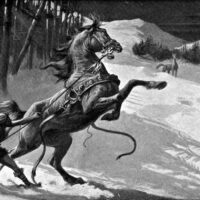
After washing the open wounds with fiery aguardiente (sugarcane liquor) and rubbing handfuls of crushed, burning-hot ají chirel chili peppers directly into the cuts, the grandfather stuffed the remains of the murdered father’s bones into a dirty burlap sack, tied the sack onto the boy’s bleeding back, and released a ferocious hunting dog named Tureco (or Perro de Agua, the “Devil Dog”) to chase him into the wilderness, pronouncing the eternal curse: “Eso no se le hace a su padre… Maldito eres para toda la vida!” (“You do not do that to your father… Cursed are you for all of life!”).
The Seven Musical Notes and Counting Bones on the Porch
Condemned to wander the Llanos forever as a towering, skeletal ghost—described as an impossibly thin giant standing nearly twenty feet tall in a wide-brimmed straw llanero hat, whose head reaches the treetops when he stands and whose knees rise above his head when he sits on a porch—El Silbón carries his burlap sack of bones over his shoulder, producing a dry, rattling clack-clack-clack with every step.
His signature weapon of terror is his deceptive seven-note whistle, which slowly climbs the musical scale from low to high and back down: C, D, E, F, G, A, B (do, re, mi, fa, sol, la, si):
- The Inverse Distance Trick: To disorient his victims—specifically drunkards, unfaithful husbands (mujeriegos), and lone night riders—his whistle reverses the laws of acoustics: sounding thunderously close when he is miles away across the plain, and fading to a barely audible whisper the exact second he leans over your shoulder to suck the navel blood or break the bones of a drunken traveler to add to his sack.
- Counting Bones at Midnight: On rainy nights during May, El Silbón sometimes sits down invisible on the front patio of a ranch house, unties his sack, and counts his bones out loud one by one onto the tiles. If someone inside the house hears him counting the bones, they will remain completely unharmed; if nobody in the house wakes up and hears him before dawn, one member of the family will die before sunrise.
- The Only Three Defenses: According to Llanero lore, no bullet can harm El Silbón, because he is already dead. The only three things on Earth that terrify him and send him fleeing screaming into the night are the memories of his grandfather’s torture: the sharp crack of a leather whip, a handful of hot chili peppers, or the bark of a dog!