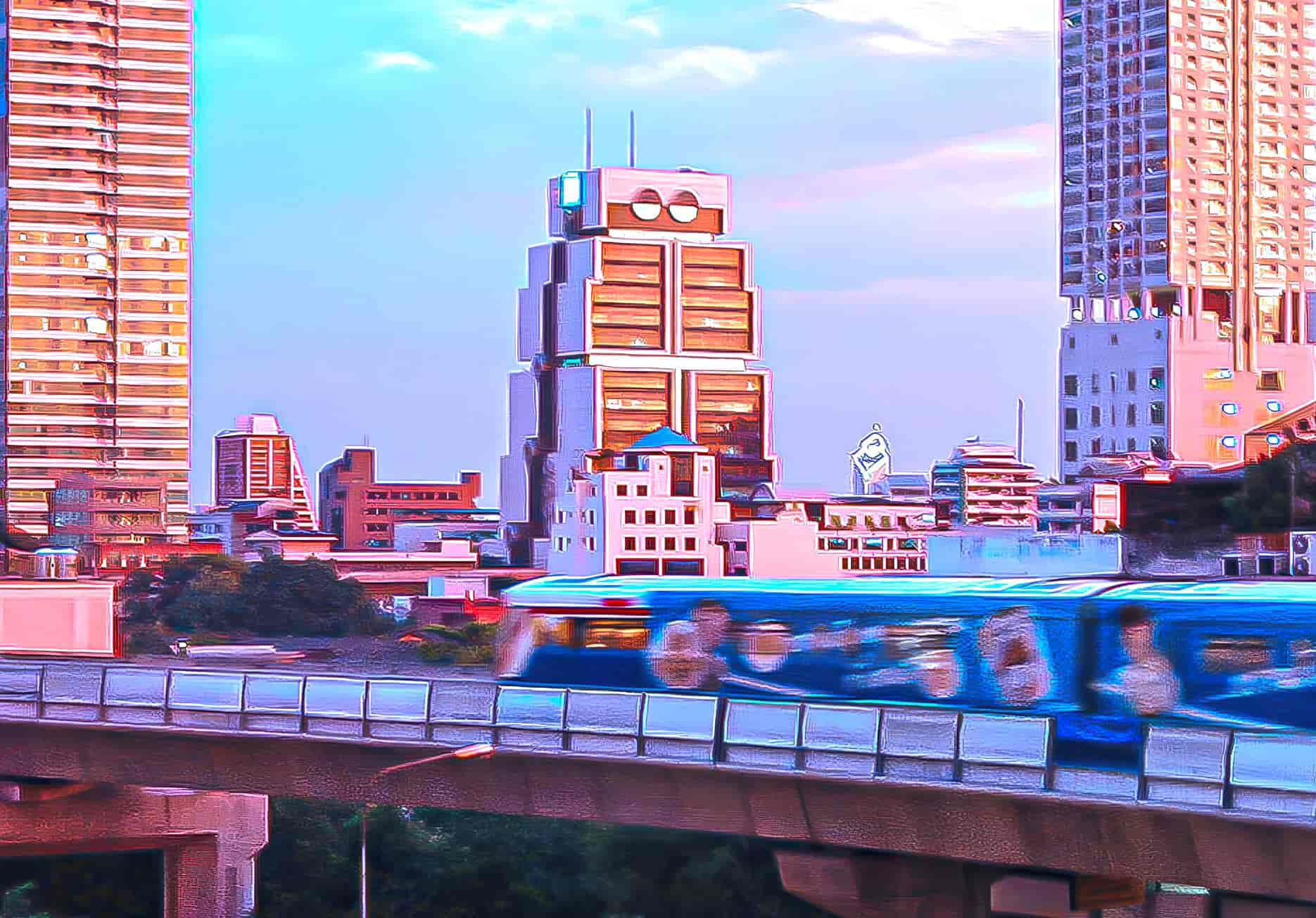
Rising three hundred and thirty-five feet above the bustling highway traffic of northern Bangkok’s Chatuchak district stands one of the most unmistakable, whimsical, and polarizing landmarks of modern Asian architecture: the Elephant Building, known locally in Thai as Chang Building (Tuk Chang). Spanning thirty-two stories across three interconnected high-rise towers bridged by a massive multi-story horizontal penthouse, this gleaming cream-colored skyscraper was purposefully engineered to replicate the blocky silhouette of a giant standing Thai elephant—complete with two glowing circular windows for eyes, a twenty-story trunk reaching to the ground, and golden yellow tusks jutting out from the facade.
Dr. Arun Chaiseri and Architect Sumet Jumsai’s Vision in 1997
Completed in 1997 right at the height of the late twentieth-century Southeast Asian construction boom, the Elephant Building was the brainchild of two towering figures in Thai design and engineering: real estate developer and structural engineer Dr. Arun Chaiseri—a passionate collector of miniature elephant sculptures who viewed Thailand’s national animal as the ultimate symbol of royal heritage, strength, and good fortune—and the Cambridge-educated Thai architect Dr. Sumet Jumsai, renowned internationally for his bold, geometric modernist landmarks like Bangkok’s Robot Building.
Rather than crafting a realistic, curvy fiberglass statue like the smaller six-story wooden “Lucy the Elephant” built in New Jersey in 1881, Sumet Jumsai approached the project through the lens of post-modern geometric abstraction. Working within a rectangular reinforced-concrete structural grid, Jumsai and Chaiseri designed a colossal mega-structure measuring one hundred and two meters (335 feet) tall and stretching one hundred and seventy meters long, proving that a high-tech commercial office and residential complex could simultaneously function as playful urban pop art that brought a smile to commuters stuck in Bangkok traffic.
How Three Towers Form the Legs, Trunk, Tail, and Tusks
Every anatomical feature of the giant concrete pachyderm serves a specific architectural and commercial function inside the sixty-thousand-square-meter complex. The massive weight of the structure is carried by three vertical thirty-two-story towers rising from a ground-level shopping mall podium. Tower A and Tower B, which house modern corporate office suites, form the thick front and hind legs of the elephant, while the narrower Tower C at the far northern end of the site serves as the animal’s long, vertical trunk extending all the way down to the street.
Spanning across the top of all three vertical towers from the twenty-fifth to the thirty-second floors is a massive, bridge-like horizontal block that forms the elephant’s torso, back, and head, housing luxury multi-level residential condominium apartments and penthouses. On the western rear facade of the hind leg tower, a vertical stack of dark tinted-glass enclosed balconies runs twenty stories down the spine to create the visual illusion of the elephant’s swinging tail. At the front of the building where the head meets the trunk, two enormous circular glass windows form the wide-awake eyes on either side of the skull, multi-story cantilevered balconies serve as the flapping ears, and two curved, golden-yellow steel-and-concrete beams project outward from the mid-level floors to form the tusks—which actually house the administrative offices of the Chaiseri management company itself.
From Architectural Controversy to Global Icon
Like Paris’s Eiffel Tower a century earlier, the Elephant Building has provoked fierce debate among architectural critics since the day its scaffolding came down in 1997. Some international design magazines periodically include Tuk Chang on lists of the world’s “strangest” or “ugliest” skyscrapers, arguing that literal animal-shaped architecture (known as zoomorphic or mimetic architecture) sacrifices sleek elegance for novelty, while residents inside the high-rise apartments joke that living *inside* the elephant is actually the best spot in Chatuchak because it is the only place where you don’t have to look at it.
Yet the global architectural community and the citizens of Bangkok have largely embraced the giant elephant with deep affection. CNNGo ranked the Elephant Building fourth among the twenty most iconic skyscrapers in the world, praising how it broke the monotonous glass-box boredom of modern city skylines by rooting a modern high-rise in unmistakable Thai cultural identity. Featured on everything from international cinema backdrops to postage stamps, Tuk Chang remains the largest animal-shaped habitable building ever constructed on Earth.