Chardin Used a Trick to Gain Recognition
During an exhibition of his paintings, the artist wanted to discreetly observe the reactions of the Royal Academy’s examiners by positioning himself in a nearby room. One of the examiners carefully studied his works, then approached Chardin and told him he had just seen some very good paintings and now wished to see his own. To this, the artist replied: “Sir, you have just seen them.”
- Chardin Used a Trick to Gain Recognition
- A Remark Pushed Him to Paint More Than Still Lifes
- He Was More Admired in the 19th Century Than in His Own Time
- Chardin Hardly Ever Left Paris
- The Artist Lived in the Louvre
- He Gradually Lost His Sight Due to Painting
- His Son Was Also a Painter
- Chardin Lost His Wife and Daughter in the Same Year
- He Was Friends with Denis Diderot
- His Son Was Kidnapped by Pirates
A Remark Pushed Him to Paint More Than Still Lifes
After Chardin mentioned to a fellow painter that any sum of money was appreciated, even for a portrait, his friend replied, “Yes, if a portrait were as easy to paint as a sausage.” This remark made Chardin deeply question himself. Fearing he would be forgotten if he only painted still lifes, he decided to start depicting scenes of everyday life.
He Was More Admired in the 19th Century Than in His Own Time
Like many artists, Chardin was not fully appreciated during his lifetime. His works, especially The Ray, were more widely admired in the 19th century. Matisse often visited the Louvre to study his paintings and even created The Buffet inspired by Chardin. Cézanne drew inspiration from his still lifes, while Proust wrote: “We learned from Chardin that a pear is as alive as a woman, that an ordinary piece of pottery is as beautiful as a precious stone.”
Chardin Hardly Ever Left Paris
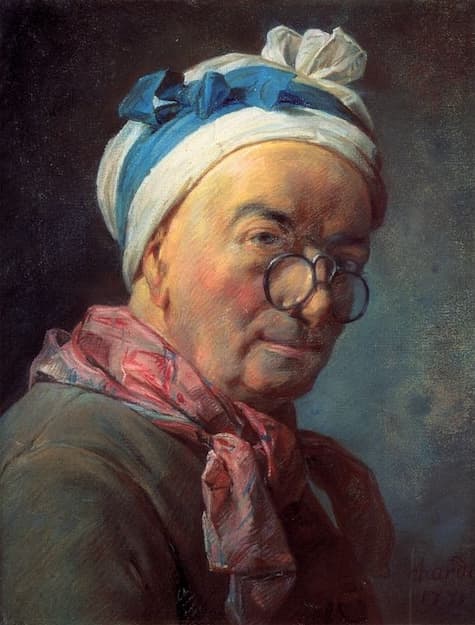
Born in Paris, Jean Siméon Chardin lived in the family home on Rue de Seine for many years. After marrying Marguerite Saintard, he moved to Rue Princesse.
He spent most of his time in the Marais district, at the Royal Academy, and at the Louvre. While many painters of his time traveled to Italy to refine their skills, Chardin remained in Paris. Even when he left Rue Princesse, it was to move into the Louvre, where he also passed away in 1779.
The Artist Lived in the Louvre
In 1755, Chardin became treasurer of the Royal Academy. Two years later, he received a letter from King Louis XV granting him the residence of S. Marteau, recently deceased, in the Louvre’s galleries. Chardin was so proud of this “promotion” that he read the letter aloud before the entire Royal Academy, as recorded in the official minutes. He moved in with his wife and had the renowned engraver Charles-Nicolas Cochin as his neighbor.
He Gradually Lost His Sight Due to Painting
From 1770 onward, Chardin’s eyesight began to deteriorate. He abandoned oil painting and turned to pastels on the advice of a fellow painter.
Chardin personally ground his pigments to achieve the colors he wanted. He then mixed them with a binding agent, but the mixture contained a significant amount of lead. This highly toxic substance likely caused progressive damage to his eyes.
His Son Was Also a Painter
Pierre-Jean Chardin was the first child of Jean Siméon Chardin and Marguerite Saintard. He was born a few months after their marriage, in November 1731. After his wife’s death in 1735, Chardin raised his son alone, who eventually became his student. Pierre-Jean furthered his training in Italy and even won the prestigious Prix de Rome in 1754. He returned to France in 1762 but went back to Italy in 1767, where he remained until his death in 1768.
Chardin Lost His Wife and Daughter in the Same Year
Some people speak of a curse when referring to the artist’s life. Chardin himself reportedly believed he was doomed. In 1735, just four years after his marriage to Marguerite Saintard, she passed away.
A few months later, their 20-month-old daughter, Marguerite-Agnès, also died—her fragile health likely worsened by the loss of her mother.
He Was Friends with Denis Diderot
Chardin was aware of the ambitious project led by d’Alembert and Diderot to create the famous Encyclopédie. Diderot, in turn, greatly admired Chardin’s works, as he understood their depth and intensity. Naturally, when they met, they became friends. Diderot often visited Chardin for tea in his Louvre apartment. In a small room near his studio, the artist would reveal to the philosopher paintings he had never shown to anyone before.
His Son Was Kidnapped by Pirates
In 1757, Jean Siméon Chardin gave his son the opportunity to study at the French Academy in Rome. However, Pierre-Jean’s time in Rome was marred by scandals that tarnished his reputation, including a dramatic incident in 1762 when he was captured by pirates. The details of this episode remain unclear—no one knows exactly how Pierre-Jean Chardin was kidnapped or how he was eventually freed.