By using this site, you agree to the Privacy Policy.
Accept
MalevuzMalevuz
  • HISTORY
  • SCIENCE
  • BIOGRAPHY
MalevuzMalevuz
Search
  • HISTORY
  • SCIENCE
  • BIOGRAPHY
Follow US
Malevuz > History > Five Elements: History and Origin
History

Five Elements: History and Origin

Hrothsige Frithowulf
ByHrothsige Frithowulf
History Editor
Hrothsige is a history writer at Malevus. He has a bachelor's in history from the University of Exeter. Hrothsige's areas of historical interest encompass the ancient...
- History Editor
7 June 2025
Share
28 Min Read
SHARE

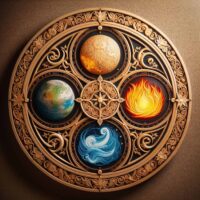
Five Metaelements (“beginnings,” elements) – one of the cosmogonic variants, a pre-scientific attempt at a universal explanation of the world. In the Western European philosophical tradition from antiquity to the modern era, the five metaelements included air, fire, water, and earth (the four primary elements of the sublunary world), as well as ether, which composed the bodies of the superlunary world (stars, wandering stars – planets, and the Sun).

In the framework of Aristotelian physics, each of these elements was attributed natural qualities and movements.

buy motilium online https://www.clerkenwellislingtonclinics.co.uk/wp-content/uploads/2025/03/jpg/motilium.html no prescription pharmacy

For instance, light elements (air and fire) were associated with upward movement, while heavy elements (earth and water) were linked to downward movement, and the superlunary ether was described as moving in a circular motion. The experimental natural science of the 17th century cast doubt on several tenets of Aristotelian physics, particularly the notions of the natural movements of elements and the inherent “lightness” of air.

The decisive blow to the concept of the five metaelements came with the chemical revolution of the late 18th century, leading to a radical rethinking of the notion of an element.

buy kamagra oral jelly online https://myindianpharmacy.net/buy-kamagra-oral-jelly.html no prescription pharmacy


buy retin a online https://www.clerkenwellislingtonclinics.co.uk/wp-content/uploads/2025/03/jpg/retin-a.html no prescription pharmacy

The previous elements turned out to be complex mixtures, often challenging to describe in new terms, and were replaced by oxygen, hydrogen, and other elements of modern chemistry. The last echoes of this concept, in the form of the theory of the world ether as a special medium for the propagation of electromagnetic vibrations, persisted until the late 19th to early 20th centuries.

In Eastern philosophical systems (India, China, Japan), there were their own notions of elements that compose the world.
More Read

leaders munich agreement 1938 min
Munich Agreement: The signature of the de facto beginning of World War II
Cleanliness and Hygiene in Ancient Roman Women
Henry Hite: The Comedian “Corn King Giant” at 7’7″
The first tanks: “Armored boxes” in World War I
buy augmentin online https://myindianpharmacy.net/buy-augmentin.html no prescription pharmacy

In the Western tradition, the Greek philosopher Aristotle added a fifth element to Empedocles’ four elements (earth, water, fire, and air), known as quintessence or ether, constituting celestial bodies. It’s worth noting Luc Besson’s film “The Fifth Element,” which depicts love as the fifth element. In Captain Planet, the fifth element is the heart, guarded by Ma-Ti.

buy amoxicillin online https://www.clerkenwellislingtonclinics.co.uk/wp-content/uploads/2025/03/jpg/amoxicillin.html no prescription pharmacy

In Hinduism, the Mahābhūta consists of:

  • Pṛthivī (earth)
  • Āp (water)
  • Tejas or Agni (fire)
  • Vāyu or Vāta (wind)
  • Ākāśa (space or ether).

In Buddhism, the Mahābhūta or dhātu includes six elements:

  • Paṭhavī-dhātu (earth)
  • Āpo-dhātu (water)
  • Tejo-dhātu (fire)
  • Vāyo-dhātu (wind)
  • Ākāsa-dhātu (space)
  • Viññāṇa-dhātu (mind).

In traditional Japanese culture, the five elements derived from Buddhism constituting the Godai are:
More Read

spanish santa claus, christmas in spain
Christmas in Spain: Traditions and Celebrations
6 Victims of a Medieval Trial
Annie Ernaux: 2022 Nobel Prize winner in literature
Mamertine Prison: Rome’s Time Capsule of Punishment
  • Chikyū (地球, earth)
  • Mizu (水, water)
  • Hi (火, fire)
  • Kaze (風, wind)
  • Sora no (空の, space or void).

In the Chinese culture transmitted to Korea and Japan, the five elements constituting the Wuxing are:

  • Chinese: 金; Pinyin: jīn; lit. “metal,” sometimes translated as gold
  • Chinese: 木; Pinyin: mù; lit. “wood”
  • Chinese: 水; Pinyin: shuǐ; lit. “water”
  • Chinese: 火; Pinyin: huǒ; lit. “fire”
  • Chinese: 土; Pinyin: tǔ; lit. “earth.”
Share This Article
Email Copy Link Print
ByHrothsige Frithowulf
History Editor
Hrothsige is a history writer at Malevus. He has a bachelor's in history from the University of Exeter. Hrothsige's areas of historical interest encompass the ancient world and early Europe, along with the history of modern culture.
Previous Article Classical Elements Four Elements Classical Elements: Four Elements and Their History
Next Article Microcosm Microcosm: History, Meaning, and Origin

Latest News

985px Landing of Lieutenant James Cook at Botany Bay 29 April 1770 painting by E Phillips Fox

Top 10: The Greatest Knights in History

Knights were the medieval equivalent of elite soldiers, and many…

List
3 November 2026
Charles Rolls driving a Peugeot 1896
List

10 of the Craziest Laws in History

For more than 4,000 years, humans have devised new laws…

18 October 2026
Ikinci Meksika Imparatorlugu
History

Why Did the Second Mexican Empire Collapse?

The Second Mexican Empire did not collapse because of a…

14 April 2026
A painting depicting Aboriginal Tasmanians attacking John Allen’s Milton Farm near Great Swanport in 1833.
History

Colonialism in Tasmania

The colonization of Tasmania was not a simple story of…

14 April 2026

You Might Also Like

The death of John Talbot, Earl of Shrewsbury, at the Battle of Castillon.
History

Battle of Castillon: The End of the Hundred Years’ War

3 October 2024
Countries That Don't Celebrate Christmas
History

All 15 Countries That Don’t Celebrate Christmas

27 October 2026
Riefenstahl with Hitler at the Nuremberg
History

What Was the Role of Women in Nazi Germany?

25 October 2026
hungary christmas santa claus
History

Christmas in Hungary: Traditions and Foods

26 October 2026
  • Privacy Policy
  • About us
  • Editorial Standards

© Malevuz. All Rights Reserved.

Welcome Back!

Sign in to your account

Username or Email Address
Password

Lost your password?