The world’s foremost authority on chimpanzees and one of the most inspirational scientists in history, Jane Goodall, was born on April 3, 1934, in London. Millions of people all across the globe have been inspired by the British lady, decades after she took the journey to Africa that altered her life. In honor of the famed ponytailed primatologist, here are interesting tidbits about Jane Goodall that you may not know.
- Jane Goodall was not destined to become a primatologist
- She has been passionate about animals since childhood
- She joined the ranks of Louis Leakey’s Trimates
- She radically altered the way we understand chimpanzees
- Controversial discoveries
- The longest field study on chimpanzees
- She was appointed United Nations Messenger of Peace
- “Every individual makes a difference”
Jane Goodall was not destined to become a primatologist
Jane, the daughter of an engineer and a writer, had to abandon her high school education in 1952 due to financial constraints. So, she enrolled in secretarial school and has since worked as a typist at Oxford University and at a documentary film studio. Her life was altered in May of 1956 when she visited a friend in Kenya.
She has been passionate about animals since childhood
Since she was very little, Jane has always had a deep love for all kinds of animals. Her father got her a teddy chimpanzee that she called Jubilee when she was two years old. Later on, when she was curious about where eggs came from, the small girl would often spend hours hiding out in the chicken coop.
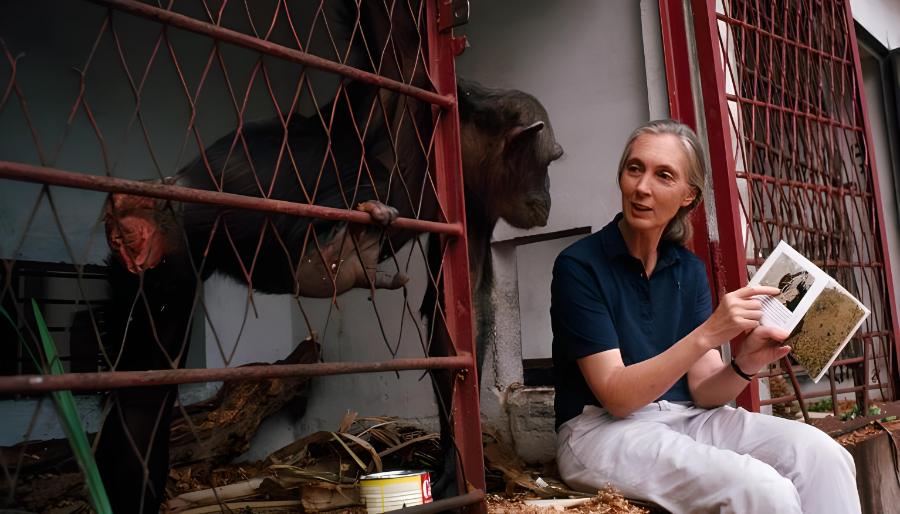
Jane has often referred to her dog, Rusty, as her first and greatest instructor. Yet, she felt the same way about the wild creatures. As a result, she started fantasizing about traveling to Africa to study the local fauna for a book. She didn’t think twice about accepting her friend’s invitation to visit Kenya. During this journey, she met the guy who would forever alter the course of her life.
She joined the ranks of Louis Leakey’s Trimates
Jane Goodall met the renowned anthropologist and paleontologist Louis Leakey during her time in Kenya. He was so impressed with her that he hired her to accompany him on a second journey to Africa, this time to the country of Tanzania, to hunt for fossils.
The anthropologist suggested that Jane undertake a more extensive trip to research chimpanzees in Gombe National Park, Tanzania, in 1958. Jane, at 26 years old—the first of the “Trimates”—and her mother Vanne were to arrive there in July 1960. The anthropologist enlisted the help of three young women to do research on the great apes: Jane Goodall for chimpanzees, Dian Fossey for gorillas, and Biruté Galdikas for orangutans.
She radically altered the way we understand chimpanzees
Understanding chimpanzees required extensive fieldwork in their native habitat. The creatures were evasive, and the circumstances remained challenging. However, Jane Goodall’s studies eventually paid off. Although chimpanzees were traditionally supposed to be vegetarians, a young lady spotted them hunting and eating meat throughout the autumn.
A few weeks later, she saw one of the people use a tool to remove termites, something she had always assumed only humans could do. This is still one of Jane Goodall’s most significant findings. In her work, she showed that chimpanzees engage in sophisticated social interactions, have personality traits, and feel and convey emotions. The findings have altered our perception of distant relatives.
Controversial discoveries
Jane Goodall has been dogged by criticism of her study methods and conclusions since she first began pursuing them. Skeptics pointed out that she lacked formal science education as a major reason to doubt her competence. The primatologist, however, believes that her lack of experience is what enabled her to see chimpanzees in a new light.
Experts at the time were eager to criticize her work because it challenged long-held beliefs not just about chimpanzees but also about what it meant to be human. Some people questioned her because she used a different technique than the standard procedures needed and because she gave the chimps names instead of numbers.
Jane Goodall spent her time in Tanzania rectifying her deficiencies in scientific education. She pursued graduate studies in ethology (the study of animal behavior) at Cambridge University, from which she graduated with a doctoral degree in 1965.
The longest field study on chimpanzees
After starting out as a young lady studying chimpanzees in their natural habitat, Jane Goodall’s work eventually took on a new meaning. The primatologist established the Gombe Stream Research Center in 1965 to carry on studies of wild chimpanzees. Since then, several researchers have visited the institution, which is supervised by a team from Tanzania.
Now, more than half a century later, it has been officially acknowledged by Guinness World Records as the longest field research ever undertaken on chimpanzees in their natural context. There were almost 165,000 hours of observation data recorded as of 2018. Jane Goodall has established many groups to protect chimpanzees from illegal trade and hunting.
She was appointed United Nations Messenger of Peace
Jane Goodall’s dedication to conservation and protecting the environment, as well as her extensive study, have both been recognized with multiple prizes. The primatologist was honored with the title of “United Nations Messenger of Peace” in 2002. She became a Dame Commander of the British Empire two years later. Besides the Unesco Gold Medal, she is also the recipient of France’s Legion of Honor and Japan’s famous Kyoto Prize.
“Every individual makes a difference”
Despite taking a break from studying chimpanzees, Jane Goodall is still actively working to protect wildlife and the natural world. She travels the equivalent of three centuries every day to give talks on the plight of chimpanzees and other creatures and the state of the planet’s ecosystems. The Jane Goodall Institute has been active since 1977 and has branches in more than 25 countries to help conserve animals and their habitats from a variety of dangers, including great apes.
Also existing since 1991 is Roots & Shoots, an exceptional youth program. Jane Goodall’s mission in life is to spread the word that “Every individual matters. Every individual has a role to play. Every individual makes a difference.”
The primatologist Jane Goodall has authored several books, the most well-known of which being Living Chimp Style. Also in 2017, a great documentary called Jane was made about Jane Goodall’s travels through Africa. It was directed by Brett Morgen and used historical footage from the National Geographic Society.