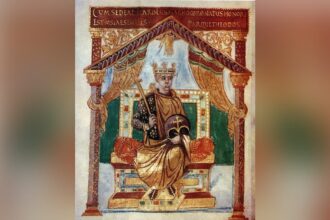
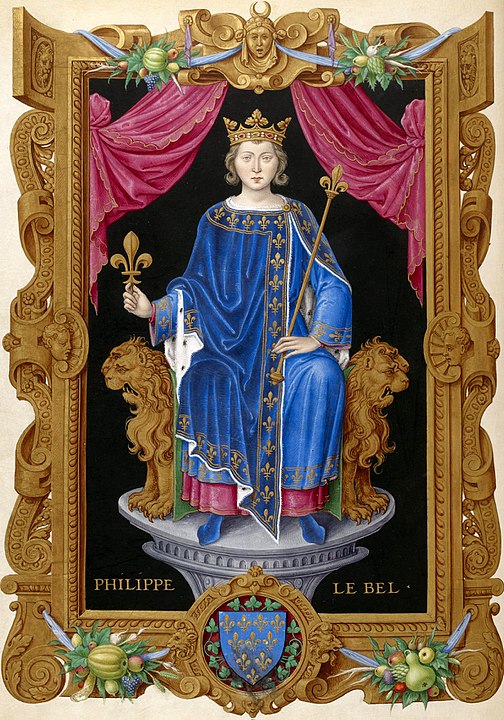
Philip IV, known as “the Fair,” king of France from 1285 to 1314, earned his nickname due to his immense stature and the beauty of his impassive face. The French prelate Bernard Saisset described him as “He is neither man nor beast. He is a statue.” His reign is considered by historians to be one of the most significant yet perplexing periods.
Alongside Philip Augustus and Louis XI, he played a crucial role in shaping French unity. An enigmatic personality, perhaps a mere instrument in the hands of his legal advisors, the legists, Philip the Fair ruled over a strong and centralized state. He demonstrated uncompromising resolve against the Templars, coveting their wealth, leading to their condemnation and the dissolution of their order.
The Promising Beginnings of Philip IV of France’s Reign
Son of Philip III the Bold and Isabella of Aragon, Philip IV ascended to the throne at the age of seventeen. Through his marriage to Joan of Navarre in 1284, he received Champagne and Navarre, becoming the first to bear the title “King of France and Navarre.” While the acquisition of Navarre was temporary, Champagne became a permanent possession. The young king promptly ended futile wars against Aragon through the treaties of Tarascon and Anagni in 1291 and 1295, respectively.
In anticipation of the Hundred Years’ War, Philip IV initiated the invasion of Guyenne (1294–1299) against England and later restored it to Edward through the Treaty of Montreuil (1299). This peace was solidified by two marriages: his sister Margaret to Edward I and his daughter Isabella to Edward’s son.
Little did anyone foresee that, with Philip the Fair having three sons, this dual alliance would grant English kings claims to the French crown, sparking a century-long conflict. Peace was restored in 1303 through the Treaty of Paris.
Attempting to annex Flanders, Philip IV imprisoned Count Guy de Dampierre in 1295, confiscating his fief and appointing a French governor. The tyranny of this governor led to a fierce uprising in Bruges known as the Bruges Matins (17–18 May 1302). The Flemish communes decimated the French army at the Battle of Courtrai, also called the “Battle of the Golden Spurs” (July 11, 1302). The king did not directly participate, likely saving his life.
However, he engaged in the Battle of Mons-en-Pévèle (18 August 1304) and emerged victorious, enabling the acquisition of Lille, Douai, and Béthune through the Peace of Athis-Mons (June 1305). From Otto of Burgundy, the king received the County of Burgundy, present-day Franche-Comté, in March 1295, arousing discontent among the Comtois nobility. Philip the Fair’s most significant acquisition was the permanent attachment of Lyon (formerly under the Holy Roman Empire and later under the Church) to France in 1312, reflecting territorial expansion to the east.
Conflict with the Pope and the Anagni Attack
Philip IV, pious yet anticlerical, opposed papal interference in French affairs. Conflict arose with Pope Boniface VIII over the unauthorized levying of tithes on the clergy and the arrest and condemnation of Bernard Saisset, the Bishop of Pamiers. Papal bulls emphasizing pontifical theocracy heightened tensions, prompting Philip IV to convene the first Estates-General (1302-1303), which strongly supported royal policy.
Supported by public opinion, Philip IV challenged the validity of the pope’s election and demanded his deposition. In response, Boniface VIII imposed an interdict on the Kingdom of France and released the French from their oath of loyalty to the sovereign. The dispute reached a point of no return. Philip IV, advised by his influential legal counsel, Guillaume de Nogaret, decided to go further and have the pope arrested in Italy. Nogaret spearheaded the operation.
Departing secretly from France, he coordinated in Tuscany with Boniface’s Italian enemies, including Sciarra Colonna, head of the powerful Colonna family. Leading an armed band, they reached the small town of Anagni, where the pope spent the summer. On September 7, they entered the city shouting “death to the pope, long live the king of France.” Boniface, abandoned by all, clad in pontifical attire with a crucifix in hand, awaited death when arrested by Nogaret.
Contrary to legend, he was not struck but threatened and insulted. Nogaret reminded the pontiff of the accusations against him and attempted to take him prisoner. Protests erupted as insults were hurled at the elderly pope and his displayed courage won sympathy from the people of Anagni. On September 9, Nogaret and his men fled the city. Boniface was escorted back to Rome. However, deeply affected by the humiliation, exhausted, and partially deranged, he died on October 11.
Subsequently, the king orchestrated the election of a French pope, Clement V, who established himself in Avignon in 1309. This solution, initially intended as temporary, persisted for three-quarters of a century, putting an end to the conflict.
Philip the Fair’s Reforms
Under the influence of legal scholars, especially Pierre Flote, Guillaume de Nogaret, and Enguerrand de Marigny, monarchical centralization intensified through the specialization of the royal court into judicial sections (the Chamber of Inquiries and the Chamber of Requests) and financial sections (the Chamber of Finances, especially the Chamber of Accounts, created de facto after he died in 1320). He establishes the Parliament in Paris and creates the Grand Council to assist in political decisions.
A significant innovation is his use of popular consultation through assemblies of barons, prelates, consuls, aldermen, and mayors of municipalities, foreshadowing the Estates-General. He convenes the Estates-General several times to ensure support for his policies.
However, the most challenging issue to tackle is that of finances, as the king can no longer govern solely with the revenues from the royal domain. Philip the Fair seeks to address this by attempting to impose regular taxes, heavily taxing Jews (expelled in 1306) and Lombards, and implementing monetary changes, earning him the reputation of a counterfeiter. He introduces the maltôte (bad tax), a property tax, and the gabelle, a tax on commodity sales, particularly salt.
The Templar Affair
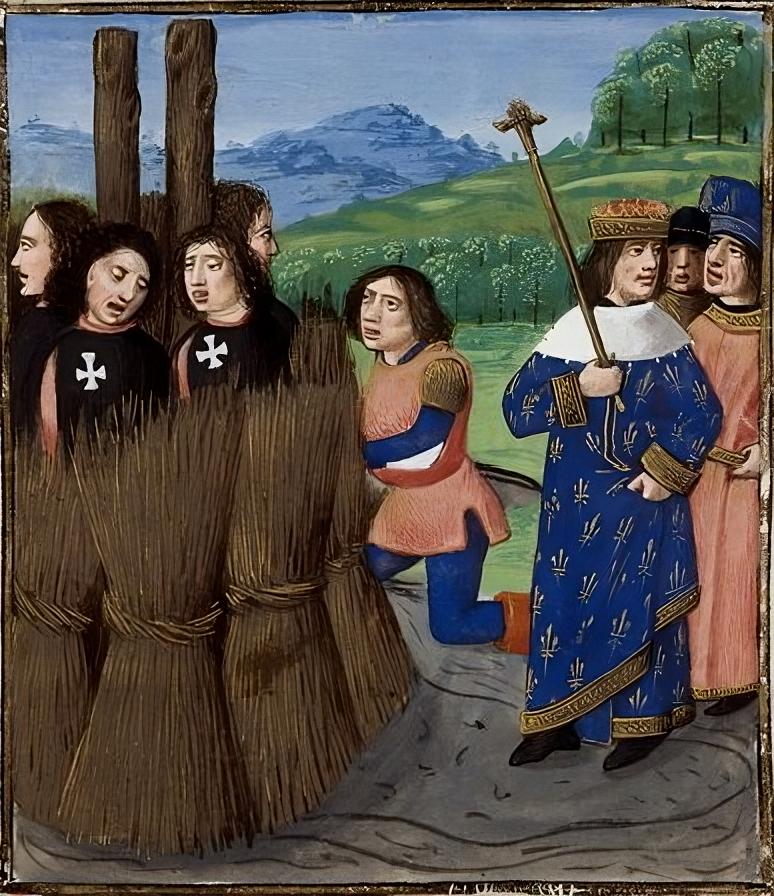
The most spectacular, if not the most lucrative, financial operation targeted the Templars. For over a century, the treasure of the Order of the Temple in Paris had become the true financial center of the monarchy. The wealth of the Templars aroused the desire of the king and his entourage, even as the state coffers remained constantly empty. Additionally, the Templars had become unpopular, accused of retaining their temporal and financial power in the West while failing to defend the Holy Land, to which their institution was dedicated. Furthermore, the highly mysterious functioning of the Order gave rise to numerous legends fueled by slander and popular vindictiveness.
Philip the Fair, advised, if not manipulated, by Guillaume de Nogaret, seized upon this unpopularity, knowing he would have public opinion on his side. The trial of the Templar Order and the confiscation of its wealth were decided and prepared by the king’s council in utmost secrecy. On October 13, 1307, all Templars residing in the kingdom were arrested and charged, starting with the Grand Master Jacques de Molay. This initiated a very lengthy trial that culminated in a council convened in Vienne in 1311, leading to the suppression of the Order by a papal bull on April 3, 1312.
During these five years, Pope Clement V was hesitant and filled with scruples. He was not convinced of the guilt of the Templar Order. However, he lacked the strength to resist the uncompromising and even threatening King of France. He eventually capitulated, abandoning the order to its sinister fate.
The Templars defended themselves poorly. In England, Germany, and Spain, investigations found no capital crimes against them. However, in France, subjected to the most atrocious tortures by the Inquisition, they renounced their defense and confessed to whatever was demanded of them. The key dignitaries were also very inept and, through their intransigence, led to the downfall of most of their brethren.
The Grand Master Jacques de Molay and the Commander of Normandy, Geoffroy de Charnay, initially sentenced to perpetual imprisonment, renounced their confessions extracted by torture. This retraction led to their delivery to the executioner and they were burned alive on a scaffold erected on the Île de la Cité on March 18, 1314.
According to the council’s judgment, the sumptuous fortune of the Templars was entrusted to the Order of the Hospitallers of Saint John of Jerusalem. However, the French crown managed to extract a considerable share along the way. All debts of the royal treasury to the Temple, which were immense, were annulled. Furthermore, the king’s commissioners seized all the assets accumulated in the various Templar houses in France.
Finally, alleging, without evidence and against all likelihood, that the Templars still owed him considerable sums, Philip the Fair compelled the Hospitallers to pay him a sum of two hundred thousand pounds. Overall, the operation proved highly lucrative for the king and the monarchy. Philip could not benefit much from it, as he died a few months later following a hunting accident on November 29, 1314.
Philip the Fair’s Legacy
Philip the Fair was the last significant Capetian king, whose policies ensured the kingdom’s prestige and power, making France the foremost European nation. His three sons (Louis X the Quarrelsome, Philip V the Tall, and Charles IV the Fair), who briefly succeeded him on the throne until the arrival of the Valois in 1328, sought to follow in his footsteps and capitalize on the immense achievements: feudalism gradually reduced to obedience, the Church rendered docile and submissive to the monarchy, the kingdom as a whole gradually organizing and expanding, establishing administrative structures that already foreshadowed the characteristics of a modern state.
The economic crisis, pervasive in Europe, and the decline of the Champagne fairs left the country discontented at the king’s death. The lack of a direct heir to Philip the Fair’s last son opened an unprecedented dynastic succession crisis among the Capetians, leading to the Hundred Years’ War.