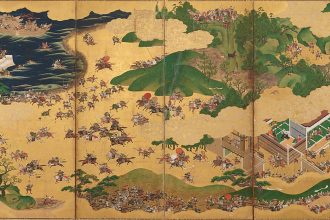
From the moment Neolithic farming communities in the Fertile Crescent first encircled their mudbrick granaries with stone walls and ditches—such as the famous ninth-millennium BC tower and wall of Jericho—warfare split into two distinct arts: pitched battles in the open field and the grueling, psychological, and engineering chess match of siege warfare (poliorcetics). In the ancient world, capturing a fortified city meant solving a deadly mathematical equation: how to breach twenty-foot-thick masonry ramparts before disease, winter frost, or starvation destroyed the attacking army camped outside.
The Five Ways to Take an Ancient Walled City
Across Mesopotamia, Egypt, Greece, Rome, and China, every ancient commander approaching a walled city had five strategic options in his playbook, ranked from least costly to most destructive:
- 1. Treachery and Stealth (Prodosis): Throughout Classical Greek history (from 500 to 350 BC), because Greek hoplite armies lacked heavy stone-throwing artillery and could not afford to leave their farms for a year-long siege, by far the most common way a Greek city fell was betrayal from within—bribing a disgruntled political faction inside the city to unbar a postern gate at midnight.
- 2. Circumvallation and Starvation: If the walls were too strong to storm, the attacker dug a continuous trench and wooden palisade all the way around the city (a wall of circumvallation) to lock the inhabitants inside until their wells dried up or their wheat ran out—sometimes adding a second outer wall facing outward (contravallation) to block enemy relief armies, most famously executed by Julius Caesar at the Siege of Alesia (52 BC).
- 3. Escalade (Over the Top): Racing forward with tall wooden scaling ladders or mobile siege towers to fight hand-to-hand along the battlements.
- 4. Battering and Ballistics (Through the Middle): Smashing a breach straight through the stone curtain wall or oak gates using iron-headed battering rams and torsion catapults.
- 5. Sapping and Mining (Underneath the Bottom): Digging subterranean tunnels directly beneath the foundations of a wall, propping the tunnel roof up with dry timber beams smeared in pitch, and then setting the beams on fire so the tunnel collapsed and brought ten thousand tons of stone wall crashing down into the hole.
The Neo-Assyrian Empire: Inventing the Mechanized Siege
While Bronze Age armies in Egypt and the Levant relied mostly on scaling ladders and starvation, the first true masters of mechanized siege engineering were the kings of the Neo-Assyrian Empire (circa 911–609 BC). Carved in graphic detail across the gypsum palace reliefs of King Ashurnasirpal II and Sennacherib at Nineveh (depicting the 701 BC Siege of Lachish in Judah, where archaeologists have actually excavated the surviving Assyrian stone siege ramp today!) are the world’s first integrated siege corps:
- Armored Wheeled Battering Rams: Six-wheeled wooden tanks covered in wet sewn ox-hides to resist fire arrows, housing a massive suspended timber beam tipped with a heavy bronze or iron chisel blade that pried mudbricks loose from enemy towers.
- Earthen Siege Ramps: Tens of thousands of enslaved prisoners hauling baskets of earth, logs, and cobbles under the cover of giant woven reed shields to build a wide sloped highway straight up to the top of a hilltop city’s wall.
- Psychological Terror: To persuade the *next* city on the march to open its gates without a fight, Assyrian kings erected towering monuments of flayed skin and impaled rebels right outside the main gate of any city that forced them to build a ramp.
The Hellenistic Golden Age: Torsion Catapults and the Helepolis
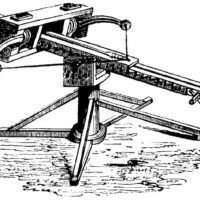
Siege warfare underwent a technological revolution in 399 BC in the Sicilian city of Syracuse, when engineers hired by the tyrant Dionysius I invented the catapult (initially the belly-bow gastraphetes), followed fifty years later under Philip II and Alexander the Great of Macedon by the torsion catapult (ballista and lithobolos). Powered not by bending wood, but by huge twisted skeins of elastic animal sinew tendon and horsehair rope, Macedonian stone-throwers could hurl sixty-pound stone balls three hundred yards with enough kinetic force to pulverize stone battlements.
In 332 BC, when the island fortress of Tyre refused to admit Alexander the Great because a half-mile of open sea separated its 150-foot walls from the Lebanese mainland, Alexander simply erased the geography: spending seven months building a two-hundred-foot-wide stone causeway right across the sea to roll 150-foot siege towers against the island walls (a mole that trapped silt over millennia and permanently turned Tyre from an island into a peninsula!). Twenty-seven years later, during the 305 BC Siege of Rhodes, the Macedonian general Demetrius Poliorcetes (“The Besieger”) built the largest mobile land weapon of antiquity: the Helepolis (“Taker of Cities”), a nine-story, 130-foot-tall armored wooden skyscraper weighing 160 tons, pushed on eight iron-rimmed wheels by 3,400 men and packed with catapults on every floor.
Roman Methodical Inevitability: Masada (73 AD)
What the Greeks invented in flashes of brilliance, the Roman legions perfected into cold, assembly-line inevitability. Every Roman legion marched with its own combat engineers (fabri), sixty-cart scorpio bolt-throwers, and one-armed stone-throwing onagers. When nine hundred Jewish Sicarii rebels held out atop the sheer, 1,300-foot desert plateau of Masada overlooking the Dead Sea in 72–73 AD, the Roman Tenth Legion (Legio X Fretensis) under Flavius Silva surrounded the base with a seven-mile stone wall and eight forts, then built a colossal 375-foot-high ramp of compacted white earth and timber framing straight up the western cliff face—rolling an iron-plated siege tower and battering ram to the summit to prove to the ancient world that no mountain on Earth stood higher than a Roman spade.