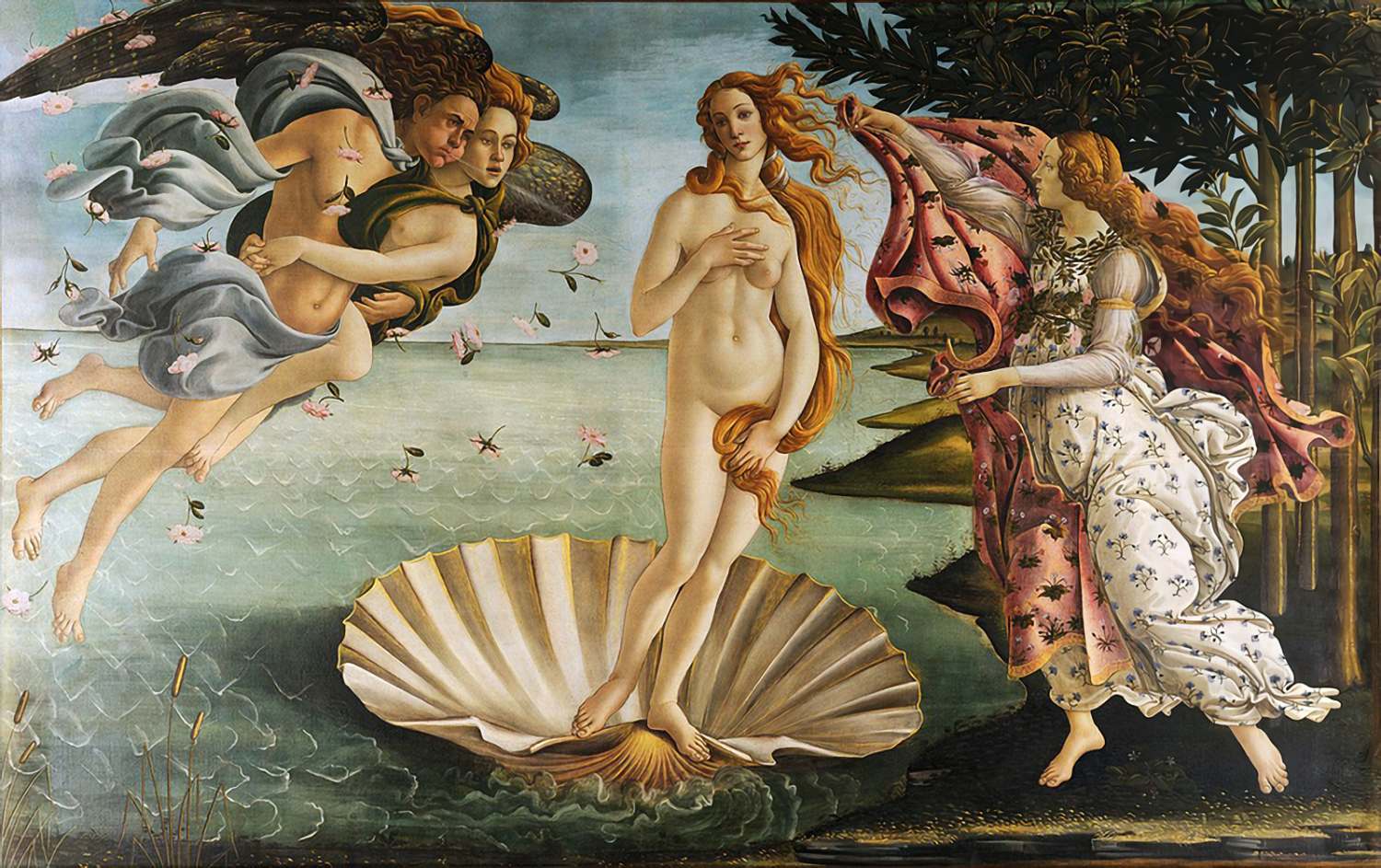
The Birth of Venus by Sandro Botticelli is one of the most iconic works of the Italian Renaissance and continues to captivate viewers today. Learn the truth behind the legend that has surrounded the masterpiece. Venus, the goddess of love, is shown here as a lady with translucent skin who is gently perched on a shell and is surrounded by people who are all facing her. For this piece, the Italian artist paid homage to the creative sophistication of his day by depicting a pagan topic.
What are the characteristics of this painting?
The painting “The Birth of Venus” is a tempera on canvas. To get this effect, the artist likely mixed ground pigments with egg white or fig milk. This colossal work, measuring in at 67.9 x 109.6 inches (172.5 x 278.5 cm), required the sewing together of two canvases.
This picture, which is now housed in Florence, Italy’s Uffizi Gallery, was either commissioned by or created for a Medici family member. It was painted in 1485, at the time of Lorenzo de’ Medici (Lorenzo the Magnificent). Sandro Botticelli aimed to pay homage to the most valuable qualities of nature through the people, scenery, and arrangement.
How is the work composed?
In this seafaring tale, three distinct groups of people emerge. The shoreline in this artwork is quite steep, and the waves are crashing ever lower. Roses, conceived by Venus, rain down from the heavens. All four classical elements are here: air (represented by the deity of the winds, Zephyr), water from the sea, earth (the coastline can be seen to the right), and fire (that of love).

A melancholy Venus perched on a shell occupies the focal point. This primary figure is nearly life size, and on each side of her are two smaller figures: a young lady (the goddess of spring) and the wind deity Zephyr, who is joined by his wife, the nymph Chloris (a symbol of physical love). The triangle arrangement focuses attention on the lovely goddess’s face.
Who are the different characters?
Venus (Aphrodite for the Greeks), the goddess of beauty, stands front and center on an open conch. Her curves convey sensuality, and her nakedness represents innocence. The shell represents the female sex, hence, it is seen as a symbol of fertility.
With a subtle motion of her hand, she covers her breasts, and her long blond hair also helps. Her subtle wiggle, reminiscent of ancient statues, gives the impression that she is in motion. Her eyes have a melancholy beauty about them.
Zephyr, the god of the winds, and his wife are seen entwined in the air to the left of the artwork. His puffy cheeks show that he is blowing on Venus to force her toward the beach. The springtime goddess Flora (one of the “Horae”) appears on the right.
She stands on the coast, holding out a purple fabric with flowers on it as a welcome mat for Venus. The cornflowers on her outfit are a nod to the romantic springtime.
What mythological episode does this painting depict?
This artwork shows Venus’s first trip to Cyprus after she was born. According to Hesiod, a Greek poet, Venus was conceived in the genitalia of her father Ouranos (Uranus), the god of the sky, who concealed his offspring under the surface of the Earth. Chronos, his disobedient son, removed his father’s internal organs and hurled them into the ocean.
When they hit the ocean, a foam arose, and from it sprang Venus, also known as Aphrodite, the goddess of love. Then Zephyr blew her to Cyprus, where the daughters of Zeus and Themis, the Horae, greeted her and whisked her away to Olympus.