How much energy do trees need in kilowatt hours in order to continue living? For the first time, researchers have calculated how much work a tree must do to pump water up from its roots to its leaves, a process that requires a lot of energy due to the pull of gravity and the resistance of the tree’s vascular system. As a result, each tree uses 0.0056 watts per square foot or 0.06 watts per square meter of surface area, and together, trees produce 9.4 trillion kilowatt hours per year for their water transport, which is almost equivalent to our worldwide energy output from hydropower.
There are over three trillion trees on Earth or roughly 422 trees for every human. The oxygen they produce by photosynthesis is vital to all life on Earth and acts as a natural temperature regulator. Trees also have a considerable cooling impact due to the evaporation of water from their leaves. Rainforests with a large enough surface area, like the Amazon, create their own microclimate and, essentially, provide their own rainfall.

The Suction is Produced by Evaporation and Photosynthesis
But before a tree can do any of that, it has to put in a lot of effort: it has to get the water from the ground all the way to the top. A tree has to fight against both gravity and the friction created by its tube system to do this. Water transport in the tree is completely passive: the suction caused by evaporation in the crown draws the water upwards, while human blood circulation is propelled by its own pump, the heart.
However, the energy required for this mode of transportation is considerable. The light provides this by facilitating both the transpiration of water through the leaves and its transformation during photosynthesis. Plants would not be able to produce enough energy via their own metabolism alone to meet this requirement.
To get water from one place to another in a tree, how much work does the tree have to put in? Scientists have finally made a more accurate calculation of this. They did this by combining data from biophysical models and satellite images of forest cover with measurements of sap ascent and the plant’s circulatory system.
Annual Global Use of 9.4 Petawatt Hours
To get water from their roots to their leaves, plants in worldwide forest ecosystems need 0.0056 watts per square foot or 0.06 watts per square meter of energy. Sounds like not much, but it’s 14.2% of the energy a tree requires to convert sunlight into sugar during photosynthesis. This labor, in contrast to photosynthesis, is passive, and it increases when environmental conditions like temperature and humidity change, making more water available for photosynthesis.
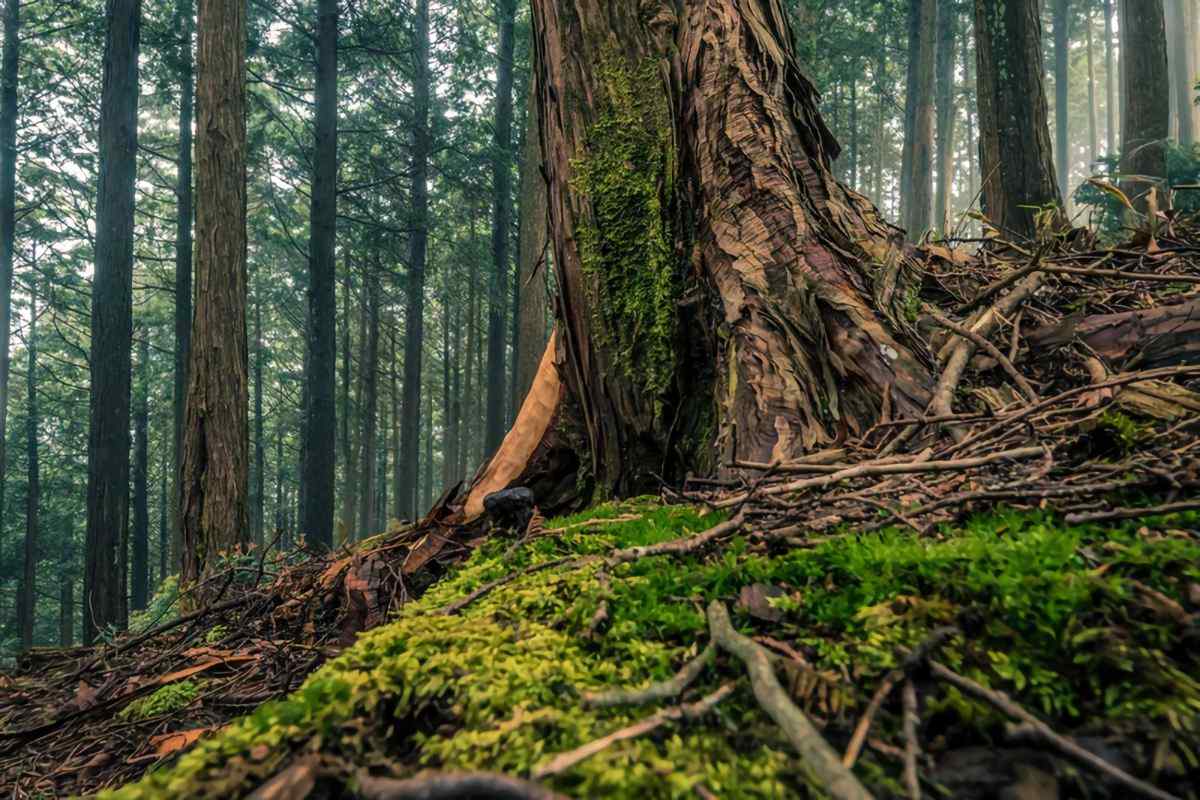
Overall, this amounts to a massive sum: worldwide, all forest ecosystems need 9.4 petawatt-hours per year for sap ascent, which is equal to the entire annual output of all man-made hydroelectric power. The same figure in kilowatt-hours is 9.4 quadrillion. In tropical rainforests, trees accomplish most of this labor by transporting water, which uses up around 18% of the energy produced by photosynthesis.
It is About Stem Resistance
Also unexpected: the researchers found that the energy needed to overcome gravity accounts for just a tiny portion of the total energy required in the upward transfer of water in the tree. Most of the energy is used to overcome the resistance in the tree’s circulatory system. The internal resistance of a drought-adapted juniper tree, for example, is rather great, whereas the black poplar that grows in a floodplain acts like a giant water pump.

Therefore, the estimated worldwide energy required for tree sap to ascent is likewise very unknown, falling somewhere between 7.4 and 15.5 petawatt-hours. These unknowns highlight how little we understand about the biogeography of plant resistance and, to a lesser degree, transpiration. It’s astounding that no one has ever attempted to measure a global energy flow on this scale. So far, this appears to have just slipped between the cracks.