The incredible relic of a bird skull dating back 66.7 million years casts doubt on our understanding of the origin of modern birds. The completely articulated beak formerly thought to be unique to contemporary birds was present in this ancient creature. However, its beak still contains teeth, and it comes from a rather simple group of extinct birds. Researchers present their findings in the journal Nature, and it sheds fresh information on how birds evolved their jaws and the evolutionary history of birds.
Thomas Huxley, a British scientist and staunch Darwin supporter, separated birds into two major families in 1867 based on the shape of their beaks, naming them the Paleognaths (primordial jaw birds) and the Neognaths (neo-jawed birds). Unlike the fused upper jaw of paleognaths, neognaths’ beaks are free to move both horizontally and vertically.
Almost all modern birds are classified as neognaths. Not included are the rump chickens or the related ratites (which include ostriches, emus, and nandus). Modern birds with movable jaws evolved after the fused beak type.
This mysterious species of Ichthyornis
Senior author Daniel Field of Cambridge University in the United Kingdom claims that since then, this has been assumed without question. One reason this misconception has survived for so long is because, until recently, scientists lacked high-quality fossils of avian palates, which date back to the period when modern birds first appeared. Fossil jawbones were especially scarce for the ichthyornithes, an early bird group considered to be the ancestors of both current paleognathic and neognathic birds.
That’s no longer the case. Recent analysis of a fossil that dates back 66.7 million years reveals that these early birds already had a flexible beak. The fossil of the ancient bird was found in the 1990s in a limestone quarry close to the border between Belgium and the Netherlands, and it was studied for the first time in 2002. However, due to its encasement in rock, researchers were limited to describing what they saw from the outside.
Carnivorous dinosaur-era bird
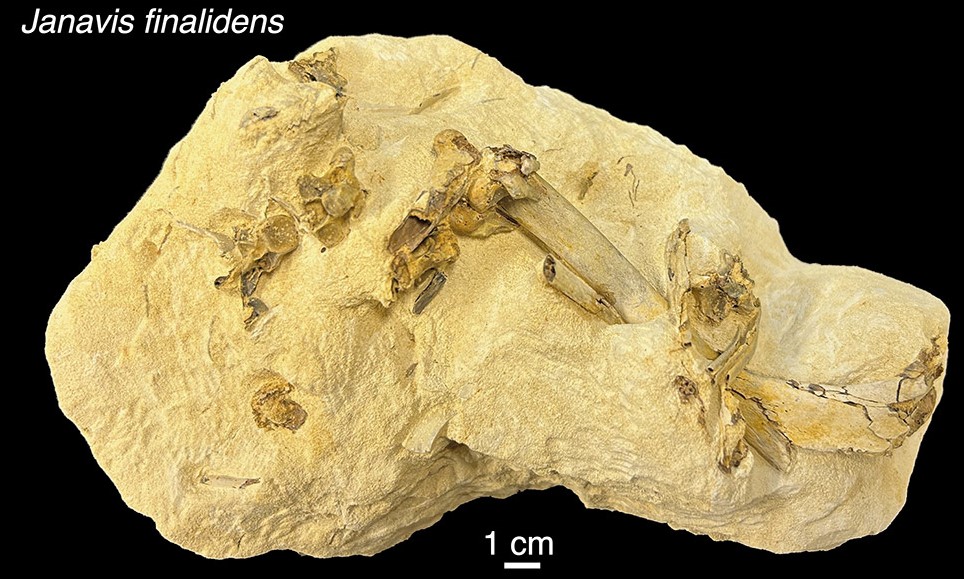
CT scans have allowed Field, the study’s first author Juan Benito, and their coworkers to see inside the fossil’s stone casing for the first time. It turned out that this Cretaceous bird was a kind of Ichthyornithes after all. Janavis finalidens is the name scientists have given the new species. The name “Janavis” comes from the Latin word for “bird,” “avis,” and the Roman deity “Janus,” who was worshiped as the god of both beginnings and endings.
Even though Janavis was quite advanced for a primitive bird, it still retained teeth (a trait that became extinct along with dinosaurs and toothed birds at the end of the Cretaceous era, thus the species name “finalidens,” which means “final tooth”). During this period, the Janavis finalidens genus also became extinct.
Janavis’ upper jaw was movable
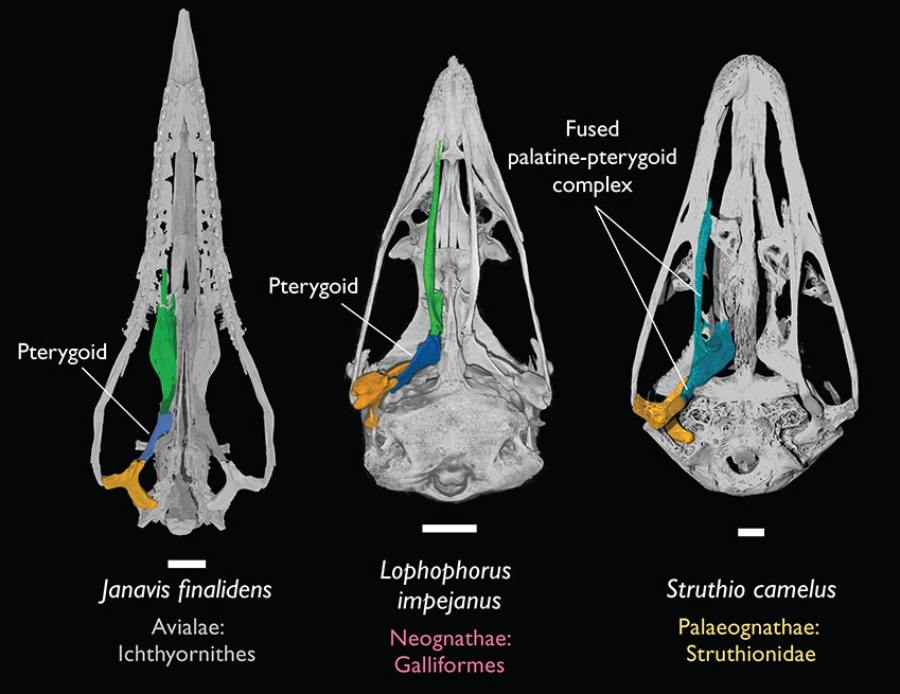
However, the deciding factor turned out to be a bone that had been described as shoulder-related at first. Rather, the tests revealed that it was very similar to the pterygoid bone of a turkey, the bone responsible for the mobility of the fowl’s upper jaw. The researchers were fortunate enough to have turkey skulls on hand. After extracting one, they saw that it was almost identical to the other bone.

This demonstrates that Cretaceous Ichthyornithes birds, like the vast majority of current neognathic birds, featured a movable upper jaw. Refuting the idea that contemporary birds’ jaws trace back to paleognathic predecessors is fossil evidence of a palate similar to that of neognaths, such as that seen in Ichthyornis.
A contemporary beak predates modern birds
At the very least with regards to this trait, the conventional bird family tree has to be redrawn. This suggests that the ichthornithes, which have a jaw that could be moved, are the archetype. The neognaths kept their flexible upper jaw when the neognathic and paleognathic modern birds formed later in development. However, the united jaw appeared again in contemporary paleognathic bird species like ratites.
A straight line cannot be drawn through the course of evolution. This fossil proves that the movable beak, previously assumed to have arisen after the emergence of modern birds, actually arose prior to the appearance of these species. For almost a century, scientists have made erroneous inferences about how contemporary bird skulls evolved.