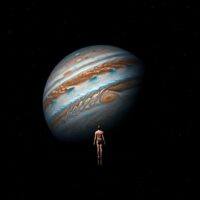
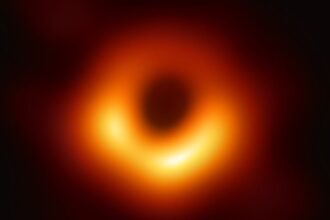
Formed when a massive star exhausts its nuclear fuel and collapses under the weight of its own gravity until its mass is crushed into an infinitely dense point, a black hole represents the ultimate extreme of Albert Einstein’s General Theory of Relativity—a region where spacetime curves so steeply that not even light moving at three hundred thousand kilometers per second can escape. If an astronaut in a spacesuit were to drift away from their spacecraft and fall feet-first toward a black hole, what they would experience—and what their horrified crewmates watching from a safe distance would see—depends entirely on the physics of tidal forces, time dilation, and the mass of the monster devouring them.
Two Different Movies: The Crew’s View vs. Your View
Before you even touch the boundary of the black hole—the event horizon, the point of no return—Einstein’s relativity splits reality into two completely different movies for you and for your friend watching through a telescope aboard the mother ship:
- What Your Friend on the Ship Sees (Frozen and Fading Red): Because immense gravity slows down the passage of time relative to a distant observer (gravitational time dilation), as your friend watches you fall closer and closer to the event horizon, you appear to move in extreme slow motion. Your waving hand slows to a crawl, the ticks of your wristwatch take hours, and the light reflecting off your white spacesuit gets stretched out into longer and longer wavelengths as it struggles to climb out of the gravity well (gravitational redshift). To your friend, they never actually see you cross the event horizon; instead, you appear to freeze motionless right at the edge, turn deep infrared red, and slowly fade into invisibility like a dying ember.
- What You Experience (Freefall at Normal Speed): From your own perspective inside the spacesuit, your wristwatch ticks at a completely normal sixty seconds per minute. You do not feel time slowing down, nor do you hit a solid wall at the event horizon; in freefall, you cross straight through the invisible boundary in a split second—provided the tidal forces haven’t already torn you apart first.
Spaghettification: Why a Small Black Hole Kills You Faster Than a Giant One
As you fall feet-first toward a black hole, your feet are slightly closer to the singularity at the center than your head is. Because gravitational force weakens rapidly with distance (following the inverse-square law), the black hole pulls on your boots with much greater force than it pulls on your helmet, while simultaneously squeezing your shoulders inward toward the center line. Astrophysicist Stephen Hawking famously gave this extreme tidal stretching the graphic name spaghettification: your body is stretched vertically like a long strand of spaghetti while being compressed horizontally into a thin ribbon of atoms.
Here lies the most counterintuitive fact in astrophysics: the smaller the black hole, the more violent the spaghettification outside the event horizon!
- Stellar-Mass Black Hole (10x the Sun’s Mass): Its event horizon is only about thirty kilometers (nineteen miles) wide. Because you get within just a few hundred kilometers of the center before crossing the horizon, the gravity gradient between your head and your feet reaches millions of Gs—ripping your body and even your molecules apart into a glowing stream of plasma long before you ever reach the event horizon.
- Supermassive Black Hole (Like Gargantua or Sagittarius A*, Millions to Billions of Suns): Because the event horizon of a supermassive black hole sits millions or billions of miles away from the central singularity, the gravitational pull at the horizon is remarkably gentle and uniform from your head to your toes. If you fell into a billion-solar-mass black hole (assuming it didn’t have a blazing disk of swirling superheated gas outside), you would sail right across the event horizon completely unharmed, feeling zero pain or stretching for hours or days until you finally approached the deep interior near the singularity!
Inside the Event Horizon: Where Space and Time Swap Places
Suppose you survive crossing the event horizon of a supermassive black hole and look back over your shoulder at the outside universe. You are not plunged into total blackness: light from the stars outside is still falling into the black hole right behind you, compressed by relativistic aberration into a bright, shrinking circular window of light above your head surrounded by widening darkness.
Inside the event horizon, however, the mathematics of Einstein’s equations reveal something mind-bending: space and time literally swap roles. Outside in the normal universe, you can move freely forward or backward in space, but you are forced to move strictly forward in time toward tomorrow. Inside the event horizon, the radial direction pointing toward the central singularity becomes a time coordinate rather than a space coordinate. Firing your spacesuit’s rocket thrusters to try to fly away from the center is as physically impossible as firing a rocket to fly back to last Tuesday; every path through spacetime points inexorably toward the singularity in your future, where within a finite number of seconds or hours, tidal curvature climbs toward infinity and crushes all matter into the unknown realm of quantum gravity.