The nickname “Roi-Soleil” (Sun King) for Louis XIV is the outcome of a meticulous construction of his image by the king himself, his court, and his advisors. It is closely tied to the image that Louis XIV sought to project of himself and the French monarchy.
Deliberately choosing the sun as the symbol of his reign, he positioned himself at the center of the French court and politics, akin to the sun at the center of our solar system. The sun, being the source of light and warmth, was perceived as a symbol of power, regeneration, and vitality.
The Sun King Nickname Inspired by the God Apollo
Louis XIV chose the sun, drawing inspiration from the symbol of the Greek god Apollo. Apollo was regarded as the god of poetry, music, light, and knowledge, and the monarch aimed to embody these qualities in his reign. In fact, Louis XIV’s iconography often depicts him with the attributes of Apollo, including a laurel crown, a lyre, and sun rays. This association reinforced the idea of the king as a divine and enlightened figure.
Louis XIV heightened this solar image through symbolic acts, such as his daily morning rise, where he presented himself to the court to be admired, and the construction of the Palace of Versailles, featuring the Hall of Mirrors that reflected light like the sun. The king sought to establish and consolidate his absolute authority by weaving an almost divine connection between himself and the sun.

The Sun King’s Royal Propaganda
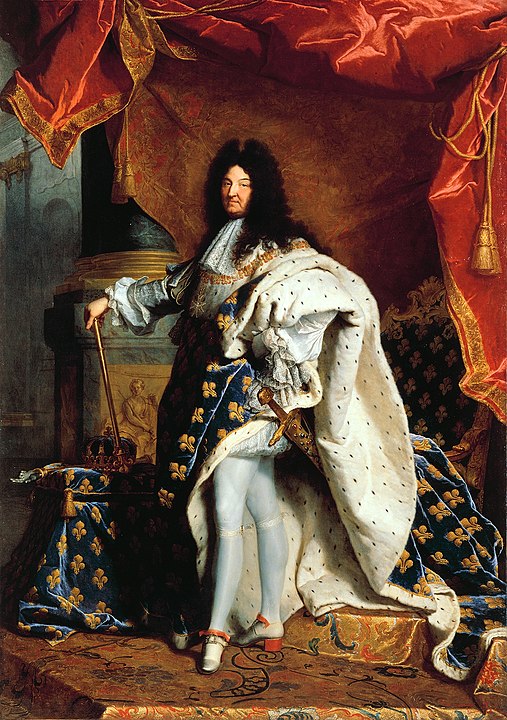
Royal propaganda played a crucial role in disseminating the moniker of the Sun King during his reign. Louis XIV had a dedicated team to promote his image and legend. Artists, writers, and playwrights contributed to crafting this solar image of the king through artistic works, plays, poems, and grand ceremonies.
As a central element of royal propaganda, the Sun King moniker aided in constructing a powerful and majestic image of the monarch, not only within France but also abroad. Moreover, this nickname continues to symbolize the grandeur and magnificence of his reign, with Louis XIV remaining one of the most iconic monarchs in the history of France.
What Was the Sun King’s Motto?
The Sun King, Louis XIV’s motto, “Nec pluribus impar,” translates from Latin to “Not unequal to many.” Personally chosen by the king, this motto underscores his superiority and unparalleled reign. It can also be interpreted as “He is superior to all.”
Reflecting the ideology of Louis XIV’s reign, this Latin expression encapsulates his desire to be regarded as the greatest of kings, the foremost among men, perhaps even transcending mere humanity.

It serves as a declaration of absolutism and grandeur, aligning seamlessly with the carefully crafted image of the Sun King. It is worth noting that the precise meaning of this motto remains a subject of interpretation among scholars. Nevertheless, it undeniably captures Louis XIV’s ambition and self-assurance.
What Were the Other Nicknames Attributed to Louis XIV?
Apart from the famous nickname “Roi-Soleil” (Sun King), Louis XIV was also called Louis le Grand (Louis the Great) or Louis Dieudonné.
- Louis le Grand: This nickname highlights the greatness of his reign, the extent of the reforms undertaken, and the magnificence of his court.
- Louis Dieudonné: This nickname was given to Louis XIV at his birth, signifying that the king was a gift from God.
The various nicknames, including the title of Sun King, explain how Louis XIV skillfully created a powerful and symbolic image of his monarchy and thus played an important role in shaping the history of France.