William Harvey was a fascinating individual. It is striking to think that a single published work has changed the future of biomedical sciences and medicine more than any other publication in the past fifteen centuries. This work is Exercitatio Anatomica de Motu Cordis et Sanguinis in Animalibus, published in 1628 by William Harvey. This thin book put an end to the physiology and medicine dogmas of Galenus of Bergama, which had been affecting the Western world since the beginning.
Who was William Harvey?
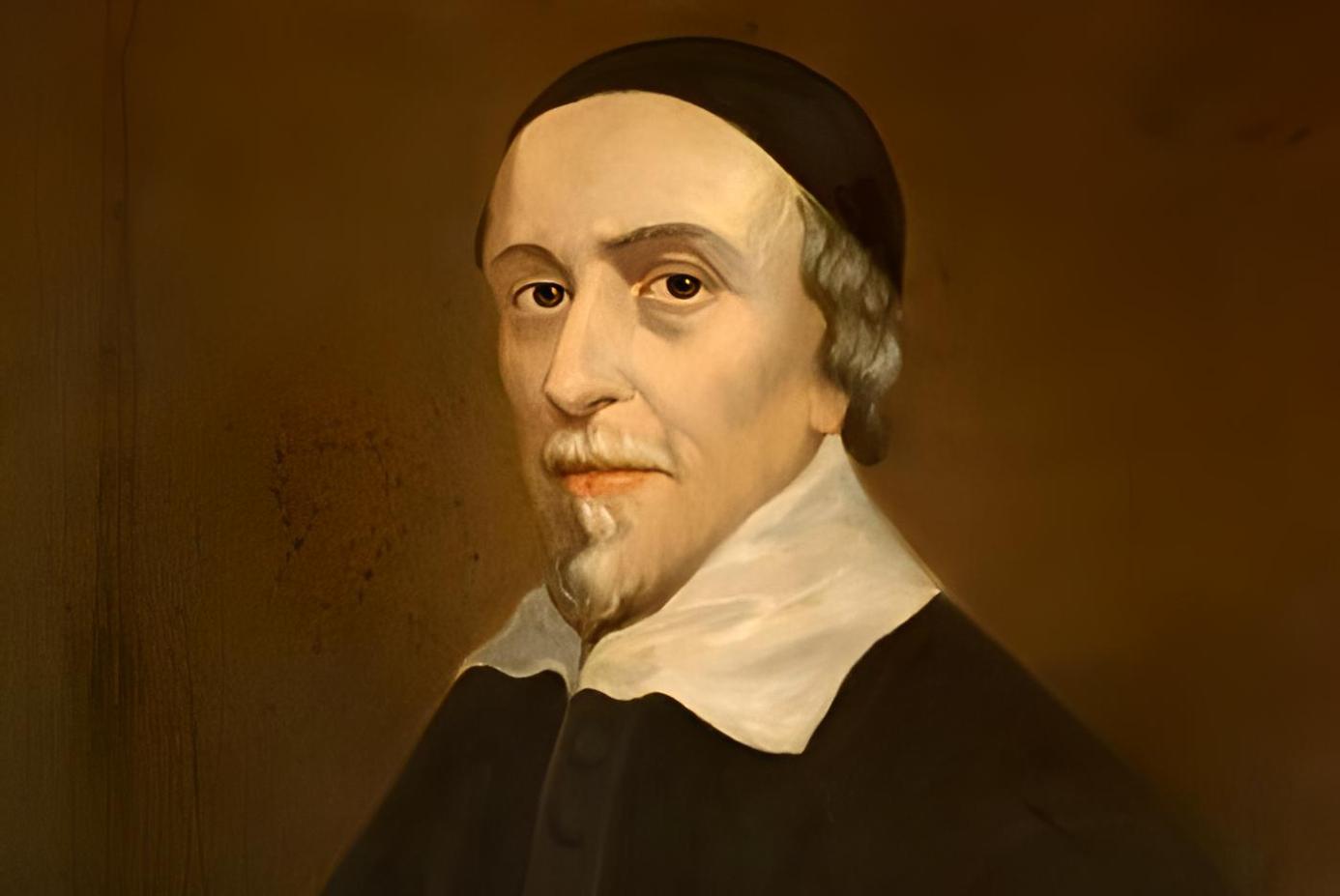
William Harvey was from a wealthy Folkestone family. He was the eldest of the seven brothers, of which five would later become traders in London. He got his bachelor’s degree from Cambridge University in 1597 and went on a long learning journey in France, Germany, and Italy. In 1602, he received a doctorate in medicine and philosophy from the University of Padova, where he attended the anatomy course of Fabricius ab Aquapendente (also known as Girolamo Fabrizio), who discovered the valves of the vessels. He returned to London immediately after graduation and was elected a member of the Royal College of Physicians in 1604.
Harvey had remarkable fame during his lifetime. He became the private physician of King James I and his son, Charles I. In addition to his intensive clinical practice, he became a physician at one of the oldest hospitals in London, St. Bartholomew’s. He was extremely patient, persistent, and careful as a scientist. It took 25 years for his studies to bear fruit. He once complained to a friend that his medical profession was damaged due to his publications on blood circulation and his colleagues’ being jealous of his reputation, which called him “crackbrained.”
He was aware that he was making a mark in the history of medicine and did his best to pursue his fame. He left part of his fortune to the Royal College of Physicians and gave Cambridge’s Caius College his birth house and the land around it.
William Harvey once said in On the Formation of Animals, 1651, that nature should be investigated; the paths it showed us should be boldly walked, because only by moving from lower to higher levels can we penetrate the very heart of the mystery of nature by consulting our appropriate senses.
Blood and heart
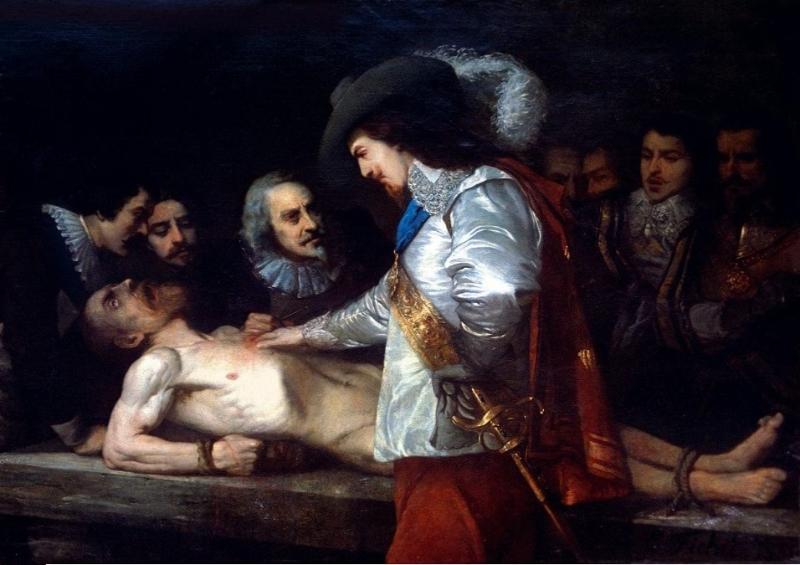
According to the teaching of Galen, blood was drawn from the liver and lung, flowing to the right side of the heart, and after passing through the ventricle, the tidal movement began between the left ventricle and the arteries. At the beginning of the 17th century, it was argued that the heart was the source of heat and that the lungs served to cool the blood. It was assumed that diastole (the rhythmic expansion of the heart) combines blood and air, and the warmed and revitalized blood enters the circulatory system. The blood being darker in the veins and lighter in the arteries was attributed to the different functions of the two vessels, such as the ability to feed tissues and maintain the vital spirit.
Harvey’s observations completely changed these ideas. He discovered that the left ventricle of the heart sends blood continuously and unidirectionally from the lungs to the main arteries and tissues, and that the blood from the right ventricle, through the last veins, is sent from here to the lungs. Harvey had come to the conclusion that the amount of blood coming out of the veins should enter the arteries for the systems to work properly. For this to happen, the outside blood had to move cyclically from the arteries to the veins. He thought that the same principle should apply to the circulation in the lungs; blood should flow from the right ventricle to the left ventricle through the lungs.
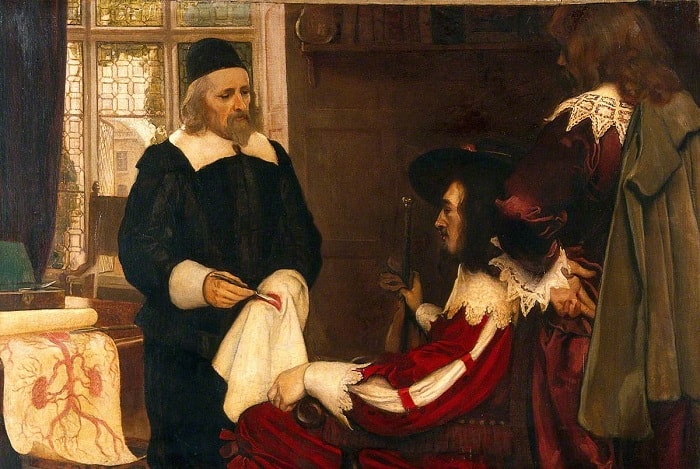
The observation of the heartbeat being synchronized with the pulse resulted in the faulty idea that the heart and arteries may contract and relax simultaneously. It was believed that the heartbeat felt by the hand was the enlargement of the heart. Harvey was able to argue for this idea by directly observing the chest walls of the animals. The reason a heartbeat was felt by hand was due to the contraction of the heart when sending the blood out and the enlargement of the ribs when relaxing. So, the pulse in the arteries was not due to the diastole (enlargement), but to the systole (contraction).
William Harvey’s work, de Motu Cordis
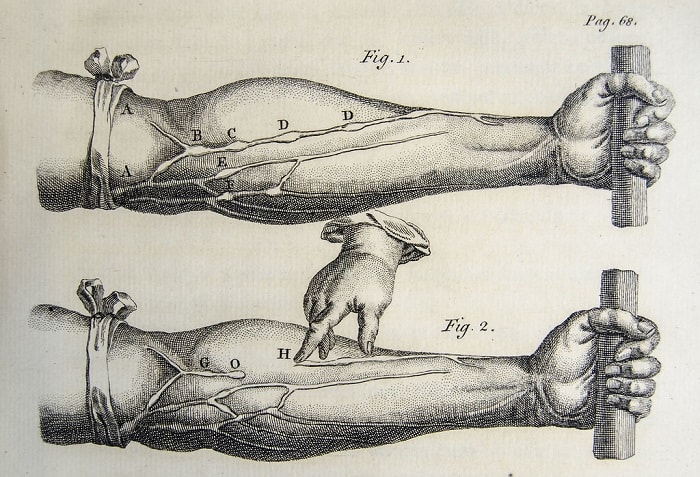
To express his thesis about blood circulation in his work, de Motu Cordis, Harvey resorted to quantitative reasoning, which was a fairly new approach. He did not believe that the source of a large amount of blood, which was constantly entering the heart from veins, could only be the food consumed. He also noticed that the amount of blood flowing in the blood vessels was well above the amount needed to feed the various parts of the body. This simple reasoning resulted in the idea that a fixed amount of blood moves “cyclically” in the body. This contribution was truly revolutionary, and it would take many years for general acceptance.
But Harvey not only made discoveries but also created the experimental method that would be pursued in biology and medicine experiments hundreds of years later. The study always starts by asking questions (there were more than twenty such questions in the first part of de Motu Cordis), some of which are intended to politely demonstrate the absurdity of the current views, and the answers should be very clear.
These are followed by questions that form the basis of the experiment. At the heart of his method was vivisection—the practice of performing operations on live animals. This experimental technique opened all the doors for Harvey. The observation made at a certain point in time (i.e., the dissection of a dead animal) was not sufficient to answer some functional questions. Thus, continuous and sequential observations of live animals were necessary. The attachment, removal, and opening of the vessels of the body parts were the means of understanding and revealing normal physiology.
William Harvey’s curious mind
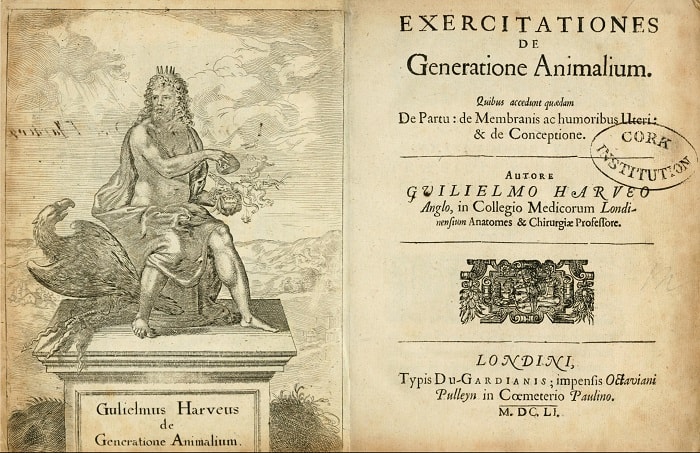
From the first days of his professional career, Harvey realized that every new breed he worked with brought him new insight. The animal species he studied were diverse. In the later years of his life, when he switched to studying embryogenesis in animals, his highly curious mind was in the most open state possible. He had always had the maxim to be objective, but he could not help but admire the creation and the creator behind it. He was interested in embryology and its earliest stages of development. What happens first? What follows next? Such thoughts stand out in Harvey’s 1961 book, Exercitationes de Generatione Animalium.
In addition to his intense curiosity toward medicine, William Harvey was a revolutionary who pursued refined and disciplined thought processes while conducting biology experiments. The result was a fundamentally new understanding of how the human body works. He showed his students how to ask the right questions, deal with them, and answer them.
William Harvey quotes
“Very many maintain that all we know is still infinitely less than all that still remains unknown.”
“I profess to learn and to teach anatomy not from books but from dissections, not from the tenets of Philosophers but from the fabric of Nature.”
“The heart is the household divinity which, discharging its function, nourishes, cherishes, quickens the whole body, and is indeed the foundation of life, the source of all action.”
“Civilization is only a series of victories against nature.”
“Nature is a volume of which God is the author.”
“Moderate labor of the body conduces to the preservation of health, and cares many initial diseases.”
“I have often wondered and even laughed at those who fancied that everything had been so consummately and absolutely investigated by an Aristotle or a Galen or some other mighty name, that nothing could by any possibility be added to their knowledge.”
“Only by understanding the wisdom of natural foods and their effects on the body, shall we attain mastery of disease and pain, which shall enable us to relieve the burden of mankind.”
Bibliography:
- Power, D’Arcy (1897). William Harvey: Masters of Medicine. T. Fisher Unwin. ISBN 978-1-4179-6578-6.
- Mitchell, Silas Weir (1907). Some Memoranda in Regard to William Harvey, M.D.
- Munk, William (1878). The Roll of the Royal College of Physicians of London, Vol. I (2nd ed.). London. pp. 124–146.
- William Harvey info from the (US) National Health Museum
- Rapson, Helen (1982). The Circulation of the Blood. London: Frederick Muller.