Three scientists who have made seminal contributions to the experimental study of quantum entanglement and its applications share the Nobel Prize in Physics in 2022. Scientists John Clauser of the United States and Alain Aspect of France devised a method to definitively detect entanglement between photons. Quantum communication relies on entanglement, which was first successfully transmitted by Anton Zeilinger of the University of Vienna.
The technologies of the future include quantum computing and quantum communication. Because they allow for rapid resolution of difficult problems and the use of “unbreakable” encrypted data. Particles like photons, ions, and atoms act under quantum physical phenomena like superposition and entanglement. Due to these occurrences, quantum computers can process vast amounts of data in a short amount of time, and quantum signals can be “teleported” almost instantly.
The mystery of “spooky action at distance”
Quantum entanglement has been described as “spooky action at a distance” by Albert Einstein and as the most crucial aspect of quantum physics by Erwin Schrödinger. Up until the measurement of the state of one of the entangled particles, the other remains in a superposition state, not knowing which of the two it is. Only then does the second one decide on its state simultaneously.
All current quantum technologies are reliant on the observation of quantum entanglement.
One analogy for quantum entanglement is that of two balls, one white and one black, whose superposition in midair renders them gray. The ultimate color of each ball is revealed only when one of them is captured. Simultaneously, it becomes obvious that the second ball is the opposite color. However, this raises the issue of how the balls determine which color they need to take on. Are their colors coincidental or do they potentially contain information that foretells the color they’ll show up in advance?

Physicist John Stewart Bell suggested a theoretical potential in the 1960s for empirically clarifying this issue. According to this, a real entanglement without hidden variables would have to exhibit a specific degree of correlation when the measurements are repeated numerous times. But how to assess this in a realistic manner remained uncertain.
John Clauser and Alain Aspect: The Bell test becomes practical
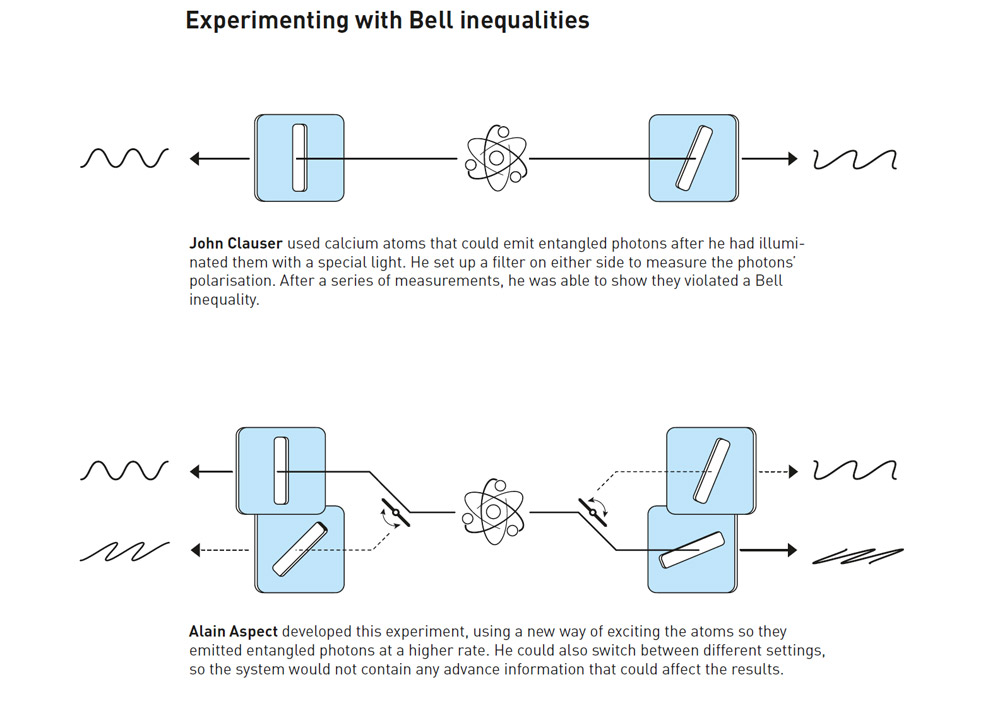
The Bell test was first put into experimental practice by John Clauser and Alain Aspect. (Credit: Nobel Foundation)
The first prize winner of the 2022 Nobel Prize in Physics was the American physicist John Clauser for his work in this area. For the first time, he devised an experiment to prove that quantum entanglement is really possible and that Bell’s inequality could be broken. The scientist accomplished this by generating polarization-entangled pairs of photons. Clauser found out how frequently each combination happened by passing these photons through various polarization filters.
As a result, it was clear that the entangled photons did disprove Bell’s inequality. There was no way to predict or account for the strength of the relationships. Instead, it was a “spooky action at distance” effect in which the measurement of one particle determines the state of another, nullifying the superposition.
Clauser and his team’s experiment was exceedingly inefficient, however, since only a tiny percentage of the created photons were traceable through the filters and hence measurable. French physicist Alain Aspect, who came in second for the 2022 Physics Nobel Prize, decided to interfere here. He refined the experiment by separating the entangled photons and measuring them after they passed through two polarizers.
Anton Zeilinger: Quantum teleportation and quantum amplification
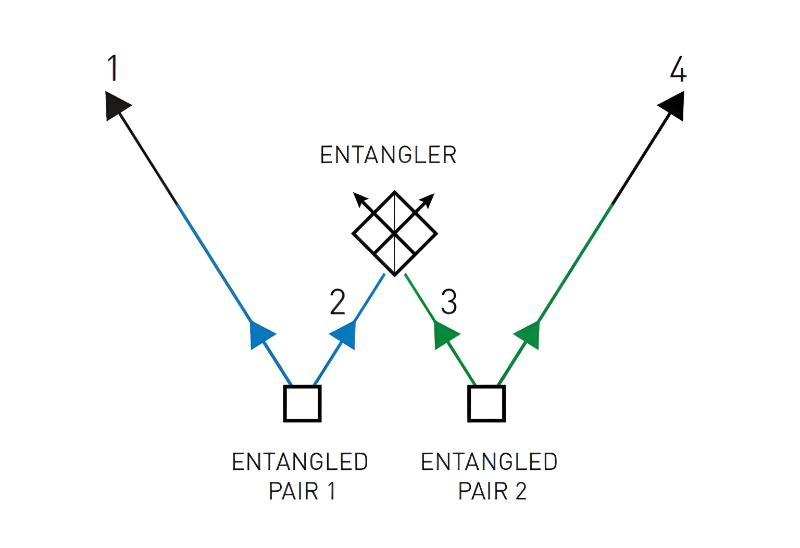
When sending optical information over long distances, for example via a fiber-optic cable, the light signal degrades, limiting the range; this is the issue that Anton Zeilinger of the University of Vienna addressed, and it is strongly connected to quantum entanglement. Over a distance of 6 miles (10 kilometers), about one photon is lost per second. Standard optical transmissions include intermediate amplifiers that account for this.
Unfortunately, this cannot be done with entangled photons; the amplifier’s need to read out the signal before boosting it would destroy the quantum signal by canceling the entanglement. In 1998, Zeilinger and his group solved the problem using quantum teleportation. This stems from the discovery that one entangled pair of photons may impart that entanglement to another.
As a result, all a quantum amplifier has to do to transport the entanglement and the quantum information it carries from one pair of photons to another is to guarantee that the two pairs make contact with each other under the correct conditions. This finding paves the way for the use of fiber optic cables to carry quantum communications across significant distances. Photons from the sun have also been “entangled” by scientists.
Early adopters of quantum technology
The three physicists who shared the 2022 Nobel Prize in Physics have thereby provided the groundwork for the eventual practicality of quantum technology. Their research on entangled states is groundbreaking. The Nobel Foundation explains that this is because “their results have cleared the way for new technology based upon quantum information.”