In medieval Spain, Rodrigo Díaz de Vivar was a Castilian knight and warlord. He fought with both Christian and Muslim forces, earning him the Arabic accolade “El Cid” and the Spanish name “El Campeador”. In 1040, he entered the world in the town of Vivar, not far from the city of Burgos. According to the saying, on June 10, 1099, El Cid was atop the battlements protecting Valencia when he was shot by a stray arrow, and his death was recounted in this way by the Latin Chronicon Malleacense (although it is most likely that he died due to natural causes): “In Spain, at Valentia, Count Rodericus died, for which there was great mourning for the Christians and joy for the pagan enemies.“
Despite his later reputation as a champion for the Reconquest of the Iberian Peninsula and a national hero, El Cid submitted to the authority of both Christian and Muslim rulers at various points in his life. Instead of fighting for a higher cause, he fought for himself, making him what some writers call a “mercenary,” or a professional soldier who does so in return for payment.
For his personal gain, Rodrigo Díaz de Vivar served as an armed mercenary for many warlords.
El Cid was a courageous knight
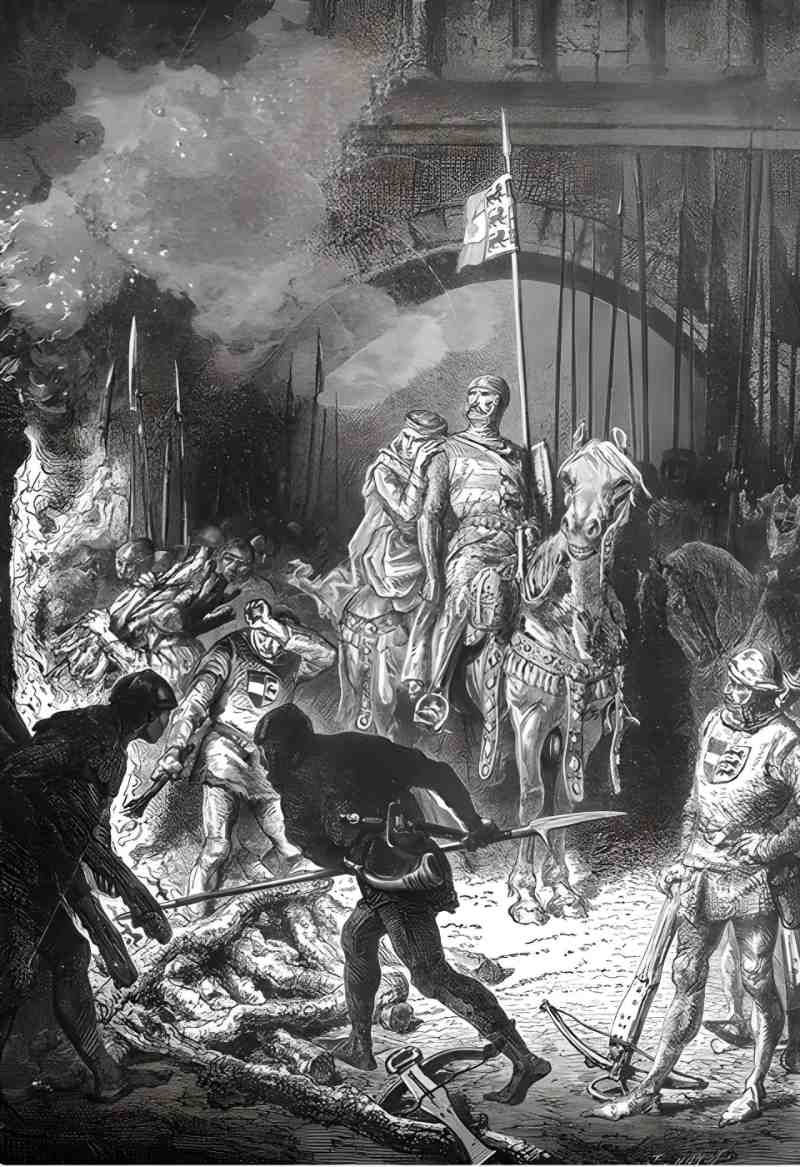
By defeating the Navarrese knight Jimeno of Pamplona in a single encounter to resolve the dominance of several border castles that the kings of Castile and Navarre were battling over, Rodrigo gained even more status as a royal lieutenant in the court of King Sancho II.
In spite of his animosity towards Rodrigo Díaz following the Battles of Llantada (1068) and Golpejera (1072), which resulted in the new monarch being forced to seek refuge in the Muslim court, Alfonso VI, who succeeded Sancho II after his death in the Siege of Zamora, honored him by giving him the hand of Lady Jimena Díaz, apparently the daughter of Count Diego Fernández and a relative of the monarch himself.

Alfonso VI showed Rodrigo respect in spite of his animosity by giving him his cousin Jimena as a bride.
The ways of El Cid
After a Muslim invasion of the Castle of Gormaz, “El Cid” had one of his most memorable occurrences (Soria). As soon as Rodrigo Diaz heard the news, he assembled his troops and marched into the Kingdom of Toledo to look for the perpetrators. But King Alfonso’s intentions were derailed by Rodrigo’s sudden move, and so he exiled him.
When King Alfonso VI of León was fighting for territory in Toledo without Rodrigo’s assistance in 1081, the Muslims invaded Gormaz (Soria) unexpectedly and won a decisive victory, taking a considerable amount of loot with them. When Rodrigo Diaz heard the news, he went straight to work looking for the perpetrators rather than waiting for instructions from the monarch. Rodrigo’s activities in Toledo, the city from which he returned with as many as 7,000 prisoners (including men and women), thwarted King Alfonso’s efforts to peacefully annex this land. The monarch’s sentence of exile did not include the confiscation of the knight’s possessions.
El Cid was exiled twice
The count of Vivar agreed to aid Al-Muqtadir, King of Zaragoza, in his conflict with his brother Al-Mundir, King of Lérida, Tortosa, and Denia, despite the fact that the counts of Barcelona and Ramón Berenguer II had all refused Rodrigo Díaz’s assistance. In 1082, Rodrigo Díaz won a decisive victory against Berenguer Ramon II at Almenar. Two years later, in 1084, he beat the Aragonese ruler and an Islamic force Al-Mundir, near Morella. During this time, Rodrigo Díaz earned the name “El Cid,” which came from the Arabic term sid, meaning “lord.”
Rodrigo earned the moniker “El Cid” when he defeated Berenguer Ramon II and Al-Mundir during his first exile.
The year 1086 was a turning point in the narrative of the Iberian Peninsula. It is believed that a sizable Almoravid army crossed the Strait of Gibraltar from the Sahara. They claimed to adhere to a strict version of Islam and were prepared to use violence to establish it. When the Almoravids besieged the Murcian citadel of Aledo in November 1088, King Alfonso VI enlisted El Cid’s assistance in breaking the siege. The Alicante region of Villena was scheduled to be the meeting site for the armies of Alfonso and El Cid, but for whatever reason, the two armies never really met.
The epitome of the mercenary
Because of his pivotal role in the so-called Reconquest of the Iberian Peninsula, El Cid is celebrated as a national hero. A real mercenary, however, he battled for his own interests throughout his life, sometimes on the Christian side and sometimes on the Muslim side.
El Cid camped out at Elche, where he was informed that King Alfonso, angry that he had not gotten the desired assistance, had labeled him a traitor. This was the lowest point of a knight’s life, and the punishment was death or exile. From that point on, the Cid led Levante based on his own self-interest as an autonomous leader. He assumed the dominion of the whole Levant in 1090.
After Alfonso VI’s death, the Taifa monarch of Toledo and Valencia, Al-Qadir, began making tax payments to El Cid. El Cid expelled the Catalan count from the Levantine territory after defeating a coalition led by Al-Mundir and Berenguer Ramón II in 1090 at the Battle of Tevar.
Conquest of Valencia
Meanwhile, in the summer of 1092, Alfonso VI advanced on Tortosa (then a tributary of El Cid) and Valencia itself, forming an alliance with the King of Aragon, the Count of Barcelona, and the towns of Pisa and Genoa, whose respective men and ships participated in the operation. However, the grand scheme ultimately failed, and Alfonso VI was soon forced to return to Castile from Valencia. At the same time, El Cid, who was in Zaragoza seeking an alliance with the King of the Taifa, launched a severe expedition into La Rioja as revenge.
In the years that followed, Ibn Jahhaf, the man who would later kill Al-Qadir, led relentless operations to seize Valencia. Cid encircled the city in 1093, and conditions there quickly deteriorated. After a year-long siege in which El Cid’s army utilized war machines to severely damage the city walls, Valencia ultimately surrendered on June 17, 1094, when El Cid declared himself “Prince Rodrigo el Campeador.”
But the Almoravids didn’t give up, and in September of that year, a force led by Muhammad ibn Tashfin reached Quart de Poblet, only five kilometers from the capital, and besieged it, only to be soundly destroyed by the Cid.
During his reign as Prince Rodrigo el Campeador, the El Cid took control of Valencia in 1094.
Jimena, El Cid’s spirited widow, kept the local resistance going for two more years after her husband’s death, until they finally capitulated to the Muslim onslaught. She took El Cid’s body with her when she fled Valencia, and buried him at the monastery of Cardea. After many trials and tribulations, El Cid’s bones were reinterred in the Cathedral of Burgos, where his grave can still be seen today.