For the first time, an unusual aircraft was observed in the skies in 1923. This was the “autogyro” aircraft, which had a rotor and a propeller and was designed by the Spanish engineer Juan de la Cierva. Autogyros are now only used by hobbyists and are being phased out in favor of helicopters because of their higher mobility. The most significant aspect of the helicopter design is the complicated mechanism placed in the hub of the rotor, which was initially employed in Cierva’s autogyros.
Who is Juan de la Cierva?
Juan de la Cierva was born to a wealthy family in Mercia, Spain. During his childhood, he decided to become an aviator, inspired by some of the aviation pioneers. In 1911, he went to Madrid to study civil engineering. In the same year, he and his two friends experimented with gliders and founded an aviation company. He built his first plane in Spain in 1912, but in the following years, two of the planes crashed to the ground due to losing altitude at low speed. To overcome this problem, Cierva designed an aircraft, an autogyro with a propeller on the front and rotor blades at the top. The rotor blades were moving faster than the air, which was providing lift power even at slow speeds.
Although some inventors had already experimented with rotors in 1907, there was little to no success. Cierva thought that the rotors should work without a power source and decided to benefit from wind power. When the autogyro was traveling in the air, the rotors would rotate on their own, just like a windmill. This design had one more positive: when the engine stops, the autogyro would not crash. Instead, just like maple seeds, it would keep spinning and make a slow landing.
Cierva secured a patent for his idea in 1920 and started experimenting with miniature autogyros. The models were successful, but when Cierva tried the idea on a full-scale model, the vehicle tipped over. He quickly solved the issue. The rotor blades were going forward for half of the time, towards the oncoming air, and backward for the other half. The forward-moving wing was quicker than the backward-moving wing in this situation. As a result, the lifting force on one side was higher than on the other.

First successful flights
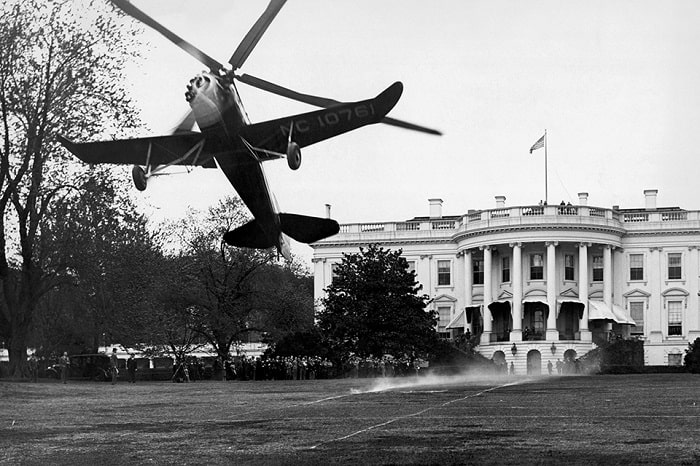
Reviewing the older models, Cierva found that the smaller rotor blades were flexible. Each time the rotors rotated, the blades flexed slowly to accommodate the varying airflow, creating a constant lifting force. Based on this observation, Cierva considered experimenting with larger metal wings. Thus, he added a flap hinge to the point where each rotor blade meets the rotor hub.
In January 1923, Cierva’s first successful prototype, the C4, flew 180 meters at an airport near Madrid. This was the world’s first successful autogyro flight. This flight made the autogyro the predecessor of modern helicopters. Soon, this was followed by longer flights. In 1925, Cierva exhibited the autogyro C6 in the UK, and with the support of an investor, he founded a company called Cierva Autogyro. Three years later, Cierva flew the autogyro C8 from England to France. The blades in the “articulated” rotor of the C8 could curl backward and absorb the drag force. In previous experiments, air resistance caused the wings to break.
New developments followed these experiments. For instance, to allow the autogyro to lift vertically, a new mechanism was developed that operated the rotor only at the time of take-off. But the most concrete change was made when Cierva started to design wingless and tailless autogyros in 1933. Until then, autogyros were operated by moving flaps on the wing and tail, just like fixed-wing aircraft. Thereupon, Cierva decided to develop a method for controlling autogyros by slightly tilting the rotor. He would have to develop a complex system of hinges and control arms around the rotor hub. The system was developed and laid the foundation for all future helicopter rotors.
Unfortunately enough, for a person who devoted his life to finding a solution for altitude loss at low speeds, Cierva lost his life in the passenger seat when a fixed-wing plane crashed into a building immediately after takeoff for the same reason.
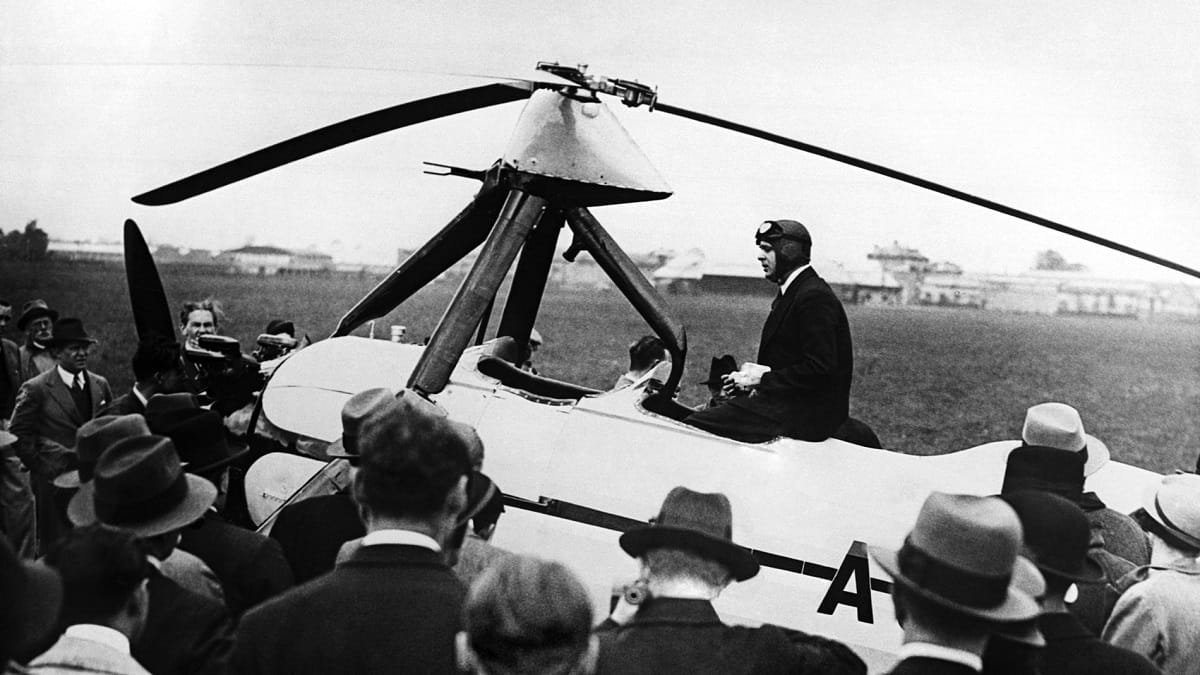
First helicopters
Invented by Juan de la Cierva and later developed by Russian engineer Igor Bensen (1917-2000), the autogyro was convenient, safe, and as fast as some planes. During the Second World War, autogyros were used for various purposes, such as reconnaissance flights or the bombing of submarines. But the autogyros could not hang in the air or make vertical ups and downs. Thus, the helicopters would take over.
The modern helicopter was developed by the Russian-American aviator Igor Sikorsky (1889-1972). Sikorsky built his first helicopters in 1909, but his efforts were in vain. After working on fixed-wing aircraft in the 1910s and 1920s, Sikorsky developed the VS-300, one of the world’s first successful helicopters (1939). He then worked on the design of the Sikorsky R-4, the first mass-manufactured helicopter (1942). Since then, helicopters have undergone very small changes.