Al-Jazari, a great pioneer of engineering, scholar, and polymath. Most people know how the ancient civilizations achieved some of the most dazzling innovations in the scientific and technical fields, such as Egypt, China, India, Greece, and Rome. On the other hand, in the Middle Ages, the Islamic Empire always kept the spirit of scientific knowledge and innovation alive. One of the greatest geniuses in the technical field was Al-Jazari, a mechanical engineer.
Who is al-Jazari?
Badīʿ az-Zaman Abu l-ʿIzz ibn Ismāʿīl ibn ar-Razāz al-Jazarī (in short, al-Jazari) was born in Mesopotamia, today in Cizre in the south of Turkey. Al-Jazari lived in the most brilliant period of the Islamic Golden Age, also called the Islamic Renaissance. The spread of Islam in the seventh century led to the emergence of rich cultures and a stable political system (the Caliphate). In 750 AD, the Caliphate encompassed a vast area extending from the borders of Northern Spain through the Middle East and North Africa in the west and to the borders of China in the east.
Becoming a scientist was a noble achievement since science was highly valued all over the Islamic Empire. Scholars translated the information they collected from other cultures into their language and further contributed to it. From the 9th century to the 12th century, the Caliphate became the world’s leading intellectual center. Stability and scientific knowledge led to a saturation of powerful dynasties and prosperity that prevailed in various regions. Al-Jazari became the chief engineer of the Turkmen Artuqid Dynasty in Diyarbakır after his father left the same post in 1174. Almost everything we know about al-Jazari is based on the book he finished before his death.
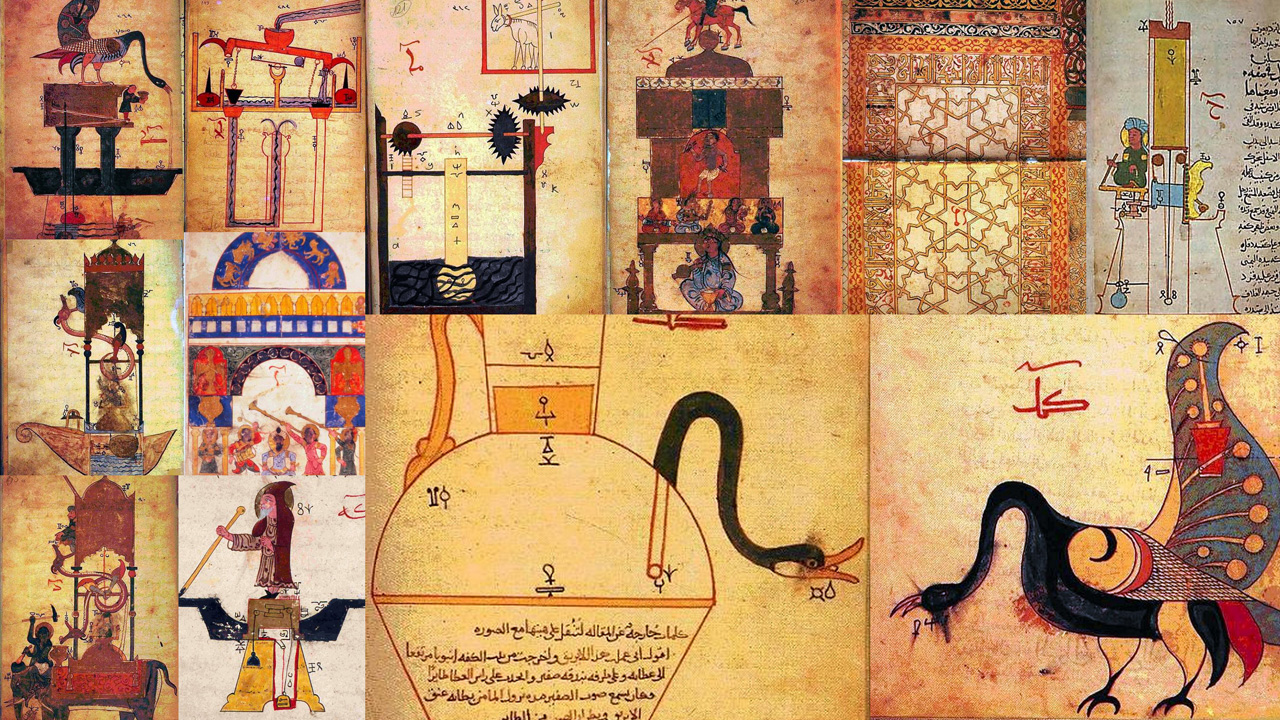
The book is a collection of engineering drawings made by Al-Jazari. According to the introduction, Nasir al-Din Muhammad, the ruler of the dynasty between 1200 and 1222, commissioned Al-Jazari to write this book in 1198. Al-Jazari’s book illustrates in detail 50 inventions that include complex clocks, fountains that regularly change their flow direction, water drawers, and various toys. The book contains illustrations of each invention that show how it is made and how it works.

al-Jazari and his unique designs
With the rise of Islam came great advances in science, mathematics, medicine, and philosophy. Despite the enormous attention and expert applications, engineering was a continuation of the technologies produced by the Greeks and Romans. Of course, there were notable outliers, and some of these creations may be found in Al-extraordinary Jazari’s book. For example, in devices powered by water—or donkey—known power transmission components like gears, levers, and pulleys were utilized.
Thus, in one of his inventions, he provides the first details of the crankshaft in a pump design with a two-way piston that allows converting circular motion to linear motion (or vice versa). Al-Jazari also pioneered the widespread use of the rotary cylinder camshaft with cams. He is also the first to mention such a shaft.
Also, al-Jazari developed the first combination lock and the oldest mechanical water supply system. This system, established in Damascus in the 13th century, provided water to hospitals and mosques in the city. Some of al-Jazari’s strange-looking machines had some automated features: they contained programmed animal or human figures in certain movements. Some are toys that show animal or human figures making certain movements. For example, four musicians in a boat or a girl filling a bathtub.
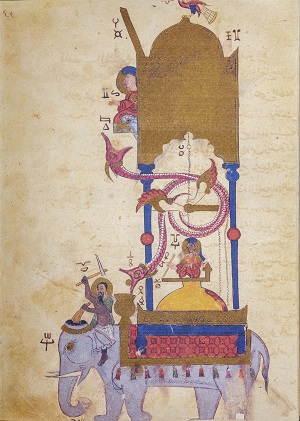
Al-Jazari’s clocks were also more versatile than previous ones. The most impressive of these was the castle clock. With a height of more than 3 meters (9.8 feet), this clock showed the constellations of the Zodiac, as well as the orbits of the Sun and Moon, and there were doors with cardboard shapes coming out every hour. This unique clock could also be set up to take into account the different lengths of the day.

Influence of Islamic knowledge
The center of scientific activity in the Golden Age of Islam was the House of Wisdom in Baghdad. The House of Wisdom, both a library and a translation center, was not only a source of ideas and studies of ancient Chinese and Greek thinkers but also a place where scholars worked with all their competence.
Much of the information that the Islamic scholars of the Middle Ages transformed and spread to Europe in the 12th and 13th centuries. Many European scholars who devoted themselves to science began to investigate the studies in Spain and Italy after these regions came under Christian sovereignty. They translated everything into Latin. Their work was the basis of early scientific research in Europe.
The works of Islamic scholars, mathematicians, astronomers, and physicians included significant developments in fields such as atomic theory, optics, surgery, chemistry, and mathematics. These scholars were the source of the Scientific Revolution that began in the 16th and 17th centuries at the universities of medieval Europe.