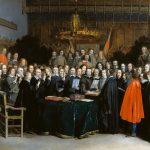
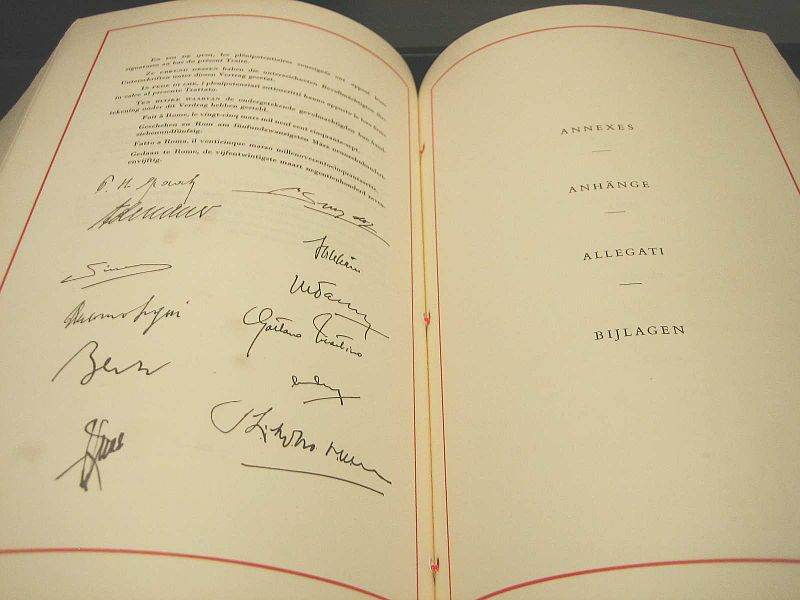
The European Economic Community was created on March 25, 1957, when officials from the Federal Republic of Germany, France, Italy, Belgium, the Netherlands, and Luxembourg signed the Treaty of Rome (EEC). This pact, which grew out of work begun inside the ECSC, was a significant symbolic step forward in Europe’s integration (European Coal and Steel Community, created in 1951).
To promote economic cooperation among its member nations, the Treaty of Rome, signed in 1957, established the European Economic Community (EEC). As a result of its incorporation into the foundation of the newly established European Union in 1993, it was rebranded as the European Community (EC).
The beginnings of the European Economic Community (1957)
In 1951, the European Coal and Steel Community (ECSC), a European Community body in charge of Europe’s coal and steel sectors, was established. This marked the beginning of the integration of Europe. After the European Defense Community plan fell through, Jean Monnet and Robert Schumann pushed for the formation of a customs union, the European Economic Community (EEC). The plan called for a Parliamentary Assembly (the forerunner to the present European Parliament), a Court of Justice, the Commission (the supranational executive), and the Council of Ministers (the intergovernmental council).
When the new organization was formed, its stated purpose was nothing less than the full economic integration of its member nations into a single market. Free trade between member states (including the elimination of customs duties and the establishment of a common external tariff), free movement of factors of production (capital and labor), free competition, and freedom of enterprise are all stated goals of the European Community Treaty, which was signed in Rome in 1957.

To defend the Community’s agriculture against cheap imports and to secure the income of farmers, industrial programs, transport policies, etc., the treaty created a common agricultural policy (CAP) in 1962, which set guaranteed common prices for agricultural and livestock output. Current EU policies are still determined by the Economic and Monetary Union (EMU).
Introducing Europe’s new institutions
As of January 14, 1958, the pact was legally binding. Many of the EEC’s institutions took their cues from the ECSC, and there were even some overlaps between the two organizations. The ECSC’s “high authority” has been transferred to the Commission, the organization responsible for formulating policies and protecting both the ECSC’s treaties and the interests of the Community.
The decision-making authority rests with the Council of Ministers (the meeting of ministers from each member country for a certain sector, such as agriculture), an intergovernmental rather than supranational organization. The European Economic Community (EEC), the European Community (ECSC), and the European Atomic Energy Community (Euratom) share a number of institutions, including the European Court of Justice (the judicial body) and the Assembly (later called the European Parliament, where citizens of Europe are represented and which holds some legislative power). An additional treaty was negotiated in 1965 with the intention of combining the Commission and the Council of Ministers with the ECSC and Euratom. This treaty entered into effect on January 1, 1967.
On September 20, 1976, the representatives of the governments of the Member States enacted a law instituting universal suffrage for the election of the European Parliament, as stipulated in the Treaty of Rome. In 1979, the first vote was held using this method.
From the EEC to the European Union
Most people would point to the Single European Act, which was signed on February 28, 1986 and entered into effect on July 1, 1987, as the first significant amendment to the treaties. Actually, it’s not just one act, but two: one to amend existing Community legislation (on an institutional level, this is the addition of a court of first instance to the European Court of Justice), and another to establish political cooperation in foreign policy.
There is little doubt that the institutional framework we have in place now safeguards national vulnerabilities while also allowing the concept of a supranational body to gain traction. It was this tension between governments and supranational organizations that would form the backbone of arguments over the EEC’s future development, ultimately leading to the formation of the European Union as we know it today (Maastricht Treaty, 1992).
After a failed vote in 2005, Europe currently has a unified currency, the Euro, and a Central Bank, but it does not have a constitution. The present operation of the European Union, which currently consists of 27 countries, is governed by the Treaty of Lisbon, which was signed in 2007.
Bibliography
- “European Community”. Encyclopædia Britannica
.
- “Introduction to EU Publications”. Guide to European Union Publications at the EDC.
- Derek Urwin, University of Aberdeen. “Glossary of The European Union and European Communities”.