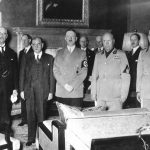
The major wartime commanders in the fight against the Third Reich gathered in the Crimean resort of Yalta from February 4–11, 1945 to plan for a new global order in the wake of Germany’s impending defeat. The leaders of the world’s three superpowers were all there: Joseph Stalin for the Soviet Union, Winston Churchill for the United Kingdom, and Franklin D. Roosevelt for the United States.
- How does the Yalta Conference fit into history?
- What were the dates and location of the conference?
- What was the purpose of the Yalta conference?
- Why was France not present at the Yalta conference?
- But why such an exclusion of France?
- What decisions were taken at the conference?
- What are the results of the Yalta conference?
For several days, they will strive to come to a consensus on how to go forward in order to set the tone for this momentous conference. The goal was to finish the war as quickly as possible but also to establish the groundwork for a durable restoration of peace in a Europe freed from Nazi rule. At the conclusion of this conference, the United Nations Organization (UNO) was formed to ensure global stability.
How does the Yalta Conference fit into history?
The three major World War II winners—Joseph Stalin, Winston Churchill, and Franklin D. Roosevelt—met at the Yalta Conference in February 1945. World War II broke out in September 1939. The main goal of this conference was to find solutions to the problems brought on by the impending defeat of Nazi Germany. While this historic and significant meeting was focused on the conditions of the German surrender, it also signaled the start of a protracted process of talks between the winners of this brutal conflict to create a new international order.
What were the dates and location of the conference?
In retrospect, it’s clear how pivotal a role this meeting played in World War II was. It took place at Yalta, Ukraine, between February 4 and 11, 1945. Yalta is a popular vacation destination in the Crimea, and it can be found on the northern coast of the Black Sea, not far from the city of Livadia. The summit took place at the Livadia Palace, the summer palace of the last Russian tsar, Nicholas II.
What was the purpose of the Yalta conference?
Germany’s capitulation seemed inevitable, and with it, the end of World War II. After almost six years of war against Nazi Germany, the world’s top leaders gathered at Yalta to establish a new international order. As a result of Hitler’s defeat, the many goals of this landmark summit were as follows:
- Use of a coordinated plan of action to hasten the war’s conclusion, primarily via the involvement of the Soviet Union in the fight against Japan.
- The planning for the future of a Europe freed from Nazi Germany and Hitler’s oppression.
- The establishment of the United Nations, a global body with the power and duty to keep the peace.
Why was France not present at the Yalta conference?
The Yalta conference, which reunited the Allied powers, was the summit gathering of the three main postwar conquerors. Even though General de Gaulle’s temporary government of the French Republic was recognized by the Allies in October 1944, it was not invited to the Yalta conference. Because of this, France was not seen as a triumphant state symbolically throughout World War II. A further humiliation, following the conclusion of four years of occupation endured by the French people, was felt by the French delegate when he was not invited to participate in the meeting.
But why such an exclusion of France?
The French weren’t at Yalta for a variety of reasons. To begin with, General de Gaulle was viewed with suspicion by the United States and Franklin Roosevelt in particular. He was labeled an “apprentice dictator” by the opposition. In contrast to the General’s optimism, the Soviets did not seem persuaded by his suggested strategy of continental balancing. Among the British, Churchill was the lone dissenter who advocated excluding France from the negotiations and instead sparing the country. In fact, the British prime minister desired to have France become a powerful continental partner in the fight against Stalin.
What decisions were taken at the conference?
During World War II, the Allies met for days to debate and negotiate the Yalta Accords, which included:
- The development of democratic administrations via free elections in the freed European republics.
- The United Nations was formally established when the United Nations Charter was signed during the San Francisco summit between April 25 and June 26, 1945.
- The USSR’s entry into the war against Japan.
- The eradication of German militarism and weapons.
- The victorious Allies partitioned Germany into three sections, which they then occupied in turn. After some time, France was granted a fourth zone of occupation thanks to Churchill’s backing and General de Gaulle’s mobilization.
- Poland’s relocation to the western side of the Soviet Union was to create new boundary lines. This nation gave up some land to the Soviet Union but gained back some areas that Germany had occupied.
- The formation and operation of the UN is a guarantee of peace and security throughout the globe. The United States, the Soviet Union, the United Kingdom, France, and China, all of whom have the authority to veto any decisions made by the Security Council, will agree on its foundation.
What are the results of the Yalta conference?
The Yalta Conference in February 1945 was a watershed moment. In light of the impending defeat of Nazi Germany, it seemed to be the only way to deepen the links of trust and collaboration that united the major Allies and winners of World War II. Germany was to be demilitarized and divided into three occupation zones, and this plan was agreed upon by all parties involved. A fourth zone would be added to France in the future. By holding fair elections, the other European nations will have the same chance at self-determination.
However, additional demands will emerge from these concerns of collaboration and peace, and many of the various aspirations of the allied countries will become clear. As a result, the Yalta accords give the appearance of being a huge victory for Stalin. Although he advocated for peace, all of Eastern Europe was ultimately subject to Soviet dominance. In a short amount of time, the continent was effectively split in two by the Iron Curtain, which marked the beginning of almost fifty years of conflict between two radically different philosophies. In the early decades of the twentieth century, the Cold War emerged as another significant war with no open hostilities between opposing nations.
Bibliography:
- Beevor, Antony (2012). The Second World War. New York: Little, Brown and Company. p. 709. ISBN 978-0-316-02374-0.
- Truman 1973, p. 208
- Fenby, Jonathan (2012). The General; Charles de Gaulle and the France he saved. Skyhorse. pp. 280–90.
- Pavel Polian. Against Their Will: The History and Geography of Forced Migrations in the USSR. Central European University Press 2003 ISBN 963-9241-68-7 pp. 244–49
- “Agreement Regarding Japan,” Protocol Proceedings of the Crimea Conference (February 11, 1945). Online.
- Leffler, Melvyn P. (1986). “Adherence to Agreements: Yalta and the Experiences of the Early Cold War”. International Security. 11 (1): 88–123. doi:10.2307/2538877. JSTOR 2538877. S2CID 153352217.
- “Potsdam Declaration”. Ndl.go.jp. July 26, 1945.