Did Charles Martel really save western Europe from the Arabs? Psychologists would undoubtedly have a fit if they knew Charles was at a disadvantage in every way while his half-brothers flourished under their father’s reign. In fact, not even the court historians paid attention to him. In the end, his father disinherited him, and his stepmother sent him into captivity. He probably would have been executed if he hadn’t escaped. No one knows for sure what effects this had on the young Charles’ mind. Charles Martel (ca. 688/91–741), the prince who slayed his opponents like a hammer, did everything he could from that point on to live up to his moniker.
Charles owed his delay to his mother Alpaida, who was likely simply a concubine of his father Pepin, whom Charles met long after Pepin’s marriage to the power-conscious Plectrude. She gave birth to Drogo and Grimoald, who went on to hold the greatest posts in the Frankish Empire.
Read Also
- Battle of Tours: End of the Arab Invasion of Europe
- Merovingian dynasty: The first race of the kings of France
- Charlemagne: King of the Franks and Emperor of the West
- Carolingian Empire: The empire that gave birth to Germany and France
Pepin of Herstal was the Mayor of the Palace of Austrasia, which was the name of the eastern part of the empire. After his victory over the western Neustrian nobles, he ascended to the position of the most influential man in the region. The Merovingian monarchs’ reign was at best nominal. The household emperors, who served as ministers, were wielding the actual power.
However, Drogo and Grimoald both passed away before their father, prompting Plectrude to do all in her power to ensure that their grandchildren would maintain the typical status of the Arnulfing clan members—later renamed the Carolingians. However, Charles’ stepmother was no match for the nobles of Neustria, who successfully declared war on her. After Charles’s jailbreak in Cologne, several prominent Austrians came to his aid. He overcame his Western opponents and coerced Plectrude into giving him the Merovingian royal riches. From that point on, it was one hit after another.
Charles began by confronting the princes who had supported his stepmother. The Carolingians had an uncompromising desire for power, and their troops plowed through the entire empire year after year, causing misery for the Frisians, Saxons, Bavarians, Alemanni, and, eventually, Neustria and Aquitaine. His political acumen was on display in the way he skillfully played on the animosity between the various families.
The expanding Carolingian territories and the reclaimed royal property supplied the funds for his military endeavors. Similarly, Charles had no qualms about seizing church property. He presumably didn’t care much about learning or culture. The sword became his preferred method of command.
Charles Martel’s Legendary Battle of Tours
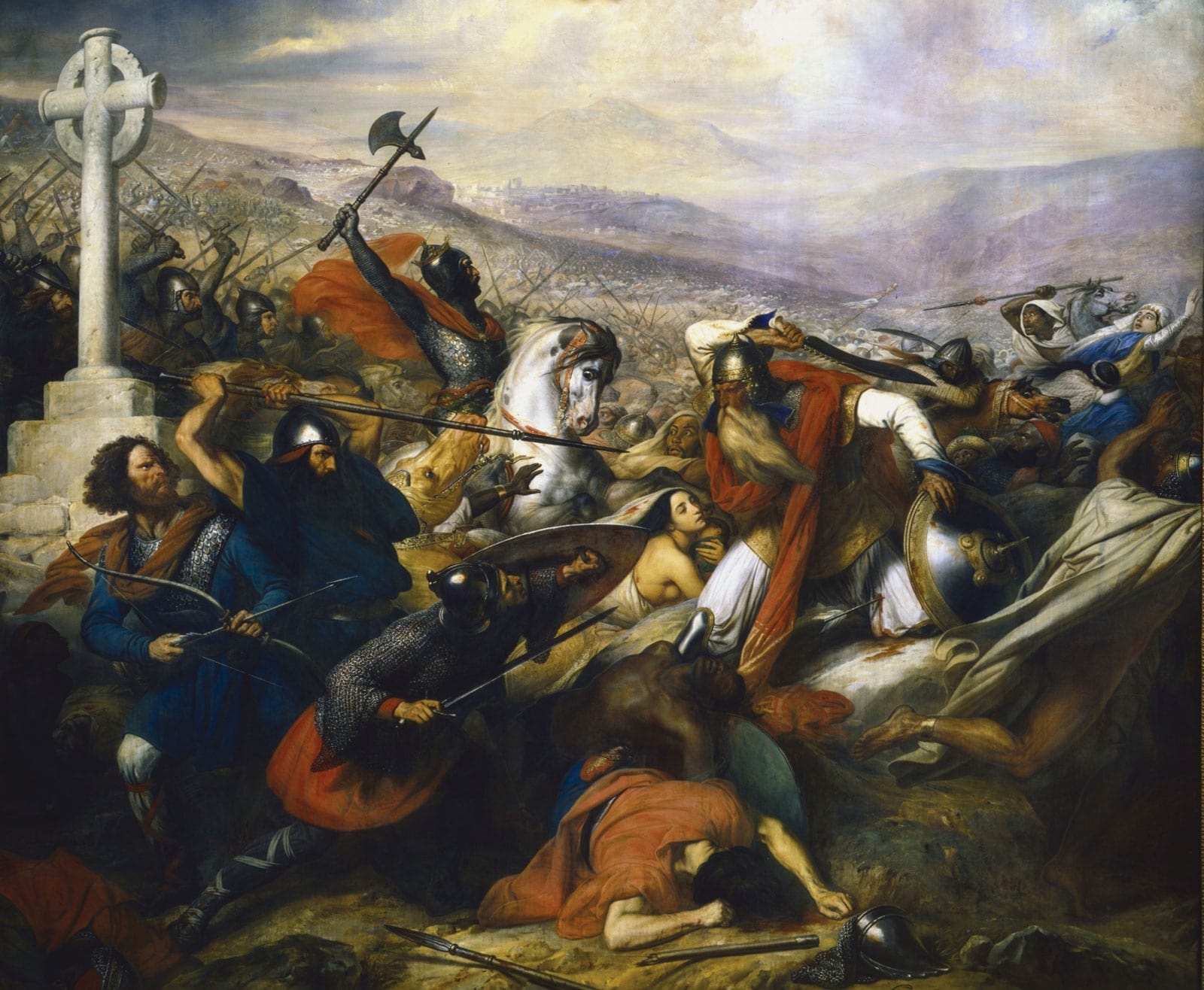
The legendary campaign that Charles led to Poitiers (Tours) in the west in 732 is often recognized as his greatest achievement. Abd al-Rahman, the Muslim governor of Al-Andalus, opposed him. Al-Andalus was a province of the Arab Empire that had been founded on the Iberian Peninsula following the Arab defeat of the Visigoth Empire in 711.

The Umayyad caliphs of Baghdad had repeatedly sent invading troops to Gaul, only to be beaten back each time. Because of the poor condition of the sources, the nature of the assault in 732 has not been resolved yet. Some historians have assumed the invasion was a regular invasion due to the importance of their commanders, while other medievalist historians assume it was one of the customary attacks, which were merely for plunder.
The onslaught continued nevertheless, and the Duke of Aquitaine was powerless to halt it. The prosperous Loire Valley city of Tours appeared to have been the Muslims’ next target. The fact that Charles’ army was bolstered by Lombards, Saxons, Frisians, and Aquitanians indicates how dangerous the Frankish Empire was seen to be. On and around October 25, 732, the two sides fought between Poitiers and Tours for seven days. Abd al-Rahman gave the command to strike on the seventh day.
From what little information we have, it appears that the Franks and their allies battled on foot, while the Arabs and Berbers rode horses. By forming a phalanx, Charles’ troops were able to fend off the onslaught and eventually wipe out the weaker, less well-equipped foe. When Abd al-Rahman was mortally wounded and fell from his horse, the morale of his troops plummeted:
“Prince Charles boldly drew up his battle lines against them [the Arabs] and the warrior rushed in against them. With Christ’s help, he overturned their tents and hastened to battle to grind them small in slaughter. The king Abdirama having been killed, he destroyed [them], driving forth the army, he fought and won. Thus did the victor triumph over his enemies.”
Fouracre, Continuations of Fredegar, p. 149
Was Charles Martel Really the Savior of the West?
His reputation as the “savior of the West” has grown in prominence through subsequent generations. A popular saying goes that if Charles Martel hadn’t won, London and Paris wouldn’t have church steeples but minarets, and Oxford would have taught the Koran instead of the Bible.
However, many historians of the present day view the Al-Andalus ascendancy as nothing more than a preliminary step. And according to others, those preliminary steps could eventually lead to the occupation.
Some medievalists like Johannes Fried offers a fresh take on the meaning of this claim. He defends the fact that Pepin’s son Charles fought against the Saracens and that Duke Eudo of Aquitaine’s triumph formed the foundation of the narrative of the magnificent, all-decisive victory at Poitiers in 732.
Whatever the case may be, Carolingian Charles became the appropriate figure of redemption after his army’s victory over foreign “infidels.” This let people forget the savagery of his early years as “king.” Due to his high status, he was able to administer the Frankish Empire as king following the death of Merovingian shadow king Dagobert Theuderic IV in 737 until his own death in 741. Pepin the Short, Charles’s son, was tasked with expanding the empire and establishing the Carolingians as the second ruling dynasty.
Interestingly, another Arab invasion is more commonly mentioned in conjunction with Charles Martel’s triumph at Poitiers (Battle of Tours). This other one may have altered the path of European history as well: The Caliph Sulaiman launched an attack on Constantinople, the capital of the Byzantine Empire, in 717. The Muslims’ invasion was repelled by the Greeks’ fire, leading to their ultimate defeat.
It is stated that the Arab Empire’s offensive might was permanently weakened by this defeat. While this is true, it ignores the reality that in 751, its soldiers nonetheless penetrated deep into Central Asia and halted Chinese westward progress at the Battle of Talas. When the Abbasids, who succeeded the Umayyads in 750, relocated the seat of their empire from Damascus to Baghdad, which was located in the east of their territory, Byzantium and the rest of Europe disappeared from view from that point on.
Bibliography:
- Fouracre, Paul (2000). The age of Charles Martel. Harlow, England: Longman. ISBN 0-582-06475-9. OCLC 43634337.
- Kreiner, Jamie (2014). The Social Life of Hagiography in the Merovingian Kingdom. New York: Cambridge University Press. p. 29. ISBN 978-1-107-65839-4. OCLC 1089392785.
- Albers, Petrus Henricus. “The Catholic Encyclopedia: St. Lambert”. www.newadvent.org. Robert Appleton Company.
- Barbero, Alessandro (2004). Charlemagne: Father of a Continent. University of California Press. ISBN 0-520-23943-1
- Riché, Pierre (1993). The Carolingians: A Family Who Forged Europe. Translated by Allen, Michael Idomir. University of Pennsylvania Press.