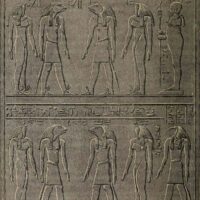
Standing inside the Egyptian Sculpture Gallery of the British Museum in London is a heavily scarred slab of dark green breccia stone measuring roughly three feet by four and a half feet, perforated in its center by a deep circular hole and radiating grinding grooves. Known as the Shabaka Stone, this artifact spent centuries being used as a mundane flour millstone by local villagers before nineteenth century scholars realized that the hieroglyphs surviving around its edges preserved one of the most profound philosophical masterpieces of the ancient world: the Memphite Theology, an account in which the universe is created not through physical biological acts, but through the rational thought of the mind and the spoken word.
Pharaoh Shabaka’s Rescue of a Worm-Eaten Papyrus
The stone takes its name from Pharaoh Shabaka (reigned circa 705 to 690 BC), a Nubian ruler of the Twenty-Fifth Dynasty who hailed from the Kingdom of Kush in modern Sudan and conquered all of Egypt to reunite the fractured country. Unlike foreign invaders who imposed alien customs, the Kushite pharaohs viewed themselves as the devout restorers of pure, ancient Egyptian orthodoxy, revering the Old Kingdom pyramid builders and the traditional cults of Memphis and Thebes.
According to the introductory inscription carved across the top two lines of the monument, while Pharaoh Shabaka was inspecting the great Temple of Ptah inside the ancient capital of Memphis, he discovered a priceless sacred scroll inherited from the ancestors that was slowly being devoured by worms and falling to pieces. Determined that this ancient wisdom should never be lost to time, Shabaka ordered his royal scribes to copy the surviving text of the decaying papyrus directly onto a slab of solid, indestructible black-green stone—creating one of history’s earliest documented acts of archival preservation.
The Memphite Theology: Creation by Mind (Heart) and Tongue
Before the decipherment of the Shabaka Stone, Egyptologists knew mostly the creation myths of Heliopolis and Hermopolis, in which the primeval sun god Atum created the first gods through physical bodily processes such as sneezing, spitting, or self-fertilization. The Memphite Theology preserved on the Shabaka Stone presented a radically more abstract, intellectual cosmology designed to elevate Ptah—the patron deity of Memphis, craftsmen, and architects—above all other gods in Egypt.
According to the inscription, Ptah brought the entire cosmos, the other gods, cities, temples, and every living creature into existence through two organs working in harmony:
- The Heart (Mind and Conception): In ancient Egyptian anatomy, the heart was the seat of rational intellect and imagination. Every divine concept, architectural form, and natural law first arose as an idea inside the heart of Ptah.
- The Tongue (The Spoken Command): Once the heart had conceived the thought, the tongue of Ptah pronounced the name of that thing aloud as an authoritative royal decree, turning invisible thought into physical reality.
Historians of philosophy and religion have long marveled at this passage. Written centuries before the Pre-Socratic Greek philosophers formulated the concept of the Logos (Divine Reason or Word) and millennia before the opening lines of the Gospel of John (“In the beginning was the Word”), the priests of Memphis had already articulated a doctrine of creation through divine intelligence and speech.
How a Sacred Monument Became a Flour Millstone
In addition to the creation myth, the surviving columns of the Shabaka Stone recount the mythological trial between the warring gods Horus and Set. In this account, the earth god Geb initially divides Egypt into two halves—giving Lower Egypt to Horus and Upper Egypt to Set—before changing his mind and awarding the entirety of the united kingdom to Horus at the exact border junction of Memphis, providing the divine justification for why Memphis stood as the supreme administrative capital of the Two Lands.
Tragically, roughly half of the hieroglyphic columns in the center of the stone are completely obliterated today. At some point after the fall of pagan Egypt in antiquity or the Middle Ages, workers scavenged the heavy rectangular slab from the ruins of the Temple of Ptah, chiseled a deep socket right into the middle of the inscription, and used the stone for generations as the lower bedstone of a rotary grain mill, with heavy wooden beams and upper grindstones wearing radial ruts right across the words of Ptah. Presented to the British Museum in 1805 by Earl Spencer, the battered slab remains a miraculous survivor that rescued the deepest philosophical thoughts of ancient Egypt from both worms and millstones.