The amazing photographs of Etna’s eruption in the middle of February 2021 arrived as the volcano saw a dramatic revival in activity. The volcano in Sicily erupted bright jets of lava, which later evolved into flows. The lava fountains from eruptions sometimes rise as high as 3,000 feet. For every one of the roughly sixty volcanoes that erupt each year, the same vocabulary emerges: crater, volcanic ash, fumaroles, lava, magma, etc.
Where can you find the magma?
Magma from the Earth’s interior rises to the surface due to convection currents that shift the mantle rocks and, in turn, the tectonic plates. The word “magma” comes from the identical Latin word meaning “residue of a scent.” It is borrowed from the Greek “μ α ́ γ μ α” which means “kneaded mass, ointment.”
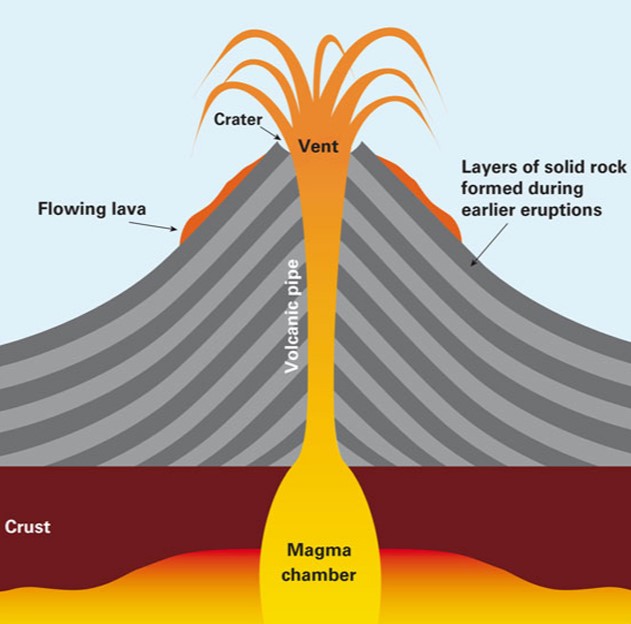
Magma is the term used to describe the molten rock found in volcanic fields’ magma chambers. Gases, liquids, and solids like crystals make up its many components. It is also known as “plutonic rock” if it is destined to stay underground. The magma chamber under the world’s oldest and greatest volcanoes may be hundreds of cubic miles in size, and the magma inside may have been kept in check for generations.
In contrast, lava is what we’re talking about when magma rises to the surface during an eruption thanks to a deft manipulation of temperature and pressure contrasts. So, it all comes down to context: once the magma reaches the surface and starts to flow down the volcano walls, we call it lava. The molten rock that erupts from the crater has a temperature of 1300 to 2200 degrees Fahrenheit (700 to 1200 degrees Celsius). It may rapidly harden when exposed to air.
Different chemical compositions
Since the lava has been partially degassed by the time it reaches the surface, its chemical makeup is considerably different from that of the magma it originated from. Depending on the geological setting, the lava’s composition might vary greatly from one volcano to another.
The magma’s constituent parts will begin to break apart throughout the eruption, releasing their constituent gases in the form of rising bubbles that will explode once they reach the summit. There, two different sorts of events may occur: effusion, in which lava flows after erupting from the crater, and eruption, in which the magma does not have enough fluidity to prevent it from erupting.
However, if the magma is very thick, the gas bubbles will expand under their own pressure and rupture openly, projecting magma across vast distances. Explicit energy like this is what we mean when we talk about explosive dynamics.
Magmas and lavas come in a variety of forms
The silica concentration of magma is one distinguishing feature; this mineral is also present in the make-up of glass and quartz, and it distinguishes between the many forms of magma. In Hawaii, for instance, the “mafic” magmas are distinguished by their low silica concentration. With temperatures around 1800°F (1000°C), they are not very thick.
Magmas from Sicily are less fluid because of the high concentration of silica. Compared to mafic magmas, they are much cooler. Rhyolitic, phonolitic, andesitic, and basaltic lavas are all varieties of lava that form from different types of magma.