When a drop of water hits a soapy liquid, it might surround itself with a thin film of air and sink slowly with the soapy water. The success of this method is contingent upon the manner in which air is displaced at first contact with the liquids. A drop may appear as the antonym of a bubble. At first glance, this seems reasonable, but it’s not, for the simple reason that a bubble is a sphere of air encased in water, and hence exists in the air.
An air-encased water ball would be the polar opposite of a bubble. And “anti-bubbles” are actually real. They may form accidentally when droplets of a liquid are dropped into another.
It is possible to produce antibubbles. You can make perfect soap bubbles in water by adding a few drops of dish detergent. A drinking straw submerged a few millimeters into the fluid will do this (1 gram of dish detergent per 1 liter of running water).
Then, you finger the top shut and raise it a scant few millimeters above the surface. You may make an antibubble approximately 0.40 inches (1 centimeter) in diameter by uncovering the entrance and directing the filling so that it shoots out.
How does antibubble form?
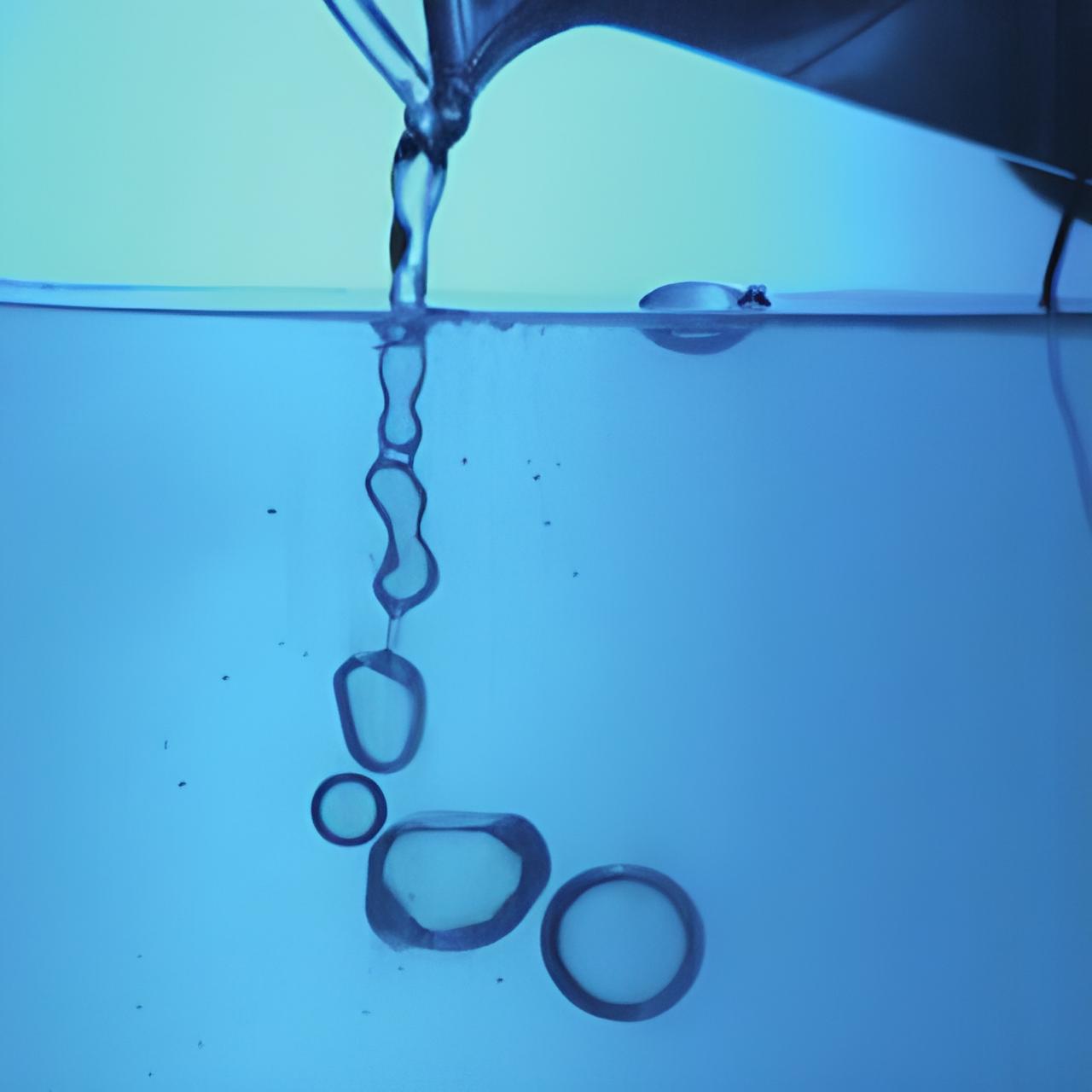
When you pop a soap bubble, you get a similar result. It is made when a thin film of soap is stretched by a current of air, and the resulting tubular structure contracts to form a sphere at a certain length.
When a droplet is submerged in water, its brief drop is long enough to “transport” the layer of air compressed on collision with the surface of the liquid. As a result, the air film around the submerged area expands and then contracts, creating a balloon-like expansion.
Visualize a layer of water colliding with the water’s surface due to the force of gravity. There is air in the gap between them, and it is pushed to one side.
As long as it’s able to move freely, there’s no need to worry. However, once the distance is below a certain value, the flow behavior of the fleeing air is increasingly determined by conventional interfacial forces.
It is being pushed out of the gap and squeezed in at the same time. Because of this, the gas molecules are now bound to one another and cannot freely travel across space. Instead, a laminar flow is created.
This implies that air molecules near the water’s edge are attracted to the liquid and accelerate into the water’s core. The air’s roughness also has a greater impact on a narrower gap. The airflow is slowed as a result of the greater frictional force caused by this. Simply said, this makes the envelope conditions rock solid and immune to outside disturbances.
The factors against the antibubble
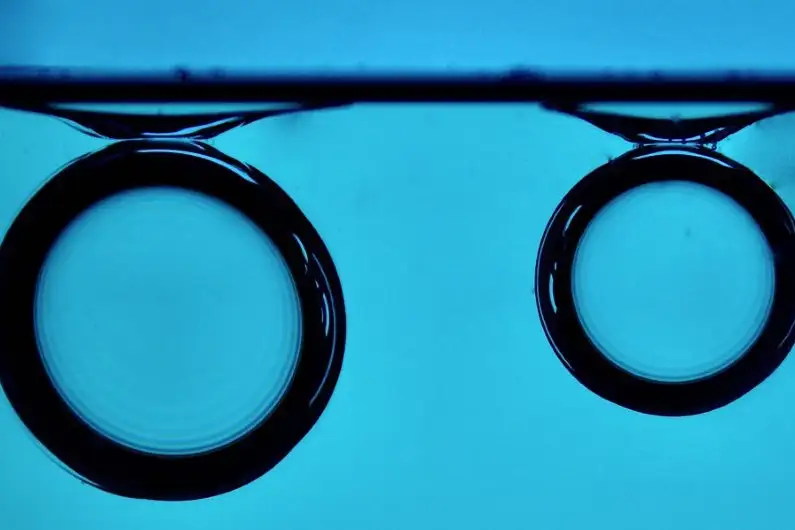
However, unlike with solid walls, the limits of the compressed air are not stable but rather fluid. Due to the frictional force, the surrounding water might be dragged along.
In such a case, the velocity of the air flow would not decrease; rather, it would continue to be high, but thin, and easily damaged. This would work against the development of an antibubble.
The surfactants given with the rinse agent have a role in this. These molecules are long and thin, with one end being hydrophilic (attractive to water) and the other end being hydrophobic. They congregate where the gas and liquid phases meet.
Entrainment of the liquid boundary layer would decrease the concentration of the surfactant molecules collected there and raise the surface tension, minimizing the energy there and stabilizing the air flow.
In response, the system generates a counterflow that keeps the boundary layer’s surfactant concentration constant. The tension between these two forces strengthens the fortifications.
Like soap bubbles, antibubbles have a finite lifespan and a difficult birth process. Both try to achieve a spherical form in order to reduce the amount of energy lost at the interface. As the bubbles’ centers of gravity drop, they release energy into the surrounding medium.
When a soap bubble bursts
Soap bubbles burst at their weakest point because the liquid within the skin slowly drips down owing to gravity. Additionally, gravity has an effect on the antibubble. In this case, the inner water ball uses its weight to exert progressive upward pressure on the air envelope. This causes the bottom gas layer to become so thin that it explodes.
When a soap bubble bursts, the lye particles in the air condense into tiny droplets and fall to the ground.
Here, the situation is exactly the opposite, as the air envelope fragments contract into water-borne bubbles that rise to the top as an antibubble.