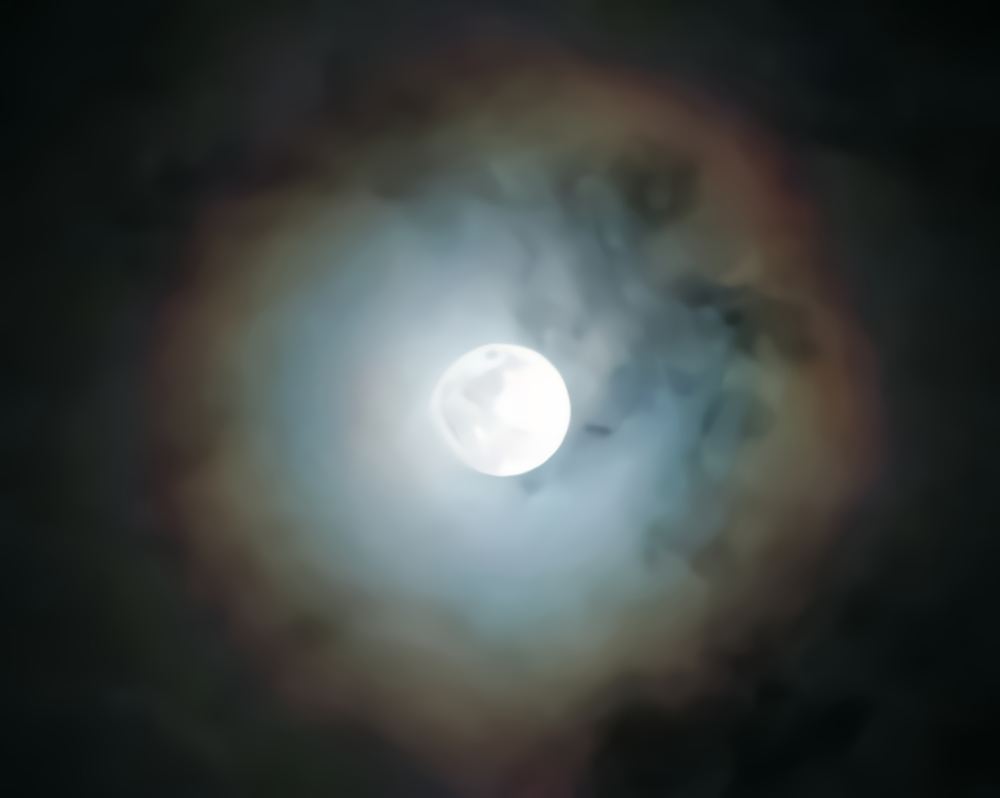
A bright full Moon illuminating the night sky is a sight to see. The gleaming disk contrasts sharply with the inky background. It’s not always easy to tell where one thing ends and another begins, like when the Moon seems to have a dazzling corona around it. Occasionally, the outskirts of this brilliant region may shimmer with a touch of color, creating the impression of a rainbow arc. Yet, what causes this lunar corona?
Astronomer Joseph von Fraunhofer (1787–1826) began looking for a solution to this puzzle around the turn of the 19th century. He had long assumed that the Moon’s coronas and colorful rings originated from Earth’s atmosphere rather than the Moon itself. Then, which is true?
The Formation of the Lunar Corona
A corona is any optical phenomenon caused by the diffraction (bending) of light by microscopic ice crystals and water droplets in a cloud or on a foggy glass surface, reflecting from the Sun or Moon. A corona consists of many colored rings surrounding the celestial object and a central brilliant spot dubbed “aureole.”
Small particles in the atmosphere looked to be the most likely culprit of the lunar corona. Because the Moon’s rays could be reflected and refracted by them. You can conduct an experiment to demonstrate this, in which you spread a large number of tiny glass beads on a glass panel, let a beam of light pass through the beads, and watch the entire thing through a flimsy telescope.
As predicted, in the 19th century, Fraunhofer saw a rainbow corona surrounding the light source. In his 1825 book, the scholar explained, “The colored rings obtained in this way are the larger the smaller the glass beads are.”
Understanding the Lunar Corona Effect
We can duplicate the lunar corona effect with a simple experiment by breathing on a cool window glass and looking through it at a light or candle. You will see rainbows emanating from the center of the beam.
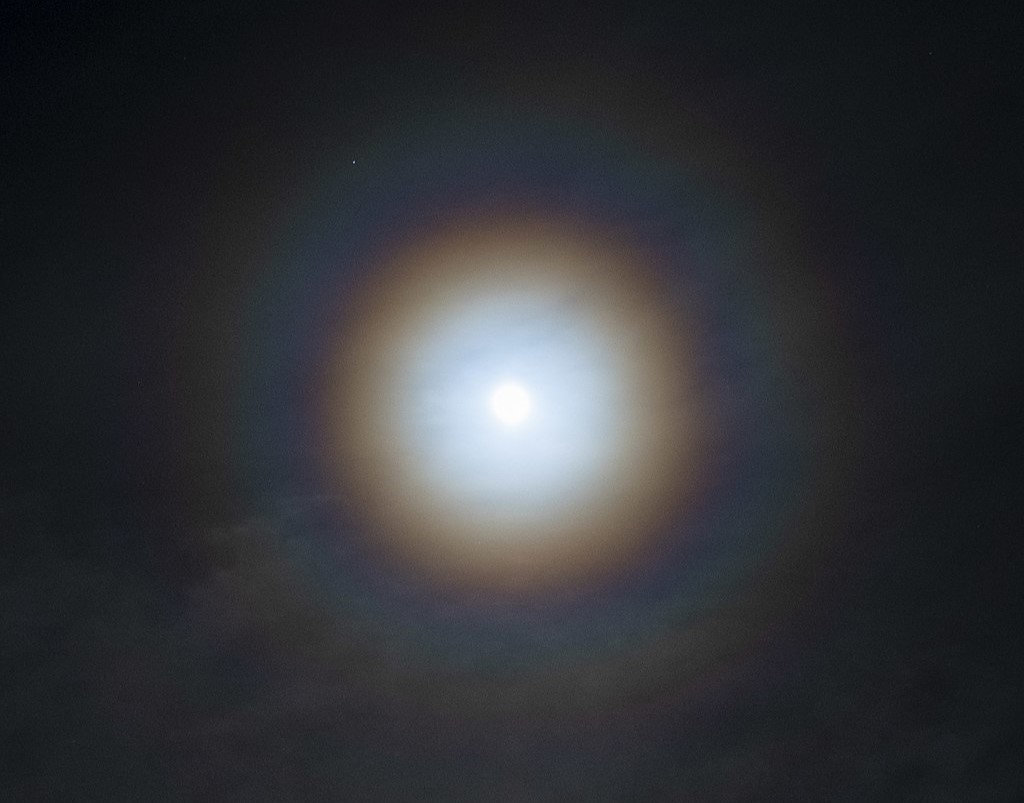
Tiny droplets on the window’s surface deflect the light beams to varying degrees, with the amount of deflection varying with the light’s wavelength. Because of this, they disperse into their component colors, creating a rainbow effect. In general, the red rings tend to be farther in than the blue ones, due to their longer wavelength (the same applies to the rainbows). In fact, this is how the Moon’s iridescent lunar rings come to be.
However, we also discovered the reason why the corona surrounding the Moon is sometimes completely white, which is called a “halo.” If the spheres of particles in the air have very different diameters, the individual colors can no longer be perceived. This is because, in each case, the light will be refracted and diffracted somewhat differently. The result is that our eyes will only be exposed to pure white light—everything will be illuminated in a single color.
Microscopic Crystals and Drops
More is understood today about the atmospheric “haze globules” that Fraunhofer first described. These microscopic particles can be found around us in the form of ice crystals or raindrops. They can only be a hundredth of a millimeter in size, however. When compared to the size of the rest of the sky, the water droplets that form a rainbow are enormous. The small droplets in the upper atmospheric layers typically generate a colorful corona. Clouds with a fine, transparent layer, known as altostratus, are most ideal for lunar and stellar coronas.
The Moon’s rays are deflected when they collide with the small droplets or crystals and are reflected back away from their source. This deflection works even on nontransparent particles like fine dust. The lunar corona may be seen even when there is a lot of it in the air, including pollen dust that can be seen with the naked eye.
Sources:
- Brand, John C. D. (1995). Lines of Light: The Sources of Dispersive Spectroscopy, Gordon and Breach Publishers. ISBN 978-2884491624.
- Hockey, Thomas (2009). The Biographical Encyclopedia of Astronomers.
- Cowley, Les. “Corona”. Atmospheric Optics.