By using this site, you agree to the Privacy Policy.
Accept
MalevuzMalevuz
  • HISTORY
  • SCIENCE
  • BIOGRAPHY
MalevuzMalevuz
Search
  • HISTORY
  • SCIENCE
  • BIOGRAPHY
Follow US
Malevuz > History > The Story of Picasso’s Guernica Painting
History

The Story of Picasso’s Guernica Painting

Hrothsige Frithowulf
ByHrothsige Frithowulf
History Editor
Hrothsige is a history writer at Malevus. He has a bachelor's in history from the University of Exeter. Hrothsige's areas of historical interest encompass the ancient...
- History Editor
11 December 2025
Share
4 Min Read
SHARE

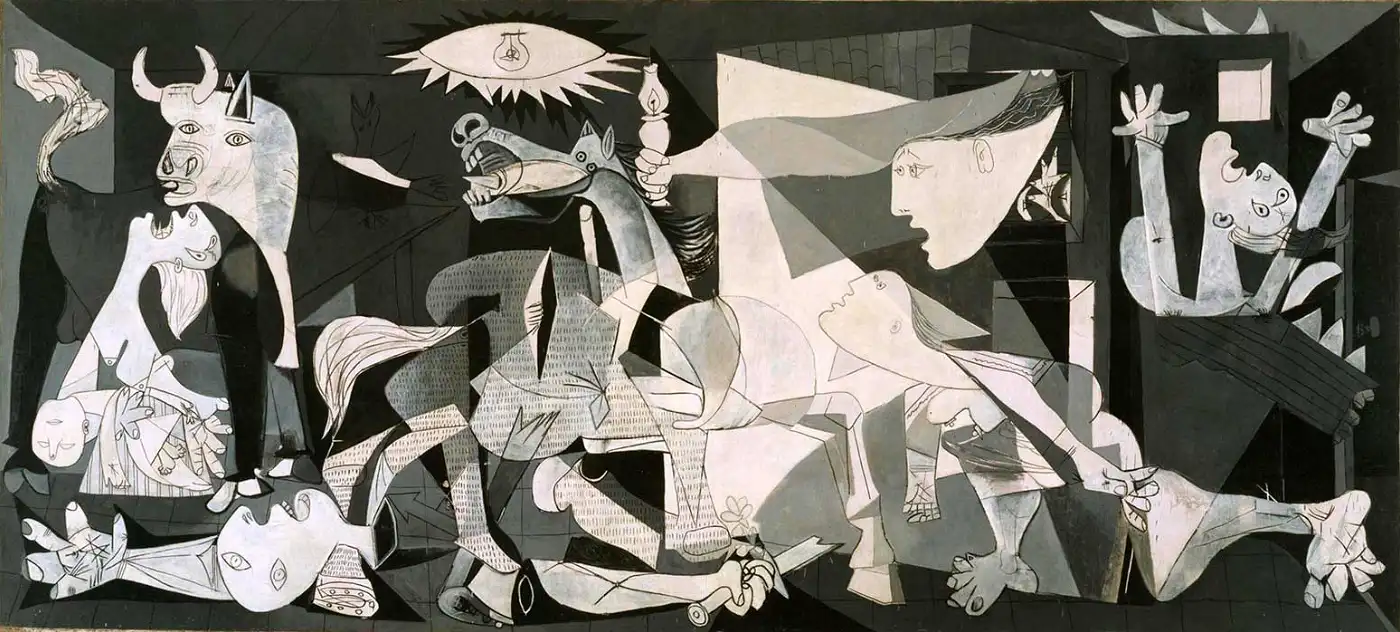
One of Pablo Picasso’s most renowned paintings, Guernica (1937) shows the bombardment of the titular city during the Spanish Civil War and is widely regarded as a strong allegory for the horrors of war.

Contents
  • Representations of the Spanish Civil War in Guernica
  • Women, men, and animals in turmoil
  • Guernica is a work of democracy

Representations of the Spanish Civil War in Guernica

Pablo Picasso, then a Parisian artist, was commissioned by the Spanish Republic to produce an artwork for the 1937 World’s Fair. But he still needed to find a topic, since the Spanish artist lacked inspiration in the late 1930s.

As political upheaval spread throughout Europe, he saw his own creative process stall. There has been a horrific civil war between Republicans and Francoists in Spain since 1936.
The story of Picassos Guernica painting 2
Pablo Picasso, Guernica, 1937, Centro de Arte Reina Sofia

On April 26, 1937, the Basque city of Guernica was bombed by the German Condor Legion, an ally of Franco’s, in an effort to intimidate the local populace into switching sides and abandoning their support for the Republicans.
More Read

Ancient Greek Temples
10 Ancient Greek Temples You Should Know
First White Terror (1795): Royalist Vengeance Against Revolutionary France
Akanbe: Meaning and Origin of the Facial Gesture
September Massacres: A Bloody Episode of the French Revolution

The onslaught, which started at 4:30 p.m. and continued for more than three hours, turned the landscape into one of dread. The streets of the destroyed city are littered with the remains of the dead. 1,645 people out of a total population of 7,000 were killed, with another 889 injured.

The following day, at the Café de Flore in Paris, Pablo Picasso read the newspaper and found out the news. It was settled; he would be studying this topic. As a nod to the black-and-white source material of the news, he opted not to use color.

Women, men, and animals in turmoil
Guernica 2

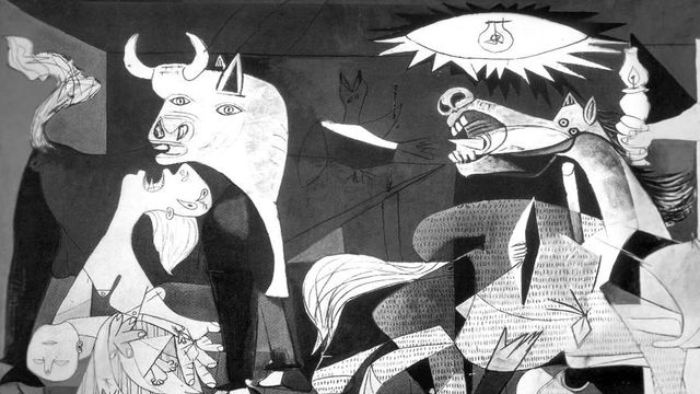
The horrors of war are shown all over the 11.5 ft x 25.5 ft (3.49 m x 7.77 m) painting. Michelangelo’s Pietà, in which the Virgin weeps for her slain son, may be alluding to the woman bearing her dead child in her arms and gazing up at the sky in a scream of grief in Guernica.

Picasso’s depiction of the horse has a skull and crossbones in its mouth and nostrils, if one looks carefully enough. The bull’s intense stare, which represents Spain, appears to implore the observer to come to its aid.
More Read

musicians
Jobs That Roman People Practiced
Oenomaus: A Rebellious Slave Leader During the Third Servile War
Dicastery: A Greek Term Used by the Vatican
Robert Fortune: The tea spy, and the most profitable heist ever

However, the artist depicts a few symbols of peace, such as the dove, which is there but unobtrusively between the horse and the bull, or the lady who arrives at the window carrying a lamp, which may signify hope or the illumination of an event of global importance.

Guernica is a work of democracy

The 1937 Paris World’s Fair was when Guernica first gained international attention; it went on to be shown in a number of other countries before being acquired by the Museum of Modern Art (MoMA) in New York. As long as Spain was not a democracy, Picasso had no interest in having his art shown there.

Pablo Picasso passed away in 1973, and then Franco two years later. The Spanish Senate began the process of returning the work to Spain in 1977 on the grounds that “freedoms are guaranteed.”

The piece was first restored to the Prado Museum in 1981, after the country’s democratic win, and then moved to the Reina Sofia Museum in Madrid in 1992.


Share This Article
Email Copy Link Print
ByHrothsige Frithowulf
History Editor
Hrothsige is a history writer at Malevus. He has a bachelor's in history from the University of Exeter. Hrothsige's areas of historical interest encompass the ancient world and early Europe, along with the history of modern culture.
Previous Article The Birth of Venus and the story around the masterpiece
Next Article Why Did the Maya Civilization Disappear?

Latest News

985px Landing of Lieutenant James Cook at Botany Bay 29 April 1770 painting by E Phillips Fox

Top 10: The Greatest Knights in History

Knights were the medieval equivalent of elite soldiers, and many…

List
3 November 2026
Charles Rolls driving a Peugeot 1896
List

10 of the Craziest Laws in History

For more than 4,000 years, humans have devised new laws…

18 October 2026
Ikinci Meksika Imparatorlugu
History

Why Did the Second Mexican Empire Collapse?

The Second Mexican Empire did not collapse because of a…

14 April 2026
A painting depicting Aboriginal Tasmanians attacking John Allen’s Milton Farm near Great Swanport in 1833.
History

Colonialism in Tasmania

The colonization of Tasmania was not a simple story of…

14 April 2026

You Might Also Like

Origin of Christmas tree: From Pagan roots to modern tradition

2 November 2026
berlin wall
History

5 Key Facts About the Berlin Wall

27 October 2026
Liberty Leading the People
History

History of the French Revolutions

2 November 2026

What Language Did Julius Caesar Speak?

11 December 2025
  • Privacy Policy
  • About us
  • Editorial Standards

© Malevuz. All Rights Reserved.

Welcome Back!

Sign in to your account

Username or Email Address
Password

Lost your password?