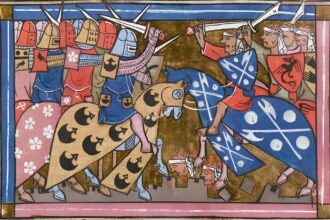
Historians disagree on the exact date, but October 25th, 732 seems to be when the Battle of Tours (Poitiers) occurred. During this period, the Umayyad caliphate of Muslims controlled almost all of Spain. They made repeated inroads into Gaul and even occupied the southeast of the region. The Duke of Aquitaine, Eudes (Odo the Great), faced another invasion in 732 and enlisted the help of the Franks under Charles Martel to repel it.
- Why did the Battle of Tours (Poitiers) take place?
- What is the correct place and date of the Battle of Tours?
- Who were the main protagonists of the Battle of Tours in 732?
- How did the Battle of Tours in 732 take place?
- Who won the Battle of Tours in 732?
- What were the effects of the Battle of Tours in 732?
Since the Franks and Aquitaine celebrated their victory against the Muslims headed by Abd al-Rahman, who was killed in the engagement, the decisive combat has been commemorated in history as the “Battle of Tours,” even though the precise site of the fighting is unknown. While warfare persisted for several more years, this incident came to symbolize the end of the Arab invasion of France. It will have been worthwhile since it increased Charles Martel’s influence and helped bring about the Carolingian victory over the Merovingians.
Why did the Battle of Tours (Poitiers) take place?
The Umayyad Caliphate maintained its massive growth in the early eighth century, expanding its control over most of North Africa and the eastern section of the Arabian Peninsula. In addition to controlling modern-day Portugal and Spain on the Iberian Peninsula, the caliphate also overran southern Europe with the help of a formidable cavalry of Berbers who had just converted to Islam. Located in the southeast of France, the Visigoths conquered the city of Narbonne and eventually became firmly rooted inside the Visigothic Kingdom in Septimania.
They often made raids over the Pyrenees, known as razzias, to steal valuables. In 719, the caliphate started paying attention to the Frankish realm. In 721, during one of his expeditions, he was soundly defeated by Eudes, Duke of Aquitaine (Odo the Great), and his forces in Toulouse.
But in 732, Abd al-Rahman led a new raid and ravaged Aquitaine. Duke of the Franks and mayor of the palace is a designation more often associated with a monarch than a mayor; thus, Eudes had to summon Charles Martel. Thus, Charles Martel and Eudes (Odo the Great), Duke of Aquitaine, will work together to repel the Islamic invasion.
What is the correct place and date of the Battle of Tours?
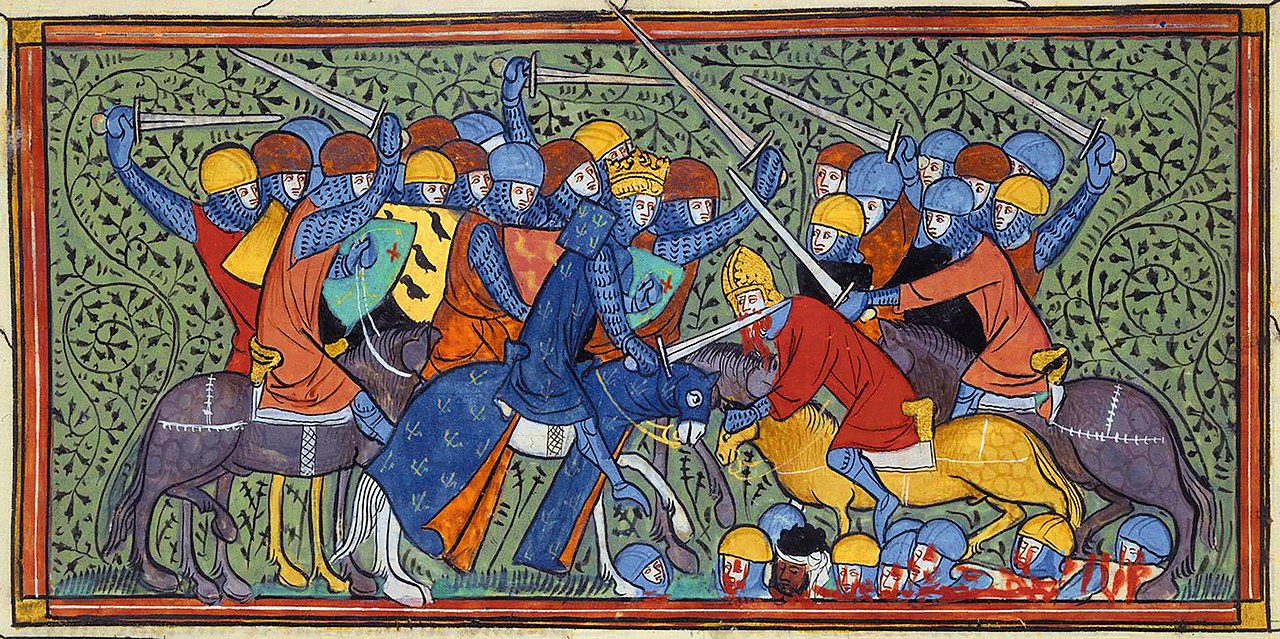
There is considerable agreement among historians that 732 was the year of the Battle of Poitiers; however, others say it occurred in 733. As for when exactly, it is still very speculative. This is unquestionably the 25th of October, 732, a Saturday. Arab reports, which are now considered the most credible, place the fight on the first Saturday of Ramadan (114 of the Hegira) or October 25. Historians are also sharply split about the precise location of the battle.
Rather than mentioning the Battle of Poitiers, the Anglo-Saxon chroniclers of the period refer to the Battle of Tours. A reasonable assumption, given the apparent destination of Abd al-Rahman: Rahman’s sanctuary in Saint-Martin in Tours. Another theory places the conflict in the little town of Moussais-la-Bataille, inside the commune of Vouneuil-sur-Vienne, about 25 kilometers from Poitiers.
Who were the main protagonists of the Battle of Tours in 732?
In the Umayyad Caliphate’s army, Abd al-Rahman held the rank of general. In 721, he participated in the Battle of Toulouse. Hisham, the Caliph, named him wali (governor) of Al-Andalus in 730. Thus, he was in command of the whole Iberian peninsula that the Muslims had conquered during the preceding decades. Charles Martel, for his part, held the titles of duke of the Franks and mayor of the palace. During that ancient period, there was no such thing as France. Charles Martel ruled over what was still a divided Francia.
He set out to expand his domain, particularly to the east. The Burgundians were also governed by Charles Martel. On the other side, Eudes reigned over the huge duchy of Aquitaine, which covered a sizable portion of present-day southern France. Eudes of Aquitaine, like Charles Martel, was an ambitious man, and in 719 their forces fought one another. Eudes, defeated, made a peace deal with the Franks and thereafter had to endure constant invasions from the south by the Arabs. An event that would lead him to form an alliance with Charles Martel in 732 for the Battle of Tours.
How did the Battle of Tours in 732 take place?
Charles Martel and Eudes mustered around 20,000 troops between them. Abd al-Rahman amassed a crowd of 25,000. Abd al-Rahman, true to the strategies that permitted Muslims to take over such a large area, sent out his powerful cavalry, which consisted mostly of Berber fighters. However, the other side employs an entirely different tactic.
The bulk of the Frankish army is made up of foot men. Strongly armed and nearly entirely armored in steel, they are formidable foes. They formed a tight line to fend off the terrifying attack, as wave after wave of enemy riders were impaled on the impregnable barrier. A actual “rampart of ice” would be mentioned in the future by Arab historians.
Who won the Battle of Tours in 732?
After a week of fighting, it seems that Eudes’s forces were successful in attacking the Muslims from behind, forcing them to retreat in order to save not only their loot but also the families who had joined them on the raids. There was a retreat by the Arabs toward Narbonne. As Abd al-Rahman was slain in the battle, the victory was decisive. The Arabs lost a total of 12,000 troops in the battle, while their opponents lost just 1,000.
What were the effects of the Battle of Tours in 732?
The outcome of the Battle of Tours was pivotal for the development of the French monarchy. The big political victor was Charles Martel, who aided Duke Eudes of Aquitaine. Because Aquitaine stubbornly defied him, his power was diminished. As a result, he was able to quickly seize control of Bordeaux, a rich city. In the years after his death in 735, Eudes’ sons took over as dukes of Aquitaine. But this was a pivotal moment in history, and Aquitaine eventually became a part of the Frankish empire under Charlemagne’s rule.
The second crucial point is the well-known saying, “Charles Martel defeated the Arabs at the Battle of Tours.” An asymmetrical dictum Although the extension of the Umayyad caliphate into Western Europe was halted thanks to Charles Martel’s triumph, the conflict itself persisted for decades. Bayonne, for instance, was ruled by Muslims until the year 759. Even when Charlemagne, the future ruler of Europe, arrived in the early ninth century, Europe still suffered from sporadic attacks.
Bibliography:
- Mastnak, Tomaž (2002). Crusading Peace: Christendom, the Muslim World, and Western Political Order. University of California Press. ISBN 0-520-22635-6
- Oman, Charles W. (1960). Art of War in the Middle Ages A.D. 378–1515. Cornell University Press. ISBN 0-8014-9062-6
- Poke, The Battle of Tours, from the book Fifteen Decisive Battles of the World From Marathon to Waterloo by Sir Edward Creasy, MA
- Reagan, Geoffrey, The Guinness Book of Decisive Battles, Canopy Books, New York (1992) ISBN 1-55859-431-0
- Collins, Roger (1989). The Arab Conquest of Spain: 710–797. Oxford, England: Blackwell. ISBN 978-0-631-15923-0.