We are both frightened and fascinated by a thunderstorm with its accompanying lighting and thunder. Rising air and water vapor are the two most crucial components of thunderclouds. But the real question is, why do lightning strikes form, and how do they reach the ground? Let’s find out exactly why.
Ice crystals and negatively charged droplets
In order for a thunderstorm to develop, two or more masses of air that are warmer than their surroundings and contain significant amounts of moisture must converge and ascend. Cluster clouds, or cumulus clouds in meteorological parlance, form when atmospheric water vapor condenses. When environmental circumstances are ideal, rising moist air causes the cloud to develop a “roof” of microscopic ice crystals in the form of an anvil. The cloud transforms into a cumulonimbus, or a thundercloud.
Cumulonimbus clouds may reach heights of 6–12 miles (10–20 km), depending on whether they form in the mid-latitudes or the tropics. Friction, collisions, and the atomization of water particles inside the thundercloud cause charges within it to split as the cloud grows. There are now positively charged ice crystals and negatively charged droplets. As a result, the cloud’s cool top section becomes positively charged, while the warmer lower part remains negatively charged.
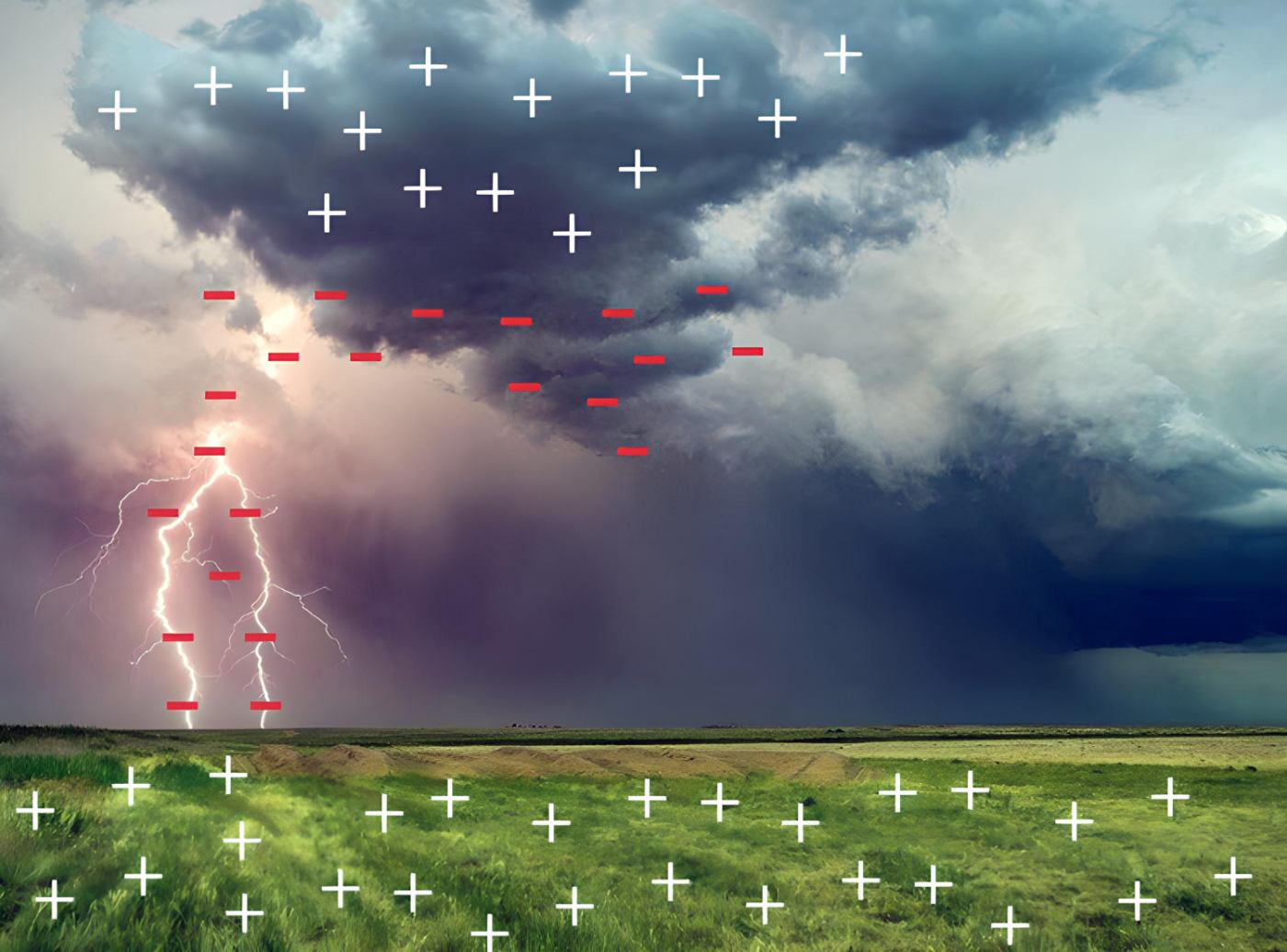
Between them, an electric field develops, which may reach up to around 170,000 volts per meter before it becomes hazardous. The lightning strikes like an enormous portent of a “short circuit.” It has the capability of discharging either inside the cloud or in the space between the cloud and the ground.
The “leader lightning”
Although there are many distinct kinds of lightning, “negative cloud-to-ground lightning” (-CG) is by far the most common. To create an ionized channel, negative charge carriers first jolt downward in what is known as “leader lightning.” An electric current may flow through air that has been “ionized,” or has had its atoms and molecules ionized, so that electrons can be released. During this time, the ground gets positively charged as it lies under the storm. The displacement of charges caused by an electric field is a phenomenon known as the “electrostatic effect” or influence.
The electric field is strongest in exposed areas, such as atop church steeples. Positivity in these locations attracts the conductive lightning via a process known as “catch discharge.” It closes the lightning pathway by making contact with the cloud and the ground. Following this comes the major discharge, which often comprises of multiple smaller releases. 100,000 amperes is the maximum possible current.
During a lightning strike, temperatures may reach 54,000°F (30,000°C) in a matter of tenths of a second to one hundred millionth of a second in the lightning channel. Through this transformation, atmospheric oxygen and nitrogen are transformed into plasma, an aggregation state of matter in which atomic nuclei and electrons are no longer connected to each other. Plus, the air expands explosively in response to the sudden drop in pressure, resulting in shock waves that we hear as the low rumbling of thunder.
How to determine the distance of lightning
It is possible to determine the distance of lightning by the time it takes for thunder to follow. Since the speed of light is 186,000 miles (300,000 km) per second and the speed of sound in air is around 1125 feet (340 m) per second, you may roughly calculate the distance in kilometers by dividing the number of seconds by 3.

The distance in miles to a lightning strike can be calculated by timing the interval between the flash and the thunder and dividing that number by 5. A distance of 5 seconds is equivalent to 1 mile, 15 seconds to 3 miles.
Though it may seem strange, thunderstorms actually raise the average voltage of electricity between the Earth’s surface and the atmosphere. This is due to the fact that thunderstorms, when combined, function similarly to electrostatic generators. A negative charge is transferred from the air to the ground during a typical lightning strike.
The voltage between cloud and ground is discharged locally, but the thunderstorm “feels” no effect from the global electric field. Therefore, from a worldwide perspective, it boils down to a question of charging. As a result, the air becomes positively charged while the ground remains negatively charged. This voltage is gradually diminished under non-thunderstorm situations due to the movement of ions, or electrically charged atoms or molecules.
The location with the greatest lightning density on Earth
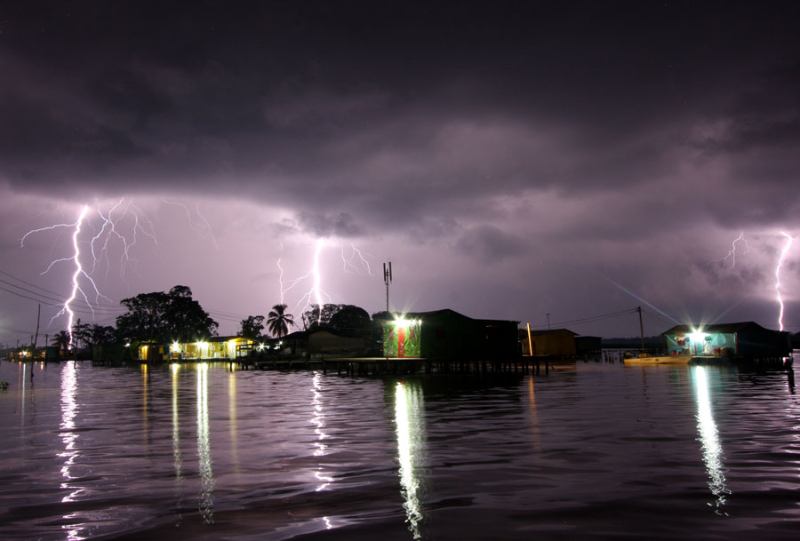
The circumstances for thunderstorms—moist, rising air—are most ideal over tropical land masses, so that’s where you’ll see the most lightning. Nearly every night of the year, thunderstorms may be seen above Lake Maracaibo in Venezuela, making it the location with the greatest lightning density on Earth.
Lightning research is conducted largely for the purposes of improving weather forecasting and developing lightning protection systems. Artificial lightning is also created for this reason in high-voltage labs. In the United States, the National Weather Service (NWS) and similar sensor networks track the frequency and position of lightning strikes in real time. The risks linked with thunderstorms will be better predicted in the near future. Since there are now an increasing number of weather satellites monitoring thunderclouds and lightning to keep track of global thunderstorms.