For a long time, it was believed that the African savanna elephant had not been tamed in antiquity, and that the Carthaginians had instead utilized a native species from the Atlas Mountains, which is now extinct but likely resembled the contemporary African forest elephant of the Red Sea and Ethiopia. In truth, the latter species was probably already in use by the Ptolemies in Egypt. The lesser African elephants of the Ptolemies were reportedly horrified by the Asian elephants employed by the Seleucids, as recounted by Polybius, Pliny, or Diodorus.
The North African elephant that Hannibal used
Hannibal’s African elephants were a little unusual compared to today’s species. The African forest elephant was widespread back then, but Hannibal’s elephant was not as large as an Indian elephant at the time.
The Carthagian people often used the extinct North African wild elephant in battle. This kind of elephant stood around 2.5 meters (8.2 feet) at the shoulder, but its bush elephant kin averaged 3.2 meters (10.5 feet). The coins show that the Carthaginians were also importing Indian elephants at this time.
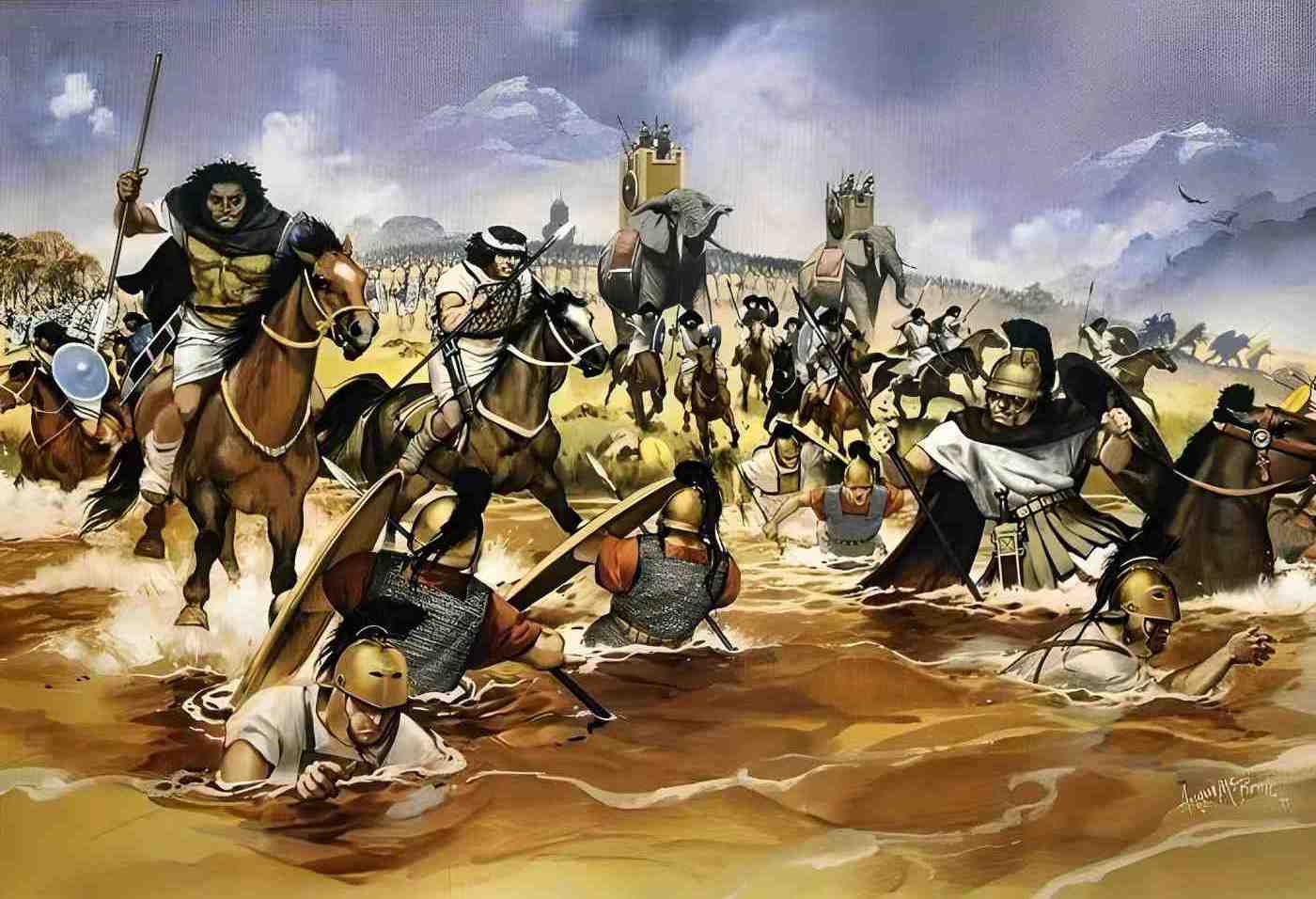
Hannibal is said to have brought more than 35 elephants with him when he invaded Italy from Spain. But only around ten elephants made it to Hannibal’s Italian combat in 218 BC, at Trebia. The elephants’ part in Hannibal’s war was not that effective either.
The Ptolemaic Kingdom, which had been reliant on Indian elephants, destroyed the Seleucid Kingdom in 217 BC. Hannibal depended on North African forest elephants in the absence of Indian elephants. Even though they were smaller than their Indian counterparts, the Roman army nevertheless posed a serious danger from these elephants.
It’s a misconception that southern African bush elephants, which are bigger and more ferocious than their northern relatives, have ever been used in combat.
The findings on war elephants
Studies of the mitochondrial DNA of elephants in Ethiopia and Eritrea by Adam L. Brandt and colleagues in 2013 imply, however, that the Ptolemies would have taught savanna elephants. This claim directly contradicts what is known from ancient sources, which highlight the lower size of Egyptian (and, by extension, Carthaginian) elephants in comparison to the Asians used by the Seleucids.
Domesticated savanna elephants in Egypt would be much bigger than their Asian counterparts. Michael B. Charles argues in a 2016 article that modern Eritrean elephants may be descended from savanna elephants that arrived after the Ptolemaic and Punic periods (Punic Wars), despite the fact that their typology is that of savanna elephants and their current distribution is not necessarily that of ancient times.
The elephant species
- Asian Elephant (Elephas maximus)
The largest Asian elephants have been recorded at 3.5 meters (11.5 feet) at the withers and 5,500 kg (12,125 lbs). The highest part of this elephant’s back is in the middle, while in African elephants it is at the shoulders.
- African Forest Elephant (Loxodonta cyclotis)
The animal stands at a height of about 2.5 meters (8.2 feet) and weighs 2,700–6,000 kg (5,600–13,200 lbs). Its tusks are longer and point farther downward than those of the savannah elephant, and its ears are broader and rounder. Currently, this species holds the record for being the smallest in existence.
- Savanna Elephant (Loxodonta africana)
It may weigh up to 8,000 kg (17,640 lbs) and reach a height of 3–4 (10–13 feet) meters at the withers. Its tusks are oriented upwards. Compared to the Asian elephant, the two African species have substantially more pronounced and triangular ears.