What language did Julius Caesar speak? Julius Caesar (100–44 BC) was Roman, and the term “Italian” has only been used in the last few centuries. This is because the term is derived from “Italy.” And Italy did not exist at the time of Julius Caesar. According to the research done by archaeologists and philologists on the etymology of the word “Italia,” the term “Itala” was first used in the 5th century BC. So, did Caesar speak Greek or Latin?
The Language of Rome
The Etruscan, Greek, and Phoenician scripts all had a role in the development of the Latin language. Over the course of many centuries, the little communities that spoke Latin along the lower Tiber River borrowed heavily from the Greek language. And over time, Latin became one of the most common languages spoken in the whole Roman Empire.
During the Roman Empire (27 BC–476 AD), which was constantly expanding through conquests, Latin was practically used as an official language and was the language of the world, much like English today. However, in the time of Julius Caesar, which was the Roman Republic (509–27 BC), the better educated Roman citizens and the Roman nobility mostly preferred to speak Greek. Did Julius Caesar speak Greek too?
The Language Caesar Spoke

In his The Lives Of The Twelve Caesars, Roman historian Suetonius of the 1st century AD claimed that, just like the other Roman patricians of his day, Julius Caesar mostly spoke Greek rather than Latin. Caesar still spoke Greek even in his final moments: According to Suetonius, Caesar’s last words before his death were the Greek phrase “Kai su, teknon?” or “You too, child?” When your life is in danger, the last thing you want to do is try to communicate in a foreign language. Instead, you use the words you’re most comfortable with. Evidence suggests that Caesar studied Greek before Latin.

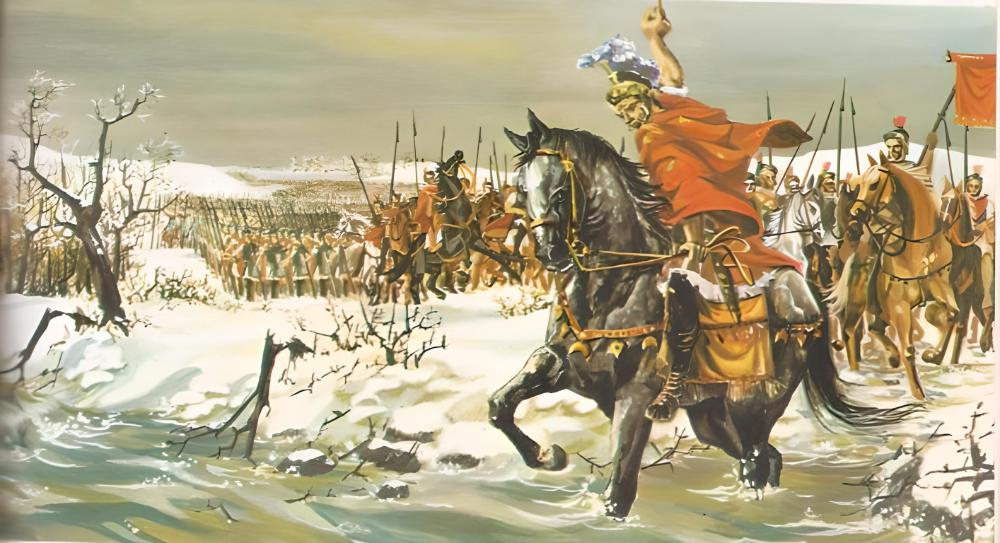
When Caesar crossed the Rubicon in 49 BC, he reportedly shouted in Greek, “Anerríphthō kýbos,” which meant “Let the die be cast!” This was recounted by the Greek historian Plutarch (c. 46–119 AD) in “The Life of Caesar.” Menander, a Greek comedic dramatist, originally wrote that statement. According to Plutarch, Caesar used the Greek version of the statement instead of the Latin “Alea iacta est.”
The late Roman Republic saw a proliferation of historical texts written in Greek. The sons of aristocratic Roman families, like Caesar’s main assassin Brutus, were regularly trained by Greek slaves and transferred to Athens for additional Greek schooling. Caesar’s surname is spelled as Kαίσαρ (Kaísar) in Greek, indicating its similarity to the Greek pronunciation.
At first, Rome was an Etruscan city. The Romans migrated to central Italy after the fall of Troy. The Latin language was created as a mishmash and borrowed heavily from a variety of other languages around the area, most notably Eastern Greek from antiquity. But other than that, they are two distinct languages, and the Romans, like Caesar, did not have to speak Greek instead of Latin in their daily lives. But they still spoke Greek.
Why Did the Romans, Like Caesar, Speak Greek Rather Than Latin?
This was because Greek was the “stylish” language in the world at the time of Caesar, and “made in Greece” was a trademark of the Roman era as well. This is similar to the Tsar’s court in Russia, when Russian nobility spoke French like French natives rather than Russian.
At the time of Caesar, there were already two different versions of Latin. The Classical Latin, which we still use today as the language of science, and the Vulgar Latin, the language of the people. Both had already differed regionally.
In time, Vulgar Latin evolved into numerous Romance languages. Poets and thinkers, and later the church, carried on the Classical Latin tradition. Marcus Cicero and Julius Caesar also played an important part in this with their Latin publications.
What Language Did Julius Caesar Write in?
All of Caesar’s main writings, such as the Commentarii de Bello Gallico (Commentaries on the Gallic War) and the Commentarii de Bello Civili (Commentaries on the Civil War) were written in Latin. Caesar understood Greek and presumably sometimes wrote in it, much like many educated Roman men of his period.
How Many Languages did Julius Caesar Speak?
Besides Latin and Greek, Caesar probably also knew Oscan, Gallaecian, Celtiberian, and maybe even Coptic. He had a reputation for being a cunning and savvy politician who used his command of the local tongue to his advantage.
Caesar’s experience in Egypt and his subsequent position as governor of Gallaecia and Celtiberia likely allowed him to acquire a working knowledge of those languages. During his many wars and travels around the globe, he may have picked up more languages as well. All things considered, Julius Caesar was a statesman who spoke many languages well. When it comes to understanding what language Julius Caesar spoke, this is pretty much all there is to it.
What Language did Julius Caesar and Cleopatra Speak?
Though she ruled Egypt as a Greek pharaoh, Cleopatra also spoke Egyptian because she was the first Ptolemaic monarch to learn the language. She was fluent in a number of languages, Latin being one among them.
During this time, it was considered a social advantage for Roman patricians to be able to converse in Greek. What language Julius Caesar and Cleopatra spoke would ultimately have come down to either Greek or Latin, with Greek being the more probable option.
The Latin that can be read in the Roman scriptures is different from the Latin that was spoken in everyday life. This is still the case today. Today, people still don’t talk to each other in the same language as it is written in a book. People mostly talk in shorter sentences, and the dialect is different.
This was the case with the spoken Latin language during Julius Caesar’s period. At the time, the Romans in Etruria (today’s Tuscany) already spoke a different Latin dialect than those living in Gallia or Africa.
Italian, French, Spanish, and other Romance languages all came from Latin, which was spoken in different ways in different parts of the world and kept splitting into new languages over time.