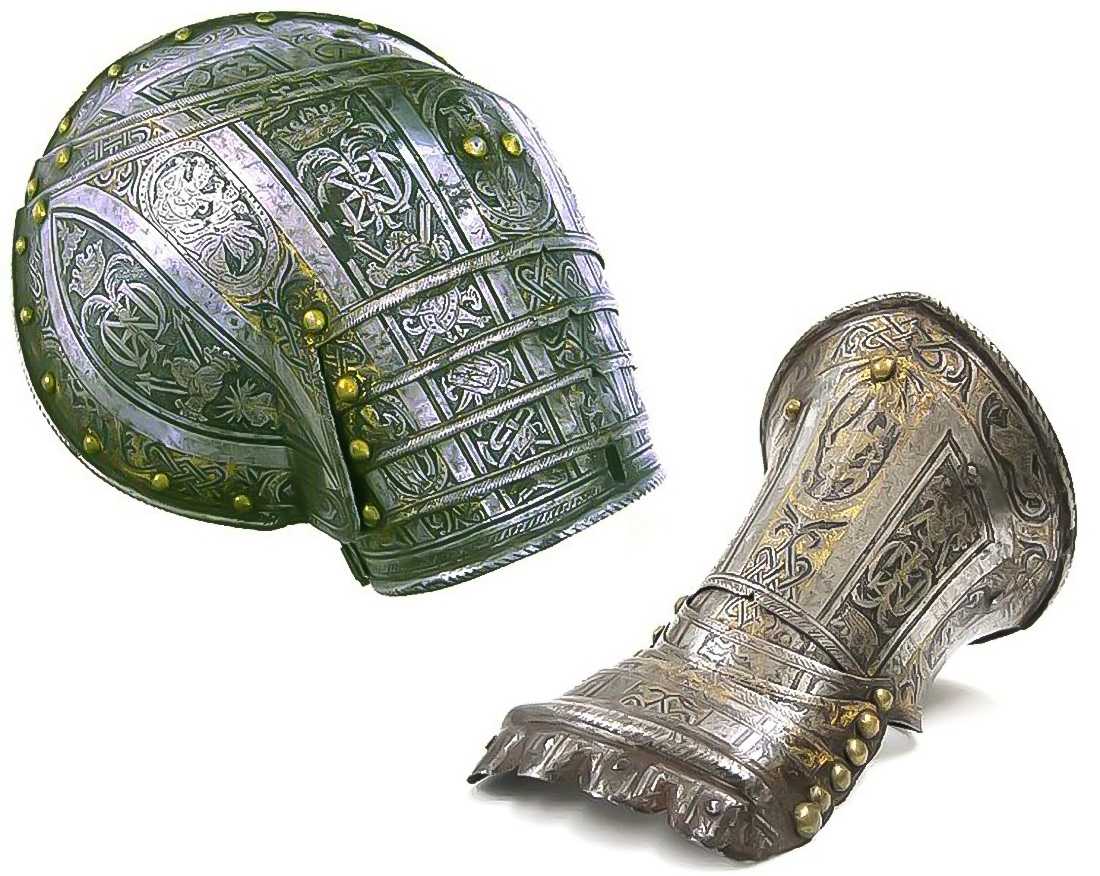
The pauldron was an integral aspect of plate armor. It was a kind of shoulder and upper arm protection for soldiers. Protecting the wearer’s chest and head, pauldrons remained an integral part of plate armor throughout the Middle Ages and the Renaissance. It was developed in the 15th century to replace the smaller spaulders.
Because unlike pauldrons, the armpit was exposed while wearing spaulders. A limited number of pauldrons extended to encompass not only the armpit but the upper back and chest as well.
History of Pauldron
Shoulder Armor in the 13th Century
Attempts to better protect the shoulder region of the knights led to the invention of the first shoulder armor around 1275. Ailettes were the first armor specially created for this.
They were fastened to the breastplate with leather straps and intended to cover the shoulder and neck, although they were not especially sturdy and frequently slipped in combat.
By the end of the 1300s, shoulders were covered with scales or transversely joined laminar plates to enhance the ailettes. One example of the latter is called lorica segmentata (derived from lorica hamata) which was popular among Roman legionaries.
Used first around 1270, this design was already pretty similar to the spaulder. However, even this evolution was inadequate, since the bottom of the arm still remained exposed when the arm was lifted to attack.
Pauldron in the 15th Century
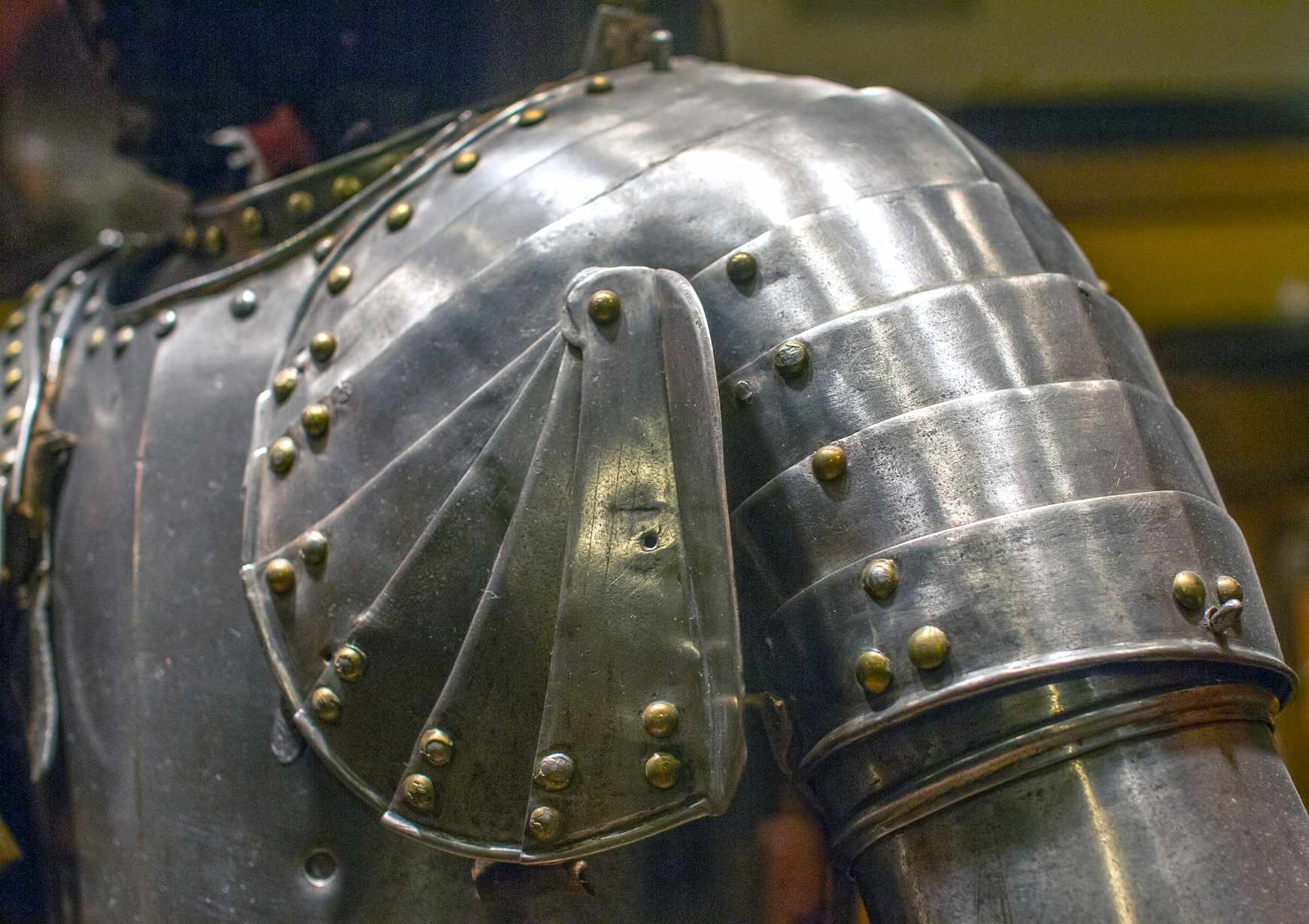
From the 15th century forward, the front and back of shoulder armor were widened to better shield the wearer’s armpits. Thus, the first pauldron was designed. These widened extensions were known as the rear and front wings.
The first pauldrons were made of a single piece of plate. But they quickly gave way to more flexible versions that provided better freedom of movement. The front wing that led to the chest was the most crucial element of a pauldron. It was common practice to experiment with a variety of widths and lengths for the front wings.
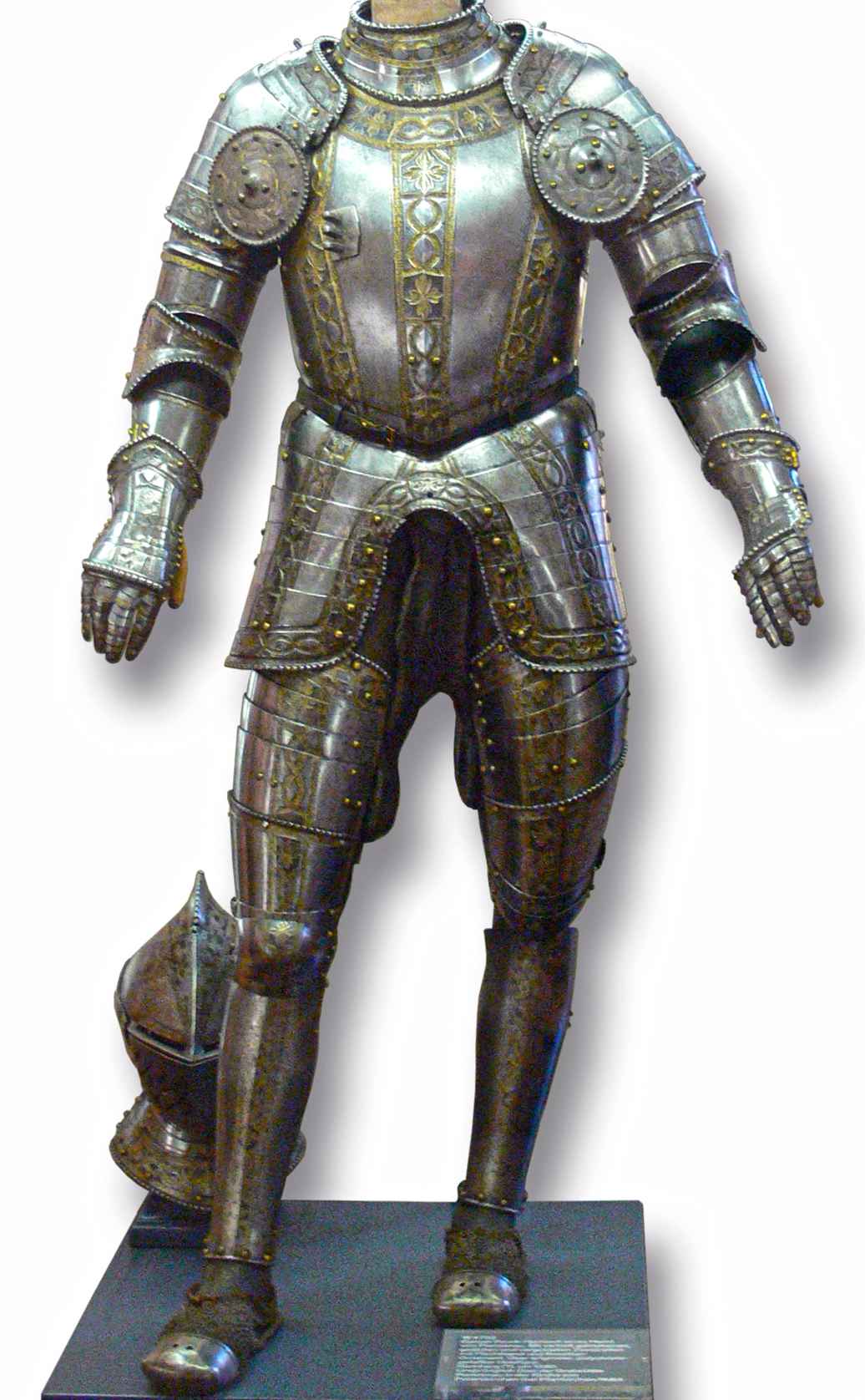
Since the lance was carried in the armpit region with the right arm, the wings on the right arm were often thinner, shorter, and cut concavely.

This was because a large pauldron would have hindered the movement of the weapon arm. On the other hand, they were substantially longer and broader on the left arm since this side was shielded and not used for carrying weapons.
Another part of the pauldron was the rondel and besagew. They were specifically developed for the pauldron to protect the armpit (rondel) and steady the jousting lance (besagew). They could be moved around to cover the gap between the armpit and breastplate. They also came in various shapes and sizes.
The rondels started out square and lobbed, but were later shaped into disks. They stayed as part of pauldrons until the late 16th century. When lances fell out of favor about 1580, their absence led to a gradual enlargement of the front wings at the locations that had been shrunk to accommodate the lances.
When the aventail was no longer worn, the back wings of a pauldron enlarged to absurd proportions. On Italian armor, they became so big that they overlapped at the rear to reinforce the rather weak back portion of the armor. The Italian armor also included a small and narrow frontal wing.
The research suggests that this was because Italians disliked movement restrictions brought on by their preferred fencing technique.
For instance, the Italian lansquenets, who are known to wield large swords like spadone, did not wear pauldrons. They rather placed a protective attachment on the gorget (a steel or leather collar around the throat), which protected the armpits, shoulders, and upper half of the arm.
There was a clear distinction between noble and mercenary armor during this period. While mercenaries favored the above design, nobles persisted in perfecting their pauldrons.
Once tournaments rolled around, the pike and the lance were once again a menace to the knights. Their shoulder armor could be destroyed or badly damaged with a single blow from the long sword or a war hammer.
The solution was to start attaching vertical armor to the edges of the wings. They came in lower and higher forms, and some of them extended over the shoulder. They deflected spearpoints and other projectiles from attacks.
Pauldron in the 16th Century
The pauldrons with vertical wings gradually faded away again by the middle of the 16th century. The forewings were now mostly above the shoulder. In most cases, the pauldrons were fastened to the gorget; in others, they were secured to the iron shoulder straps or the pauldron straps.
In the 16th century, additional shoulder pieces were employed to significantly reinforce them for jousting armor. By screwing on an additional second pauldron, they were greatly strengthened. And they protected not just the shoulder but also the left side of the helmet, the face, and part of the chest. The right shoulder was once again smaller to make room for the lance.
The elbow caps on the left arm were expanded significantly, and sometimes even a second cap was put on, known as a double cap. The left side of the plate armor, including the left pauldron, was fortified more often than the right since that’s where the opposing lance tended to strike.
The existing caps were expanded by broadening their top edge since they were fairly small to begin with. Some of these caps were so large that they went over the top portion of the arm. Armor destined for jousting tournaments often included these extraordinary reinforcements.