For human beings, celebrating a one-hundredth birthday is a rare milestone of extreme longevity. Yet in the cold, dark depths of the world’s oceans—where near-freezing water temperatures slow cellular metabolism to a crawl and stable ecosystems remain untouched for millennia—a century is barely the end of childhood for several remarkable species. Counting down the ten longest-living animals on planet Earth reveals creatures alive today that were already swimming or filtering seawater during the height of the Roman Empire, the construction of the Egyptian pyramids, and the last Ice Age.
- 10. Giant Tortoises (Aldabra and Galápagos): 180 to 250+ Years
- 9. Red Sea Urchin (Mesocentrotus franciscanus): 200+ Years
- 8. Bowhead Whale (Balaena mysticetus): 200 to 211+ Years
- 7. Rougheye Rockfish (Sebastes aleutianus): 205 Years
- 6. Freshwater Pearl Mussel (Margaritifera margaritifera): 250 to 280 Years
- 5. Tubeworm (Escarpia laminata): 300+ Years
- 4. Greenland Shark (Somniosus microcephalus): 390 to 512 Years
- 3. Ocean Quahog Clam (“Ming the Clam,” Arctica islandica): 507 Years
- 2. Black Coral (Leiopathes species) & Deep-Sea Glass Sponges (Monorhaphis chuni): 4,265 to 11,000+ Years
- 1. The “Immortal Jellyfish” (Turritopsis dohrnii) and Hydra: Potentially Immortal
10. Giant Tortoises (Aldabra and Galápagos): 180 to 250+ Years
The undisputed longevity champions among all terrestrial land vertebrates are the giant tortoises of the Indian and Pacific Oceans. As of the mid-2020s, the oldest living land animal on Earth is Jonathan, a Seychelles giant tortoise living on the South Atlantic island of Saint Helena who hatched around 1832—making him well over 190 years old! Even older was Adwaita, an Aldabra giant tortoise in Kolkata, India, whose shell carbon-dating after his death in 2006 pointed to an estimated lifespan of 255 years (born around 1750, before the American Revolution).
9. Red Sea Urchin (Mesocentrotus franciscanus): 200+ Years
Crawling across rocky kelp forests along the Pacific coast of North America from Alaska to Baja California, the spiny Red Sea Urchin was once thought by marine biologists to live only ten to fifteen years. When researchers used radioactive carbon-14 signatures from 1950s atmospheric nuclear testing to date the growth rings inside their calcium spines, they were stunned to discover that once a Red Sea Urchin survives past its vulnerable youth, it shows virtually zero biological aging—routinely living past 100 to 200 years with the exact same reproductive capability and cellular regeneration at age two hundred as at age ten.
8. Bowhead Whale (Balaena mysticetus): 200 to 211+ Years
Measuring sixty feet long and using its massive, eighteen-inch-thick skull to smash breathing holes straight through Arctic sea ice, the Bowhead Whale is the longest-living mammal on planet Earth. How did scientists prove that a warm-blooded mammal can outlive humans by more than a century? In the 1990s and 2007, Inupiat Eskimo whalers in Alaska harvested bowhead whales and found the broken tips of nineteenth-century stone and brass Yankee whaling harpoons (patented and manufactured in New Bedford, Massachusetts, around 1879–1885!) still embedded in the whales’ blubber! Confirming their ages using amino-acid racemization inside the lenses of the whales’ eyes proved one healthy male bowhead was 211 years old—protected from cancer across two centuries by unique DNA-repair gene duplications (such as ERCC1 and PCNA).
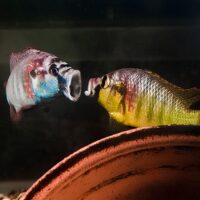
7. Rougheye Rockfish (Sebastes aleutianus): 205 Years
Swimming in deep, frigid waters along the North Pacific seafloor at depths of 500 to 2,500 feet, the pink-and-tan Rougheye Rockfish is the longest-living ray-finned bony fish ever documented. By slicing open and counting the microscopic annual calcium growth rings inside its ear-stones (otoliths)—which grow one ring per year just like the trunk of an oak tree—fisheries biologists verified specimens reaching 205 years of age.
6. Freshwater Pearl Mussel (Margaritifera margaritifera): 250 to 280 Years
Inhabiting clean, fast-flowing cold rivers in Scandinavia, Scotland, and Russia, these filter-feeding bivalve mollusks have one of the slowest metabolic rates of any freshwater animal on Earth. Russian malacologists and Swedish researchers counting hinge-ligament growth rings have verified individual Freshwater Pearl Mussels living between 250 and 280 years.
5. Tubeworm (Escarpia laminata): 300+ Years
Down on the pitch-black bottom of the Gulf of Mexico at depths of 3,300 to 10,000 feet, where cold-seep vents leak hydrocarbon gases from the seafloor, colonies of sessile tubeworms (Escarpia laminata) live in partnership with chemosynthetic bacteria. Because adult tubeworms face almost zero deep-sea predators and grow less than a millimeter per year, demographic growth modeling published in 2017 proved these worms routinely live past 250 to 300 years, with large individuals likely exceeding 500 years.
4. Greenland Shark (Somniosus microcephalus): 390 to 512 Years
Cruising through the near-freezing depths of the North Atlantic and Arctic Oceans at a leisurely top speed of less than one mile per hour, the twenty-foot Greenland Shark is the longest-living vertebrate animal in the world. Because sharks have soft cartilage skeletons instead of hard calcified bones with growth rings, their age was a mystery until a landmark 2016 study led by Julius Nielsen at the University of Copenhagen radiocarbon-dated the crystal proteins at the center of the sharks’ eye lenses (which form before birth and never change during life). The largest sixteen-foot female shark tested had an estimated age of 392 years (± 120 years, meaning between 272 and 512 years old)—and remarkably, Greenland sharks don’t even reach sexual maturity and start having babies until they are 150 years old!

3. Ocean Quahog Clam (“Ming the Clam,” Arctica islandica): 507 Years
In 2006, marine researchers dredging the seabed off the coast of Iceland hauled up a living, palm-sized edible clam of the species Arctica islandica. When scientists at Bangor University in Wales counted the annual summer-winter growth bands on its shell under a microscope, they realized the clam had lived for an astonishing 507 years! Nicknamed “Ming the Clam” by reporters because it was born in the year 1499 during China’s Ming Dynasty (just seven years after Columbus sailed to America, and before Leonardo da Vinci painted the Mona Lisa!), the clam represents the oldest verified non-colonial individual animal ever recorded.
2. Black Coral (Leiopathes species) & Deep-Sea Glass Sponges (Monorhaphis chuni): 4,265 to 11,000+ Years
Although corals and sponges look like underwater plants or rocks, they are 100% multicellular animals belonging to phyla Cnidaria and Porifera. Off the coast of Hawaii, marine biologists used radiocarbon dating on deep-sea golden and Black Corals (Leiopathes) and proved single living colonies were 4,265 years old. Even older is the deep-sea Glass Sponge (Monorhaphis chuni), which anchors itself to the ocean floor using a single giant three-meter-long rod of pure biological silica glass as thick as a human thumb; chemical isotope analysis of one specimen’s silica spine revealed the sponge had been filtering seawater continuously for 11,000 years—since the end of the last Ice Age!
1. The “Immortal Jellyfish” (Turritopsis dohrnii) and Hydra: Potentially Immortal
Claiming the absolute number-one spot is a tiny, translucent hydrozoan jellyfish no bigger than a human pinky fingernail native to the Mediterranean Sea and global oceans: Turritopsis dohrnii. Every other animal on Earth moves on a one-way biological street from embryo to youth, adulthood, and death. When Turritopsis dohrnii grows old, starves, or suffers physical injury, however, it pulls off the ultimate cellular magic trick known as transdifferentiation: sinking to the ocean floor, reabsorbing its tentacles and bell, and transforming all of its adult specialized cells backward in time into an infant polyp cyst—from which brand-new, genetically identical baby jellyfish bud off to start their lives all over again, bypassing death from old age entirely!